Friday, February 24, 2023

New Riders of The Purple Sage Tour History, January-April 1973 (NRPS IV)

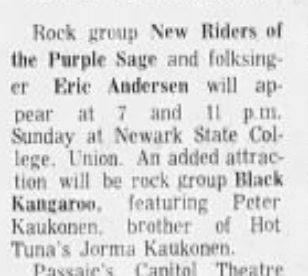
The ad in the February 22, 1973 Village Voice mentions "Special Friends" on the bill, a reference no one would have missed. The Grateful Dead were booked in Long Island during this weekend.

New
 Riders Of The Purple Sage Tour History, January-April 1973 (NRPS IV)
The music of Jerry Garcia casts a large shadow, if a shadow that is bright rather than dark. It is so large, however, and so bright, that it outshines many things around it. In the 21st century, the New Riders of The Purple Sage are best known as the vehicle through which Jerry Garcia created an opportunity to play pedal steel guitar as a sideman in 1970 and '71. When the demands of playing full-time with both the Grateful Dead and the New Riders became too gargantuan a task, Garcia stepped aside from the Riders. For most Deadheads, that's where the story ends.

Yet the story of the New Riders of The Purple Sage was only beginning. For obvious reasons, the Riders are always compared to the Dead, and like almost every other 20th century rock band, the Dead outshone NRPS by many orders of magnitude. Compared to all the other bands struggling to make it in the early 1970s, however, the New Riders of The Purple Sage were hugely successful. After their debut album with Garcia in late 1971, they released four more albums with Buddy Cage on pedal steel in 1972 and 73. The albums sold well--Panama Red eventually was certified Gold--and the New Riders were a popular concert attraction. 

On top of the Riders' undeniable success, they were still part of the Grateful Dead's business operation. Grateful Dead tours were booked by their in-house Agency, Out-Of-Town Tours, led by Sam Cutler. Cutler and Out-Of-Town also booked the New Riders. So a review of the New Riders touring history in 1972 and '73 shows both what lessons Cutler had learned from the Dead's rise to success in 1970 and '71, and also provided an avenue for Cutler to expand his relationships with promoters who worked with the Grateful Dead. So the New Riders touring schedule was both a do-over for what had come before and a rehearsal for what would come later for the Grateful Dead. 

This post will continue the series on the tour history of the New Riders of The Purple Sage in 1972 and '73, with a particular emphasis on how their saga was both similar to and different from that of the Grateful Dead. These posts would not have been possible without the stellar research of fellow scholar David Kramer-Smyth, whose contributions have been both deep and broad. The first post focused on the New Riders' performance history from January to April, 1972. The next posts focused on the New Riders' performance history from May through August 1972, and then the New Riders' performance history from September through December 1972. This post will focus on the New Riders' performance history from January through April 1973. Anyone with additions, corrections, insights or just interesting speculation, please include them in the Comments. Flashbacks welcome.

The New Riders of The Purple Sage had released Gypsy Cowboy, their third album on Columbia, in December 1972

New Riders Status Report, New Year's Eve 1972

The New Riders of The Purple Sage had had an excellent 1972. They had released their second and third albums on Columbia, and established themselves as separate from Jerry Garcia. Heavy touring in the Northeast, particularly in colleges, was creating a solid fan base for them. The Grateful Dead were more popular than ever, and the Riders' association with them only helped. At the same time, there was an undeniable merger occurring between hippies and country music, with more "country-rock" bands and more country bands letting their hair grow a little bit. 

The New Riders were now a tight live band, playing two-hour shows that were a mix of old and new material, both originals and covers. John Dawson was still the focal point, but Dave Torbert's singing and writing made a nice contrast. David Nelson sang the occasional country cover, too, just to widen the band's scope. The record industry was booming, the concert industry was booming, and the New Riders were good and signed to a major record label. By any reasonable standard, the future looked very bright for the band at the end of 1972.

The New Riders were still part of the Grateful Dead family, and not just socially. Grateful Dead manager Jon McIntire shared the same duties for the New Riders with NRPS road manager Dale Franklin. McIntire was the principal go-between for the record companies. The Riders were booked by Sam Cutler and Out-Of-Town Tours, who also booked the Dead. By booking multiple bands, Cutler had more to negotiate and thus more leverage with promoters and agents throughout the country. The Riders didn't have to worry about being left out of the mix--Cutler's principal assistant was Sally Mann Dryden, the drummer's wife (whom Cutler refers to now as "Mustang Sally," perhaps a reference to her 428ci Ford Mustang). Travel arrangements were made by the Grateful Dead's in-house agency, Fly By Night Travel.

The New Riders of The Purple Sage, January-April 1973
John Dawson-vocals, rhythm guitar
Buddy Cage-pedal steel guitar (ex-Great Speckled Bird and Anne Murray)
David Nelson-lead guitar, vocals (ex-New Delhi River Band)
Dave Torbert-bass, vocals (ex-New Delhi River Band, Horses)
Spencer Dryden-drums (ex-Jefferson Airplane)

February 14-17, 1973 The Gallery, Aspen, CO: New Riders of The Purple Sage (Wednesday-Saturday)
The New Riders had worked very hard throughout 1972. In the back half of the year they had recorded a new album and that had a grueling, but seemingly very successful National tour. So it's no surprise that they seemed to take a break the first six weeks of 1973. Apparently, their first shows of the year were four nights at a tiny club called The Gallery, in Aspen, CO. We have not yet been able to confirm this booking, but it seems likely.

Now, we think of Aspen, CO as a wealthy resort town, just a playground of the elite. But of course it became such a playground because it was an appealing place to go. Besides the skiing, and the beautiful Rocky Mountains, a bunch of freaks had congregated around the area. The most famous of these freaks was Hunter S. Thompson, who lived in nearby Woody Creek. So Aspen was a ski resort where long hair and weed were welcome, when that wasn't always the case in comparable destinations.

The Gallery itself was apparently the main (possibly only) nightclub in Aspen. Most famously, when David Geffen constructed The Eagles out of some Hollywood rock veterans who hung out at the Troubadour in West Hollywood, he apparently sent them to The Gallery to be the house band for several weeks.  The new band played a couple of weeks in October of 1971, and then returned for a few more weeks in November. By the end, they were a real band. Glenn Frey would end up purchasing a house in Aspen, and became a long-time resident. The status of Aspen as a hip playground rose along with the career of Frey and the Eagles. Hunter Thompson remained based in Woody Creek until he traveled on in 2006.

In February of 1973, the New Riders would have been rusty after several weeks, the Aspen booking seems like a sort of paying rehearsal.

February 19, 1973 International Amphitheatre, Chicago, IL: Grateful Dead/New Riders of The Purple Sage (Monday)
The New Riders of The Purple Sage had built a strong market in the Northeast, but had less of a footprint elsewhere. The strategy for this leg of a tour seems to have been designed to use the Grateful Dead to introduce the Riders to a broader audience. The New Riders had played Chicago in December of '72, opening for Mott The Hoople (of all bands). I think this Monday was a Federal celebration of Washington's Birthday (which was actually February 22, 1732).


February 21-22, 1973 Assembly Hall, U. of Illinois, Champaign, IL: Grateful Dead/New Riders of The Purple Sage
(Wednesday-Thursday)
The University of Illinois Urbana-Champaign, colloquially known as the University of Illinois, had been established in 1867. It is a huge school, currently enrolling 56,000 students. It is a few hours South of Chicago, in the flat plains of the agricultural Midwest. The size of the school, however, means it can support a huge rock market. Assembly Hall, at 1800 South 1st Street, was the school's basketball arena. It had opened in 1963, and had a basketball capacity of 15,000. It is surprising to see the Grateful Dead (or any band of the era) play two nights at a University instead of one, but the University of Illinois was  large, with many students from the greater Chicago area. I don't know what the attendance was like.

February 25, 1973 [venue], U. of Missouri, Columbia, MO: New Riders of The Purple Sage (Sunday)
While the Grateful Dead played the University of Iowa (February 24) and the University of Nebraska (February 26), the New Riders of the Purple Sage went West on Saturday night to play the University of Missouri, in Columbia, MO. The University of Missouri had been founded in 1839, and it, too was a large Midwestern school (currently 30,000 students). 

While Columbia, MO was a small college town at the time (population about 60,000), the University of Missouri was on I-70, midway between St. Louis and Kansas City. The New Riders had headlined in both cities, so they would have a ready-made audience at the University. I don't know what venue the band played.

February 28, 1973 Salt Palace, Salt Lake City, UT: Grateful Dead/New Riders of The Purple Sage (Wednesday)
The Dead and the New Riders closed out their tour by playing together at the Salt Palace. Salt Lake City was conveniently located between the Midwest and California, so a lot of bands made tour stops there. The Salt Palace, at 100 S. West Temple street, had opened in 1969. It had a basketball capacity of about 12,000. At this time, the Salt Palace was home to the Utah Stars of the American Basketball Association. The Stars would fold in early '75, ultimately replaced in 1979 by the Utah Jazz (who had relocated from New Orleans). 

The New Riders had not played in Utah or generally in the Mountain West, so opening a Dead show was a proven way to introduce them to their future audience. We have a setlist from this show (possibly incomplete). The New Riders followed the Grateful Dead path, making a point to play songs that were not on albums. This was appealing to fans who had seen them before (not likely an issue in Salt Lake), and also allowed the band to hone their arrangements before going into the studio. The Salt Palace set included a cover of Red Allen's "Teardrops In My Eyes" (sung by Nelson), Dawson's new song "One Too Many Stories" and Dave Torbert's homage to Sally Mann Dryden, "Groupie." All three would end up on The Adventures of Panama Red, not recorded until the Summer.

SF Examiner March 5, 1973

March 8, 1973 Berkeley Community Theater, Berkeley, CA: New Riders of The Purple Sage/Commander Cody and His Lost Planet Airmen/Ramblin' Jack Elliott
(Thursday) Jolly Blue Giant Presents
6'7" Bill Ehlert, known locally as "the Jolly Blue Giant" was a club operator and promoter in Berkeley. He had run Berkeley's Jabberwock until it had closed in 1967, and ran the Matrix for a while after that. In the 1970s, he promoted local concerts under the name Jolly Blue Giant. Berkeley Community Theater was both the local civic auditorium and the Berkeley High School auditorium. It seated about 3,500. It's unlikely that the New Riders and Commander Cody could sell it out on a Thursday night, but they probably drew a pretty good crowd. The New Riders were now a Bay Area concert headliner.

Commander Cody and His Lost Planet Airmen had moved from Ann Arbor, MI to Berkeley in Summer 1969. Their hippie honky tonk was instantly popular. They regularly performed locally with the Dead and the New Riders, and were often booked with the Riders around the country. Their weren't a lot of long-haired pot smoking hippie bands playing rocking country music, so they made an excellent fit. George "Commander Cody" Frayne had even played on a few tracks of the NRPS debut album. 

Paramount Records had released Cody and the Airmen's own definitive debut, Lost In The Ozone in November, 1971. They scored a memorable regional hit with Cody's cover of "Hot Rod Lincoln." Their second album, Hot Licks, Cold Steel and Trucker's Favorites had been released in May, 1972. At this time, although the Austin, TX based "Outlaw Country" scene was just starting, "country rock" seemed like a sound whose time had come. The Riders and the Airmen seemed to be among the harbingers.

Legendary folksinger (and Bob Dylan influence) Ramblin' Jack Elliott lived in the North Bay. He, too, was booked by Sam Cutler's Out Of Town Tours. He would often open for the New Riders, and often joined in to sing backup on a song or two. On this evening, he joined the Riders to help sing the Rolling Stones' song "Connection."

The New Riders had other guests in Berkeley, both of whom would appear many times in 1973. Singer Darlene DiDomenico was from New York, where she had been part of a singing duo with Dan Healy in 1970 and '71. When Healy returned to the West Coast to sign on as the Grateful Dead's soundman, she went, too, although she split with Healy. DiDomenico sang with a local band (whose name I have lost), but she was also employed as part of the Grateful Dead/New Riders complex (possibly with Out Of Town Tours). Thus she regularly sang with the New Riders, both in the studio and on stage. For example, she had sang on the Gypsy Cowboy album. In Berkeley, she sang on "Whisky," just like on the record.

Harmonica player Matthew Kelly had been in various bands with Dave Torbert in 1968 and '69. Kelly had ended up in England, in an American band (Gospel Oak) that had needed a new player. He sent a plane ticket for Torbert, then in Hawaii, to join him in London. David Nelson's girlfriend "coincidentally" called Torbert when he had stopped at his parents' house in Redwood City, and the boys had invited him to join the New Riders. Torbert called Kelly, who graciously told him to take the gig with Jerry Garcia. So Kelly was in good with the New Riders, notwithstanding he had known Nelson and Dawson as long as he had known Torbert. In Berkeley, Kelly sat in on 5 songs, including Torbert's newly-written "It's Alright With Me," which would end up on Panama Red.


March 16, 1973 Nassau Nassau Coliseum, Uniondale, NY: Grateful Dead/New Riders of The Purple Sage
(Friday)
The New Riders had expected to begin their Eastern tour on Saturday, March 17, at SUNY Stony Brook (see below). Meanwhile the Grateful Dead were playing three nights at the Nassau Coliseum on Long Island. For some odd reason, the Dead were booked for Thursday (March 15), Friday (March 16) and Monday (March 19). Saturday, March 17, had not been available, as the New York Islanders had a home game (they beat the St. Louis Blues 6-4). Interestingly, these shows were produced by Bill Graham Presents, making a rare foray out of his Bay Area territory.

In any case, the opening act booked to open for all three Nassau shows were Marin's Sons Of Champlin. The re-organized Sons had just released a new album on Columbia Records, Welcome To The Dance. The Sons were also booked by Sam Cutler's Out Of Town Tours, so it seemed that the plan was to build an East Coast audience for the Sons by introducing them to the Northeastern Grateful Dead fanbase. The New Riders, meanwhile, having built such an audience, could largely tour on their own. 

The Sons opened the Dead show on Thursday, March 15. Tragically, however, the family of Sons bassist David Schallock was murdered in San Rafael by a disturbed young man with a shotgun. The Sons instantly abandoned their tour and returned home. The New Riders, already on the East Coast, filled in at Nassau on Friday and Monday. 

The Grateful Dead were getting to be very popular in the Northeast, but they were not yet the automatic sellout that they would become. By adding an opening act, the shows were a longer party, and thus more appealing, even if the openers themselves (the Sons or the New Riders) did not in themselves attract a different audience.

March 17, 1973 [venue], SUNY Stony Brook, Stony Brook, NY: New Riders of The Purple Sage/Ramblin' Jack Elliott (Saturday)
The Grateful Dead had started playing Long Island's SUNY Stony Brook as far back as 1967. The New Riders had opened for the Dead there in 1970. Now, as the Dead had grown too large to play the school, the New Riders had played again on April 20, 1972 and now in  '73. Granted, since college students graduate, almost no one in the school would have seen all the shows there. Still, there would have been undergraduate continuity and thus word of mouth.

The New Riders probably played Pritchard Gym, with a (basketball) capacity of about 2,000, where the Dead had played previously. Ramblin' Jack Elliott opened the show and joined the New Riders for the encore of "Honky Tonk Women." The entire concert was released as an archival CD in 2007.


March 18, 1973 Felt Forum, New York, NY: New Riders of The Purple Sage/Ramblin' Jack Elliott
(Sunday) Ron Delsener Presents
Ron Delsener was a major Manhattan promoter who had taken on a bigger role in the rock market once Bill Graham had closed the Fillmore East. The Felt Forum was a theater in the basement of Madison Square Garden, first opened in 1968 (and now the Hulu Theater). The concert capacity appears to have been 4,332, although the theater could be configured at various sizes. The Grateful Dead and the New Riders had played four memorable nights at the Felt Forum on December 4-7, 1971. Now, the New Riders hd returned as the headliners.

The March 18, 1973, New Riders Of The Purple Sage show at The Felt Forum was broadcast in its entirety on WNEW-fm, New York City's leading rock station. Besides being a fine broadcast of the New Riders in their prime, the show featured numerous special guests. Ramblin' Jack Elliott and Donna Godchaux helped out on vocals on different songs, Jerry Garcia played electric guitar and banjo on a few numbers, Bob Weir sang a couple, and Keith Godchaux played grand piano for much of the show. The most memorable part of the performance, however, was when Garcia, Weir and Godchaux joined the New Riders and began the second set with a trio of gospel numbers: "Cold Jordan", "I Hear A Voice Calling" and "Swing Low". Garcia played banjo and Weir played acoustic guitar, the only instance of the two playing acoustic together on the East Coast between 1970 and 1980.

The Grateful Dead were playing three nights at the Nassau Coliseum in Uniondale in Long Island, but they had the Sunday night off to hang out with the New Riders. It's remarkable enough that the Dead guested on a radio broadcast, but thanks to the great Its All The Streets You Crossed blog, we can now see that the Grateful Dead were all but advertised in the Village Voice. The ad above is from the February 22, 1973 edition of the Voice, a full month before the show, and the ad says "New Riders Of The Purple Sage & Special Friends." The message would be unmistakable: in 70s rock talk, "Special Guests" would have meant 'opening act who hasn't been booked yet', but "Special Friends" would imply extra people on stage. It wouldn't take a genius to note the Dead's performance dates on Long Island and see that they had the night off.

There were plenty of live FM performances in the 1970s, but relatively few of them featured guests, as the record company was paying for the band to be on the air. The economics of 70s FM broadcasts depended on some entity, usually a record company, buying up the ad time that was "lost" during the time the band was playing live on the air without commercials. Generally speaking, if a record company paid for their band to be broadcast live on FM radio, they did not want their sponsored act upstaged by friends, however talented, when the purpose of the financial subvention was to promote the company's act. Columbia Records, the New Riders label, would have paid good money to make sure that the New Riders were broadcast live for some hours on the biggest New York rock station. As a practical matter, I suspect that Columbia agreed to purchase a substantial number of ads through the month of March, rather than laid out cash per se, but the net effect would have been the same.

In the case of the Dead, however, since they were bigger than the New Riders and had a unique relationship to them, Columbia would have been ecstatic to have the Dead join the New Riders on the FM broadcast throughout the entire Tri-State area. For the Dead, the significant factor here was that by Spring 1973 they had left Warner Brothers and were working for themselves, so they didn't have to concern themselves with whether their own record company "approved" of them appearing with their friends.  Since both the Dead and the New Riders were booked by Out Of Town Tours, Sam Cutler's agency,  coordination would have been easy.

In fact, as an indication of the clout of the Dead in this context, not only were the New Riders broadcast in their entirety, but the set of opening act Ramblin' Jack Elliott was broadcast as well. At the time, Elliott, though a legend, did not have a label and had not released an album in three years (his last album had been released in 1970 on Reprise). However, Elliott was also booked by Sam Cutler, and clearly the presence of Jerry Garcia was enough to induce Columbia to subsidize the broadcast of Ramblin' Jack's set as well as that of the Riders.

However, since the Dead were performing elsewhere, their contract with the Nassau promoter, old friend Bill Graham, would have prevented them from being mentioned by name. Also, since the name "Grateful Dead" was not formally invoked, the band members could show up and perform on whichever or whatever songs they felt like. Knowing what we know today, Garcia must have had his banjo with him because he was probably practicing constantly, trying to get up to speed for Old And In The Way, which had just begun to play in the Bay Area. It's a great touch that he used it to perform with the Riders--I think March 18, 1973 was almost the only time he played banjo on stage with them (Garcia did play banjo briefly at a unique show at The Matrix on July 7, 1970). Besides the mini-acoustic set, Garcia played banjo on "Henry" as well as electric guitar on "Glendale Train," obviously just having the kind of fun he couldn't have if the marquee had said "tonight: NRPS with Jerry Garcia."

Of all the unreleased New Riders tapes that circulate, the Felt Forum show is surely the most memorable. Hopefully it will be released in its entirety someday (I have discussed this concert at some length elsewhere).

March 19, 1973 Nassau Coliseum, Uniondale, NY: Grateful Dead/New Riders of The Purple Sage (Monday)
On their return to Nassau, Ramblin' Jack joined the New Riders for their "Connection" encore. He did not open the show, however.

For the opening leg of their Northeastern tour, the New Riders performed on eight consecutive nights (from March 16 through 23). Bands on the road rarely played this often, typically playing a couple of nights in a row and then having a few nights off. One thing to note, however, about this stretch was how the New Riders' gigs clustered around New York City. The travel obligations were a lot smaller, mostly only going from Long Island to Manhattan and back.


March 20, 1973 Field House, U. of New Hampshire, Durham, NH: New Riders of The Purple Sage
(Tuesday) S.C.O.P.E Presents
The New Riders broke out of their New York Metro bookings to play two gigs in New England. The University of New Hampshire is in Durham, about 270 miles from Manhattan (and just 65 miles North of Boston). Given the consecutive dates, the New Riders probably flew from La Guardia to Manchester airport (likely on long-gone Northeast Airlines). Durham, NH, is on the border of Maine, near the ocean, and has a population of about 15,000. The English had made their presence known as far back as 1622. UNH was founded in 1866. The University currently has a student body of 14,000, although I doubt they had that many students in 1973.

While Durham is only an hour North of Boston, the school seems pretty isolated. So the students would have heard Boston FM radio, yet there probably weren't that many local concerts. Thus a lot of students might attend a show on campus, even if they had only barely heard of the band. Also, although Durham itself was isolated, the students were often from suburbs or big cities, so a band like the New Riders could build a regional audience by playing colleges. The Riders played at the Field House, which had built in 1938. Most likely they played Lundholm Gym (part of the Field House), which had a capacity of 3,000.

March 21, 1973 Palace Theater, Waterbury, CT: New Riders of The Purple Sage/Hot Tuna (Wednesday) Shelly Finkel and Jimmy Koplik Present
On Wednesday night, the New Riders played for promoters Shelly Finkel and Jim Koplik in Central Connecticut. Finkel and Koplik had been promoters in the New England area for about two years, initially using the name Cable Music. They had booked the New Riders in December, 1972 in Boston.

Jim Koplik had gotten his start as a promoter in college, putting on a Steppenwolf concert in 1968 at Ohio State when he was a student. Around 1972 he teamed up with Shelly Finkel to form Cable Music. Finkel was a bit older, and Koplik was the "house hippie," a common enough arrangement in concert promotion at the time. Entrepreneurs who knew the business side were not necessarily able to navigate who was cool and who was not, so they needed a younger partner.

Shelly Finkel (b.1944) wasn't some neophyte in the concert business. In 1967, Finkel (then running a dating service) managed to parlay a job passing out flyers into managing the Action House in Long Island. The Action House was the premier rock club in the region, breaking local bands like Vanilla Fudge and the Vagrants, and also putting on shows by touring bands like the Doors, Cream and the Grateful Dead (on November 9-10, 1970). 

The owner of the Action House was an infamous Long Island club owner named Phil Basile. Over the years, he was involved in numerous other Long Island clubs and discos, including Speaks (the re-named Action House), My Father's Place,  Channel 80 and Industry. In the late 60s, however, thanks to the Action House, Basile had recognized how much money there was in live rock music. Basile formed the promotion company Concerts East, who put on most of the Jimi Hendrix and Led Zeppelin shows in the East in the 68-70 period (the Grateful Dead had opened for Hendrix at a Concerts East production at the Temple Stadium in Philadelphia on May 16, 1970). While Finkel had just been Basile's house manager at the Action House, he would have had plenty of intersection with the larger business of rock promotion. Finkel and Koplik played a critical role in the Grateful Dead's success in the early to mid-70s, and did so for the New Riders as well.

Finkel and Koplik booked the New Riders at a now-legendary venue called the Palace Theater in Waterbury, CT. Waterbury is between Hartford (33 miles to the Northeast) and New York City (77 miles to the Southwest). It had (and has) a population of around 110,000. In the first half of the 20th century, it was a thriving industrial city. From the 60s onward, however, Waterbury underwent a severe economic decline. As a rock peculiarity, however, Waterbury had a large movie theater from its glory days, and easy freeway access from larger areas. The Palace Theater, at 100 E. Main Street in downtown, had been built in 1922. By the early 1970s, it wasn't apparently in great shape, but it had a capacity of a few thousand and fantastic acoustics. It went from being an oversized movie house to a destination rock concert venue. 

The New Riders had played the Palace in May 1972 (for different promoters), and now they returned to play for Finkel and Koplik. By pairing them with Hot Tuna, the weeknight show was a more appealing draw, while still providing a payday for both bands. The show would not have had to sell out to be worthwhile financially for all concerned. This very same night, about 200 miles Northwest of Waterbury, Finkel and Koplik were presenting the Grateful Dead in Utica, NY.

March 22, 1973 46th Street Rock Palace, Brooklyn, NY: New Riders of The Purple Sage/others (Thursday) (ABC In Concert Taping) broadcast May 11
In December, 1972 ABC debuted ABC In Concert, a bimonthly 90-minute rock show on Friday nights at 11:30pm. In Concert was instrumental in breaking open the late night market for TV networks, paving the way for Tom Snyder's Tomorrow and Saturday Night Live, because the show indicated that young people would stay up to watch interesting "non-family" TV. For suburban teenagers like me, ABC In Concert was like a portal to a New World. The shows were staged for TV, yes, but the bands were playing in real venues with their real equipment in front of a live audience. I was stuck in the suburbs, but at least I got a glimpse of all the bands touring the United States while I was in High School.

The New Riders appearance on ABC In Concert was filmed on a Thursday night in Brooklyn. The former Loew's Theater was called Banafish Gardens at the time. Back in 1970, the theater was briefly a competitor to the Fillmore East called The 46th Street Rock Palace. The Grateful Dead and the New Riders had headlined four thinly-attended shows on November 11-14, 1970. The 3000-capacity former movie theater had first opened in 1927, had been converted into a rock venue around October 1970. The venue was located at 46th Street and 11th Avenue in Brooklyn, near Alben Square. The venue booked some of the top touring acts: The Byrds, The Youngbloods, the Dead, Jefferson Airplane and others. The venue had only been open for a few weeks.  There were plenty of Grateful Dead fans in New York City, and plenty even in Brooklyn, but for whatever reasons fans did not come to the 46th Street Rock Palace. By 1973, the theater was called Bananafish Gardens and periodically used for taping ABC In Concert, but it's not clear how many other times the venue was used.

The New Riders episode of ABC In Concert was broadcast on May 11, 1973. Other acts on the show were Hot Tuna, Jerry Lee Lewis and Gladys Knight And The Pips. I don't know for sure if all three of those acts also recorded this night in Brooklyn (I would bet that Hot Tuna did, since we know where they were the night before). At this time of the In Concert broadcast, I had all three New Riders' albums, but had never seen them live. When they jammed out on"Willie And The Hand Jive," teenage-me was thrilled: I had no idea they sounded that cool in concert. It's impossible to underestimate the impact of ABC In Concert (and competing shows on other networks) on expanding the audience for different touring bands during this era. The New Riders were no exception.


March 23, 1973 Capitol Theater, Passaic, NJ: New Riders of The Purple Sage/Ramblin' Jack Elliott (Friday)
For this weekend, pity poor John Scher. In New York at the time, Howard Stein and Ron Delsener promoted shows North of the Hudson River (New York City proper) and John Scher generally promoted shows South of it (in New Jersey). Scher's principal venue was the Capitol Theater in Passaic, NJ. Scher booked both the Grateful Dead and the New Riders throughout 1972 and '73. Scher had booked the New Riders at the Capitol for Friday, March 23, 1973, five days after the Felt Forum show. The New York City (Tri-State) metro area is so large that the Passaic show would have drawn a different crowd than the Felt Forum show, even though they were only 20 miles away from each other.

However, with the Dead having made a surprise guest appearance at the Felt Forum show, and the Riders opening for the Dead, the buzz would have been in the air, so everybody in New Jersey must have assumed that the Dead were going to drop in at Passaic, too. Never mind if that's a rational judgment: I guarantee you everybody standing in line for the show that night had heard about New York (probably in a greatly exaggerated fashion) and was fully expecting Jerry and the boys to make an appearance. Anyone on the Deadheads mailing list could have seen that the Dead were booked for Utica on March 22 and the Spectrum March 24, so it would have seemed perfectly plausible.

The 1973 New Riders were a great live band, and I'm sure they put on a terrific show at the Capitol. Kathleen Miller of the Paterson News gave the band a very positive review, although she didn't seem that familiar with the material. Still, I think that the audience was probably still let down. It must have been tough for the Riders to rock through their best songs while a crowd of Jersey Deadheads (plus some Philadelphia lunatics, of course) shouted "Jerrrry!" 

Per the Miller review, Ramblin' Jack's opening set was poorly received, even if he was backed on a few numbers on drums by actor Michael J Pollard. Sound problems marred Elliot's set, a common  enough scenario for solo performers playing big halls.

March 25, 1973 Playhouse, Hofstra U., Hempstead, NY: New Riders of The Purple Sage (Sunday) early and late shows
The Hofstra University Playhouse was an 1105-seat theater on the Hofstra campus. Hofstra is a private college that was founded in 1935. It currently has about 10,000 students, although I don't know if it had that many in 1972. Ramblin' Jack sang at least one song with the New Riders in the early show, so I wouldn't be surprised if he opened the shows as well.

March 30, 1973 War Memorial Auditorium, Rochester, NY: Grateful Dead/New Riders of The Purple Sage (Friday) Festival Presents
The New Riders played a couple of Grateful Dead dates, where they had a chance to add to the Dead's audience and also pick up some new fans. Although the New Riders' audience overlapped about 100% with the Dead, by booking them, the show was longer and more of an event, so it would have been appealing to bored teenagers looking to fill up the whole evening.

The Grateful Dead had been playing Rochester since 1970. After playing some smaller halls, they were moving up. The Community War Memorial Auditorium in Rochester had opened in 1955, and had a capacity of over 11,000 for concert (now the Blue Cross Arena). 

We know that Keith Godchaux played piano on at least some of the New Riders' songs, possibly all of them. Keith would go on to sit in with the New Riders a number of times over the next two weeks, occasionally joined by his wife.

March 31, 1973 Memorial Auditorium, Buffalo, NY: Grateful Dead/New Riders of The Purple Sage (Saturday) Harvey n Corky Present
The Buffalo Memorial Auditorium (not "War Memorial") was a big old concrete block, built in 1940 with a concert capacity of around 18,000.

It's doubtful that the Dead sold out an 18,000 seater in Buffalo in 1973, even on a Saturday night. But they probably didn't have to. The economics of the show were probably that the promoter could break even on a half-filled arena, and the band and promoter split the overage. Why was there such a big venue in Buffalo? Buffalo, in its way, is a symbol of the history of the Erie Canal and New York State. When the Erie Canal took hold in the 1830s, Buffalo was the gateway to Lake Erie and thus the city was a critical transportation hub linking Canada, the Atlantic Ocean (via the St. Lawrence Seaway) and Manhattan, all via canals and later railways, feeding the Central and Upstate manufacturers. In 1940, Buffalo had a population of 575,901.

By 1970, however, the world had changed and Buffalo was declining significantly, with a population of only 462,768. It was shrinking during the Baby Boom. Still, there were still a lot of people in Buffalo, many of them young, and they wanted to rock and roll like everyone else. The biggest local promoters were "Harvey 'N' Corky." The independent production company was run by Corky Burger and two brothers, Harvey and Bob Weinstein. After some years as successful concert promoters, the Weinstein brothers moved into the movie business. Miramax pictures was extremely successful in ensuing decades. Harvey Weinstein is also widely known as a convicted rapist.

It's pretty likely that Harvey Weinstein, a former SUNY Buffalo student, had had some engagement with a Howard Wales/Jerry Garcia concert in Buffalo in January 1972, and at a New Riders show at SUNY Buffalo on April 12, so that probably provided a level of confidence for the bands to book with an untried promotion company.  Things must have gone well, since the Dead played for Harvey 'N' Corky Productions again later in the year, and again in 1977.  

Once again, it's known that Keith Godchaux sat in with the New Riders for a few numbers, possibly more.

April 2, 1973 Boston Garden, Boston, MA: Grateful Dead/New Riders of The Purple Sage (Monday) Cable Music Presents
The Boston Garden, at 150 Causeway Street, was the city's principal arena. It had been built in 1928 and had a capacity of about 15,000. It was the home arena for both the NHL Boston Bruins and the NBA Boston Celtics. As a result, potential concert dates were limited. At this time, no specific promoter had an exclusive least on concerts at the Garden. Jim Koplik and Shelly Finkel were presenting the Dead for their debut at the Garden.

Boston was both awash in college students and a big city surrounded by suburbs, so it's no surprise that the Grateful Dead had a big following. Still, the Dead had played Boston less than you might expect prior to 1973. Nonetheless, per a Boston Globe review, the Dead managed to sell out the Boston Garden, even though it as a Monday night. Once again, booking the New Riders as part of the show seems to have been a strategy to help fill out the crowd when the Dead were playing in bigger places than they had played previously. 

As a funny footnote, sometime earlier in the tour, David Nelson had told Robert Hunter that he had a dream where he was writing songs like "serving up cheeseburgers." Hunter then than turned up in Nelson's hotel in Boston with the lyrics to the song "Crooked Judge" (supposedly adding "do you want fries with that?"). Nelson would write the music, and the song would turn up in New Riders' sets in the Fall. It was later released on the 1974 album Brujo.

April 3, 1973 Orpheum Theater, Boston, MA: Hot Tuna/New Riders of The Purple Sage (Tuesday) Don Law Presents
The Grateful Dead's Spring tour had ended at Boston Garden on Monday night, but the New Riders kept right on rolling. The next night, the band played their first gig for Boston promoter Don Law. The Grateful Dead had played for Don Law at the Boston Tea Party in October and December 1969, including New Year's Eve in Boston. Law was one of many promoters in the Boston area, but the Dead had not played for him since '69. By the mid-70s, the Grateful Dead would play the Boston area exclusively for Don Law, a relationship that remained intact until 1995. Similar to John Scher and Jim Koplik, it seems that the New Riders were the ones who re-initiated the Dead's relationship with Law.

Don Law Jr was the son of Columbia Records Staff Producer Don Law Sr (1902-1982). You can look up Law Sr's remarkable career, yourself, but among many other things he produced Robert Johnson's recordings (yes, that Robert Johnson) and became head of Columbia's Nashville division, steering the careers of the likes of Johnny Cash. Law also produced numerous legendary country hits himself, like "El Paso" (Marty Robbins) and "Battle Of New Orleans" (Johnny Horton). 

Don Law Jr was a Boston University college student when he started presenting local events. By mid-1968 he ran the Boston Tea Party, Boston's principal underground rock venue. The Tea Party was particularly legendary for booking touring English bands like Jethro Tull and Ten Years After. Law also co-owned Boston's first full-time FM rock station, WBCN. WBCN began broadcasting on March 15, 1968, with dj's often spinning records from a studio on an upper floor of the venue itself (the all-night DJ, known as "The Woofuh Goofuh," was future J Geils Band lead singer Peter Wolf). 

The tiny Tea Party had closed by the end of 1970. Law went on to book other venues, but initially he was just one of many promoters in the competitive Boston marketplace. There were numerous college students in the center of town, plus public transport to bring in teenagers from the suburbs, so there was a market for far more events than in some typical bohemian downtown neighborhood. Every hip band came through Boston, whether mainstream or underground, but they didn't just play one or two places.

By 1973, Don Law Jr's principal, though not only, venue was the 2700-seat Orpheum Theater, at 1 Hamilton Place. On this Tuesday night, Law booked Hot Tuna and the New Riders together, like so many other promoters. One interesting thing to consider is whether Keith and Donna Godchaux played with the New Riders this night, since we know they played at least two of the next three nights.

April 4, 1973 Atwood Hall, Clark U., Worcester, MA: New Riders of The Purple Sage (Wednesday early and late shows)
Worcester, MA is about an hour West of Boston, and the Grateful Dead had played at Clark University there in 1967 and '69. The Dead returned to Worcester on May 9, 1970, with the New Riders but this time at Worcester Polytechnic Institute. The bands had played Harrington Auditorium (at 100 Institute Road), built in 1968 and home to the school's basketball teams. The venue held about 3,000.

The New Riders now returned to headline Atwood Hall at Clark. Atwood has only 658 seats, so there were early and late shows. An archival cd of the complete show was released by Kufala Records in 2003. Keith Godchaux sat in with the New Riders for both sets, and Donna Godchaux sang a few numbers as well, including singing lead on Loretta Lynn's "You Ain't Woman Enough To Take My Man." Keith would have known all the New Riders material from all the shows the bands played together, and he adds a lot to the band's sound. 

It's worth noting that the Godchauxs' presence couldn't have been casual. The Grateful Dead had returned home, and yet Keith and Donna stayed on tour. Bringing a piano player on stage also means that a piano has to acquired, and at Clark it seems to have been a grand piano. It may have been a university piano.

April 6, 1973 [venue], Syracuse, NY: New Riders of The Purple Sage (Friday)
On Friday night the New Riders played Syracuse. I don't know the venue, but given that it was a weekend it could have been Loew's Theater, a 2900-capacity theater at 362 S. Salina Street. I'll bet Keith and Donna sat in, too.

April 7, 1973 McGonigle Hall, Temple U., Philadelphia PA: New Riders of The Purple Sage/Meters/Dr. John (Saturday)  Electric Factory Presents
McGonigle Hall was a relatively new 3900-capacity basketball arena at Temple University. The arena had only opened in 1969, and was located at Broad and Montgomery, just North of downtown. The concert was co-promoted by the Temple Student Union and Electric Factory. The Electric Factory were Philadelphia's biggest rock promoters, and had been presenting the Grateful Dead since 1968 (and would continue through 1995). The size of the venue and Electric Factory tells us that the audience wasn't exclusively students, but also downtown rock fans (although Temple Students got tickets for $4 instead of $5).

The Electric Factory probably didn't expect the New Riders to sell McGonigle out, but by having a bigger venue they could absorb as big a crowd was available. The show must have been an absolute banger. Dr. John The Night Tripper had played with the New Riders many times in 1972. In late February, he had released his sixth album, In The Right Place, on Atco. It was Dr. John's best selling album, and it would reach #24 later in the summer. The signature hit single "Right Place, Wrong Time" would reach #10 in the Summer. There were other great songs on the album, too: "Qualified," "Such A Night" and "I Been Hoodoo'd," to name a few. 

As if The Night Tripper wasn't enough, his backing band on this tour was the same as his album, namely New Orleans very own Meters. Each member of The Meters--guitarist Leo Nocentelli, organist Art Neville, bassist George Porter and drummer Ziggy Modeliste--was an absolute monster. So The Meters would play an incredibly funky set, Dr. John would come out, and then the New Riders had to follow that.

At least the New Riders came heavily armed. Keith Godchaux played electric piano for the whole show, and Donna sang on a few songs, including joining in for the "Honky Tonk Women." Such a night, indeed.
 

Newsday listing from April 7, 1973 for the Monday, April 9 New Riders show at Queens College


April 9, 1973 Colden Auditorium, Queens College, Flushing, NY: New Riders of The Purple Sage (Monday) 7pm-9:30pm shows
The Grateful Dead had played Colden Auditorium at Queens College on October 10, 1970. Once again, the New Riders were following a prior trail.

Queens College had been established in 1937, and by 1970 was part of CUNY (City University of New York). In 1970, the school had also adopted an "Open Admissions" policy, allowing any New York High School graduate to attend regardless of scores and grades. So, no matter what, it was a forward looking place at the time. There were probably about 15,000 undergraduates in 1970. Colden Auditorium had been built on the campus in 1961, and had a capacity of 2,085. The fact that there were early and late shows suggest that the show was trying to draw people from around the area, not just college students.

April 13, 1973 [venue], Pittsburgh, PA: New Riders of The Purple Sage (Friday)
April 14, 1973 [venue], Providence, RI: New Riders of The Purple Sage
(Saturday)
A tour ad lists two final weekend dates, in Pittsburgh and Providence. Both seem very plausible, and these may have happened, but we can't find any confirmation.

May 1. 1973 Ahmanson Theater, Los Angeles, CA: New Riders of The Purple Sage/Dr. Hook and The Medicine Show/Bruce Springsteen (Tuesday) 
Whenever the New Riders Northeastern tour exactly ended, the band returned to California and took most of the month off, prior to a run along the West Coast later in May. In between, however, there was one extremely interesting performance in downtown Los Angeles, a reminder that the hippie New Riders were signed to a very big corporation.

Columbia Records was the largest record label in the world, and also a division of the powerful Columbia Broadcasting System, so the label could do things on a scale beyond that of other labels. In early 1973, Columbia chose to book all their major acts in Los Angeles' finest theater for seven consecutive nights. The real purpose of this mini-festival was to showcase their acts for radio djs, talent agents and Columbia sales staff. This was commonly done at company sales conventions. At a typical sales convention, however, with the drinks flowing, newly-signed bands found themselves playing to drunk industry pros catching up on gossip with their pals. By selling tickets at a big theater, the hall was filled with regular civilians who liked the bands. It was more of a true concert atmosphere, and the pros could more fairly guage the impact of each band.  


The Ahmanson Theatre had opened in 1967, as part of the Los Angeles Music Center. It was Los Angeles' premier theater, and regularly featured prominent Broadway productions. For the week of April 29-May 5, Columbia booked the 2084-capacity Ahmanson for seven nights, with three acts each night. The acts ran the gamut, as Columbia was prominent in rock, soul, country, jazz and pop styles. Billboard reviewed all seven nights, which were apparently 95% sold out (Part 1 is here, and Part 2 can be seen here). 

The New Riders played Tuesday, May 1, headlining the show over Dr. Hook and The Medicine Show. Dr. Hook had released their album Sloppy Seconds, which included their lasting single "Cover Of The Rolling Stone." Opening the show was one Bruce Springsteen, who had released his debut album Greetings From Asbury Park in January 1973. Columbia recorded and filmed the shows professionally. Bits and pieces of all seven nights have turned up over the years. A tape of the five-song Springsteen set has circulated for decades, and a fragment of the video even turned up in a 1998 BBC documentary. Apparently the entire set can be found on YouTube now.

An unnamed Billboard reviewer ran down the Ahmanson show in the May 19, 1973 issue:

If any one artist captured the essence of what the week was really about it was Bruce Springsteen. Latest in Columbia's recent acquisitions of singer-songwriters (Bill Quateman & Andy Pratt) he has an appeal that borders on the universal...a glowing and vibrant performer in his own right.
Conversely, the reviewer was scathing about Dr Hook, calling them "insufferably self-indulgent...instrumental sloppiness and vocal insipidity did nothing to salvage their performance."

All in all, the Riders came out fairly well. He says:

The New Riders of The Purple Sage have uncovered nothing new or outrageous, but they do what they do very well and with more than a little bit of inspiration. The mode is country, mellow and laid back yet ready to set off sparks at a moment's notice. Joined by Grateful Dead members Bob Weir, Keith Godchaux and Donna Godchaux they transformed the staid Ahmanson into a veritable hoe-down.

So Bob Weir made his last appearance with the New Riders, and Keith and Donna played yet another gig with the band, lending a little star power to the proceedings. This was never nothing in status-conscious LA. Also, given that we know the Springsteen material exists, it's just possible that there is professional audio and video of the May 1 NRPS Ahmanson show, deep in the Columbia vaults. 

New Riders of The Purple Sage Status Report, May 1, 1973
By May, 1973, the New Riders of The Purple Sage had released three albums on Columbia Records, all of which had been moderately successful. The band had established themselves as a successful touring entity independent of Jerry Garcia. They were inevitably associated with the Grateful Dead, which was not at all a bad thing, but it made it harder to establish a fully separate identity. Long-haired country rock seemed to be rising in popularity, although no one suspected that the Outlaw Country sound coming out of Austin at this time would supersede it. The New Riders were becoming an established act in the Northeast, able to fill the smaller halls and college gyms that the Grateful Dead had been filling just a few years earlier. 

For the next post in the series (NRPS Tour History May-Sep 1973) see here


Friday, October 21, 2022

New Riders of The Purple Sage Tour History, September-December 1972 (NRPS '72 III)

Gypsy Cowboy, the third album on Columbia by the New Riders of The Purple Sage, was released in December 1972. The name was inspired by a Western botique in St. Louis, MO

New
 Riders Of The Purple Sage Tour History, September-December 1972 (NRPS III)
The music of Jerry Garcia casts a large shadow, if a shadow that is bright rather than dark. It is so large, however, and so bright, that it outshines many things around it. In the 21st century, the New Riders of The Purple Sage are best known as the vehicle through which Jerry Garcia created an opportunity to play pedal steel guitar as a sideman in 1970 and '71. When the demands of playing full-time with both the Grateful Dead and the New Riders became too gargantuan a task, Garcia stepped aside from the Riders. For most Deadheads, that's where the story ends.

Yet the story of the New Riders of The Purple Sage was only beginning. For obvious reasons, the Riders are always compared to the Dead, and like almost every other 20th century rock band, the Dead outshone the NRPS by many orders of magnitude. Compared to all the other bands struggling to make it in the early 1970s, however, the New Riders of The Purple Sage were hugely successful. After their debut album with Garcia in late 1971, they released four more albums with Buddy Cage on pedal steel in 1972 and 73. The albums sold well--Panama Red eventually was certified Gold--and the New Riders were a popular concert attraction. 

On top of the Riders' undeniable success, they were still part of the Grateful Dead's business operation. Grateful Dead tours were booked by their in-house Agency, Out-Of-Town Tours, led by Sam Cutler. By December 1972, Cutler and Out-Of-Town were also booking the New Riders. So a review of the New Riders touring history in 1972 and '73 shows both what lessons Cutler had learned from the Dead's rise to success in 1970 and '71, and also provided an avenue for Cutler to expand his relationships with promoters who worked with the Grateful Dead. Thus the New Riders' touring schedule was both a do-over for what had come before and a rehearsal for what would come later for the Grateful Dead. 

This post will continue the series on the tour history of the New Riders of The Purple Sage in 1972 and '73, with a particular emphasis on how their saga was similar to and different from that of the Grateful Dead. These posts would not have been possible without the stellar research of fellow scholar David Kramer-Smyth, whose contributions have been both deep and broad. The first post focused on the New Riders' performance history from January to April, 1972. The next post focused on the New Riders' performance history from May through August 1972. This post will focus on the New Riders' performance history from September through December 1972. Anyone with additions, corrections, insights or just interesting speculation, please include them in the Comments. Flashbacks welcome.


New Riders of The Purple Sage Status Report, September 1972

Buddy Cage had debuted with the New Riders of The Purple Sage on November 11, 1971. Amazingly, his debut was broadcast live on FM radio, perhaps a unique occurrence in rock history. Throughout the Fall of 1971, the New Riders of The Purple Sage had toured the country with the Grateful Dead, often broadcasting live on FM radio along with them. As far as I can tell, the NRPS album got a fair amount of FM radio airplay throughout the country. NRPS had reached #39 on the Billboard charts, fairly respectable for a debut album without a big AM hit single. Still, although the New Riders had scored a successful debut, they no longer had their most high-profile member. Yet while the absence of Jerry Garcia also provided freedom, the New Riders were going to have to make it in 1972 flying under their own power.

Nonetheless, the New Riders were still part of the Grateful Dead family. Grateful Dead manager Jon McIntire shared the same duties for the New Riders with NRPS road manager Dale Franklin. McIntire was the principal go-between for the record companies, while Franklin focused on the day-to-day of touring. The Riders were booked by Sam Cutler and Out-Of-Town Tours, who also booked the Dead. By booking multiple bands, Cutler had more to negotiate and thus more leverage with promoters and agents throughout the country. Cutler pal and henchman Chesley Millikin handled the New Riders for the Agency. In any case, the Riders didn't have to worry about being left out of the mix--Cutler's principal assistant was Sally Mann Dryden, the drummer's wife (whom Cutler refers to now as "Mustang Sally," perhaps a reference to her 428ci Ford Mustang). Travel arrangements were made by the Grateful Dead's in-house agency, Fly By Night Travel.

The New Riders' second album Powerglide, had been released in April, and had done just about as well as their debut. The New Riders had toured the East Coast with some seriousness in the Spring, and had even joined the Grateful Dead in Europe. Performances were somewhat intermittent in the Summer of 1972, mainly because a number of shows that were canceled when the Byrds were unavailable to headline. Nonetheless, Columbia was clearly behind the band, and the New Riders had begun recording their third album in the Summer. For the fall, the New Riders were going to tour the Northeast and elsewhere, building on their Grateful Dead association while trying to stand on their own two feet.

The New Riders of The Purple Sage, September-December 1972
John Dawson-vocals, rhythm guitar
Buddy Cage-pedal steel guitar (ex-Great Speckled Bird and Anne Murray)
David Nelson-lead guitar, vocals (ex-New Delhi River Band)
Dave Torbert-bass, vocals (ex-New Delhi River Band, Horses)
Spencer Dryden-drums (ex-Jefferson Airplane)


September 19, 1972 Roosevelt Stadium, Jersey City, NJ Grateful Dead/New Riders of The Purple Sage
(Tuesday)
The New Riders of The Purple Sage had toured hard throughout the Summer of '72, but they only played a few shows in the six weeks between the Springfield Creamery Benefit in Oregon (August 27) and the start of a Canadian tour (October 21). I believe they spent most of their time recording their third album for Columbia Records. Gypsy Cowboy would be released in December. Columbia had the New Riders producing two albums in the same year, a somewhat punishing pace for a band that toured a lot. By 1972, most major-label bands were producing just one album a year. John Dawson had written a slew of songs from 1968 to 1970, so the debut album had featured the best of them. Some of the Dawson songs on Powerglide dated from before the first album. Like in any major-label group, there was a lot of pressure on the songwriters--in this case Dawson and Dave Torbert--to come up with viable new material. 

John Scher was the rising young promoter in New Jersey. Once Bill Graham had closed the Fillmore East, New Jersey became viable territory for rock concert promotions. Along with his partner Al Hayward, Scher was booking the Sunshine Inn in Asbury Park and the Capitol Theater in Passaic. Scher had also arranged to put on concerts on a decaying, largely unused minor league stadium in Jersey City, NJ. Roosevelt Stadium, built in 1937, had a baseball or football capacity of about 24,000, and since rock concerts could put people on the field, as well, the concert capacity was even bigger, probably approaching 40,000. 

Roosevelt Stadium was at the Southern end of Jersey City. Its location (Rte 440 at Danforth Avenue) was perfectly positioned for all of Northern New Jersey to reach it by car, since it was at the nexus at what now would be (now) Route 1, Route 9 and the New Jersey Turnpike (Exit 14). Roosevelt Stadium had a big parking lot, so suburban kids in their parents' station wagon did not have to circle the block in strange neighborhoods looking for street parking. At the same time, Jersey City was just across the Hudson River from Manhattan, so New York City fans had a relatively easy time getting to the stadium as well. Roosevelt was cheap to rent, had twice the capacity of Madison Square Garden, and no regular sports tenants competing for dates (I wrote about the history of the Grateful Dead and Roosevelt Stadium at length elsewhere). 

Scher booked the band Chicago to headline the first Roosevelt Stadium rock concert, on July 13, 1972. For the second one, however, he booked the Dead, and they drew 23,000 fans on a Tuesday evening. Who knew the Grateful Dead could draw so many on a weeknight? Roosevelt, with low upfront costs and easy access for both New York Metro and the Jersey suburbs, was a sign of the future growth of American rock concerts into football stadiums. Scher booked the Grateful Dead to return to Roosevelt Stadium just three months later, joined by the New Riders of The Purple Sage. 

John Scher would go on to become one of the most successful American rock promoters, and he played a critical role in the Grateful Dead's rise to concert prominence. From 1976 onwards, Scher booked every Grateful Dead and Jerry Garcia concert East of the Mississippi (Bill Graham covered the West). Yet Scher's relationship with the Dead actually began with the New Riders. The New Riders had played at Scher's Capitol Theater in Passaic (at 326 Monroe St) on April 22, 1972. It must have gone well, since Scher booked the Dead at Roosevelt shortly afterwards (as the July 18 show must have been booked by May). Now, both the Dead and the New Riders were returning to Roosevelt together. Although the New Riders were probably busy recording their next album, it would have been worth their while to fly out and join the Dead for such a high-profile show.


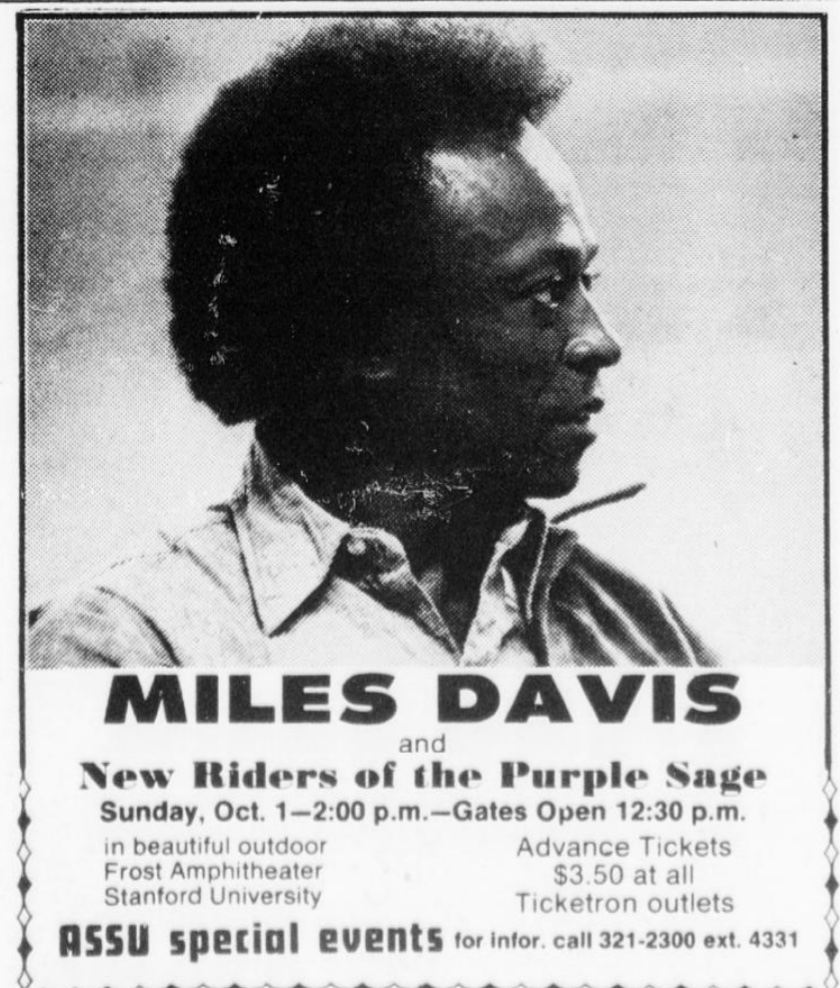
October 1, 1972 Frost Amphitheatre,  Stanford U., Palo Alto, CA: Miles Davis/New Riders of The Purple Sage
(Sunday) 2:00pm
Stanford University had a complex, contested history with rock bands performing on campus. The Grateful Dead, for example, seem to have been informally banned from campus as many as three times in three different decades. Stanford had great facilities in a county where there were no proper rock venues, but the University didn't really need any revenue from concerts. Frost Amphitheatre, a beautiful open-air grass bowl holding up to 11,000, had been used off an on for rock concerts since the 1960s. The venue wasn't very secure, however, and locals knew how to sneak in. A Sly Stone concert in October 9, 1970--Sly was hours late--and a Tower Of Power concert in 1971--Santana made an unannounced guest appearance--were particularly troublesome. Stanford responded by banning having any rock concerts on campus

Stanford didn't ban jazz concerts, however. In October, 1971, the "Stanford Jazz Festival" had featured Jerry Garcia and Merl Saunders, along with some conventional jazz acts. The next year, in '72, Miles Davis headlined at Frost. Miles' 9-piece band was probably as loud as any rock band, although I don't think you could dance to it. The New Riders supported Miles, although in fact for some reason they came on stage after Miles. Both Miles and the Riders were on Columbia, which probably explains the connection, but it's still an odd booking. What happened? According to a Miles Davis site, the same old same old:

Fistfights and gate crashing marred the performance of Miles Davis and the New Riders of the Purple Sage yesterday at Frost Amphithetare. ASSU organizers opened the gates at 4 pm after a crowd of 300 outside the amphitheater repeatedly rushed the gate and threw rocks at Santa Clara County Sheriff's deputies hired to provide security. 

The Miles Davis set was apparently broadcast on the campus radio station, KZSU-fm, who had been broadcasting live since 1968.  

Dave Torbert (top), David Nelson (b-r) and John Dawson (l) of the New Riders of The Purple Sage, at Frost Amphitheatre on the Stanford University campus, October 1, 1972. Photo "Mazzy"
 Over on the Hoffman Forums, user "Mazzy" posted some photos of the New Riders from that day


October 9, 1972 Winterland, San Francisco, CA: Grateful Dead/New Riders of The Purple Sage
(Monday) Benefit for Grateful Dead Crew
The Grateful Dead, in a unique event in the history of rock, had a Monday night benefit for crew members so they could afford to buy houses. What few benefits bands have ever held for crew members have always been for some tragedy--only the Dead ever had one for healthy living crew members. The New Riders opened the show. Grace Slick made a guest appearance during the second Dead set. 

October 21, 1972 The Gardens, Vancouver, BC: New Riders of The Purple Sage/Dr John (Saturday)
With recording presumably done for Gypsy Cowboy, the New Riders set out on a tour of the Pacific Northwest. We have announcements of a number of dates, but there seems to have been some cancellations, and some of the venues are unclear. The Riders were supposed to have played a place called  The Coral (more likely "The Corral") in Calgary on Thursday, October 19, but that show seems to have been moved to the Victoria Pavilion. A review in the Calgary Herald (October 20) mentions opener Dr. John playing the show, and notes that the New Riders were no-shows.

Both the New Riders and Dr. John were booked two nights later at a place in Vancouver called The Gardens. I have no idea where "The Gardens" were, or if the New Riders actually played. 

October 24, 1972 The Garden, Seattle, WA: New Riders of The Purple Sage/Dr. John (Tuesday)
The tour continued into Seattle. I don't know anything about a place called The Garden in Seattle, and indeed with a similarly-named place in Vancouver, I wonder if there isn't a transcription error.

The October 16, 1972 Spokane Chronicle describes the week of events for Homecoming at the University of Idaho. The New Riders played the gym on Wednesday, October 25

October 25, 1972 Memorial Gym, U. Of Idaho, Moscow, ID: New Riders of The Purple Sage (Wednesday)
Universities were lucrative gigs for bands willing to travel. At this juncture, the New Riders were a nice cross between a genuine (pot-smokin') hippie rock band and country music, which probably reflected the musical tastes of a lot of areas outside of big cities.  Universities had entertainment budgets, so ticket costs only had to cover a portion of the expenses. The New Riders concert in the gym was part of week-long festivities for Homecoming, culminating in a big football game on Saturday (October 28)

The University of Idaho is a public land-grant research university in Moscow, Idaho. It is the state's land-grant and primary research university. Formed by the territorial legislature on January 30, 1889 (Idaho only became a state on July 3, 1890), the university opened its doors in 1892 on October 3, with an initial class of 40 students. The first graduating class in 1896 contained two men and two women. UI now has an enrollment exceeding 12,000, with over 11,000 on the Moscow campus. I don't know how many it had in 1972. War Memorial Gymnasium is a 2,500-seat multi-purpose indoor arena that had opened in November, 1928.

October 26, 1972 Kennedy Pavilion, Gonzaga U, Spokane, WA: New Riders of The Purple Sage (Thursday)
Gonzaga University is a Jesuit school in Spokane, which had opened in 1887. It currently has 7,500 students, although I don't know how many it had at this time. The band played the John F. Kennedy Memorial Pavilion. The Pavilion was named in honor of JFK as the country's first Catholic president. The building was completed in 1965, and the basketball gym could hold 3,800 fans. The building is now known as the Charlotte Y. Martin Centre. The highly-ranked Gonzaga Bulldogs men's basketball team played in the Martin Centre until 2002, when they moved into the 6000-seat McCarthy Athletic Center.

The Sacramento Memorial Auditorium, at 1515 J Street, as it appeared in 2009

October 27, 1972 Memorial Auditorium, Sacramento, CA: Tower of Power/New Riders of The Purple Sage/Doobie Brothers (Friday)
Befitting the capital city of a booming state, Sacramento opened the Memorial Auditorium downtown at 1515 J Street in February, 1927. It had a capacity of 3,687, huge for the time. The Sacramento rock market in the 60s wasn't large, but its proximity to San Francisco made it an attractive "extra" booking for bands touring on the West Coast. By the 1970s, the rock market had exploded, so Bay Area bands would play the Sacramento Auditorium regularly. Multiple acts would be booked to draw different ticket buyers.

For this Friday night, there were three rising Bay Area bands that had established themselves, but were not yet big draws. There seems to have been a conscious effort to book contrasting bands who would not draw from the same core audiences. Anyone who went, however, regardless of who they intended to see, would have found themselves at a great show. 

Tower Of Power had been playing around the Bay Area since early 1970 (and long before under different names). In May, 1972 they had released their epic second album on Warners, Bump City. That record is so far ahead of its time that it sounds contemporary now. Big songs off the album were “Down To The Nightclub” and the ballad "You're Still A Young Man." The latter got huge airplay in the Bay Area, and while it wasn't a giant National hit, it was huge in Northern California. On top of their recent recorded success, Tower were absolute monsters on stage, and surely brought down the house (because they always do).

Shows are usually booked about 90 days in advance, so back in July the Doobie Brothers would have just released their second album on Warners, Toulouse Street. The Doobies' debut had not done particularly well, and the band had been slugging it out at all the local clubs like the Keystone Berkeley in the meantime. By October of '72, however, the Doobie Brothers had a giant hit on their hands with "Listen To The Music," and the Toulouse Street album was racing up the charts. 

The New Riders had really gotten their act together by the end of '72, and they sounded great as well. Ironically enough, they would have been facing off against two classic Bay Area bands just hitting their prime. All in all, this would have been a great show for anyone who went. All three bands would be stand-alone headliners by the next year.

November 3-4, 1972 Winterland, San Francisco, CA: Hot Tuna/New Riders of The Purple Sage/Rowan Brothers (Friday-Saturday)
The New Riders returned to familiar territory, booked for Friday and Saturday night underneath Hot Tuna. Jefferson Airplane had recently completed a tour, and were on a hiatus that would last for seventeen years, although no one knew that at the time. Hot Tuna, meanwhile, in contrast to the other Airplane members, played around as much as they could. At this time, Tuna's most recent album was Burgers, their third on the Airplane's label Grunt (distributed and financed by RCA). Burgers had been the group's first studio album. Hot Tuna now had a stable lineup, which hadn't really been the case in previous years. Along with Jorma Kaukonen and Jack Casady, Sammy Piazza was the drummer and Papa John Creach played his inimitable electric violin. Papa John was also a member of Jefferson Airplane. 

The Rowan Brothers opened the show. Cutler had probably wangled the Rowans onto the bill as a favor. Brothers Chris and Lorin Rowan had released their debut album on Columbia a few months earlier. Since they lived in Stinson Beach, their uphill neighbor Jerry Garcia had been sincerely, but unfortunately, quoted as saying they were "like the Beatles." They weren't bad, actually, but they weren't the Beatles. In electric concert configuration, Lorin Rowan played lead guitar and shared vocals with his brother (who played rhythm). Their producer "David Diadem" played keyboards, along with bassist Bill Wolf and drummer Jack Douglas. 

The one time I saw the Rowan Brothers, opening for the Grateful Dead a month later (December 12 '72), I was quite surprised when "David Diadem" jumped out from behind the organ and played a blazing electric mandolin solo. Later in life, I figured out that the Diadem monicker was the Nom Du Rock of David Grisman, so the mandolin solo finally made sense. 

According to the most reliable source, on Friday (November 3) the Rowans were joined by Jerry Garcia on pedal steel guitar for two numbers. Garcia had played on the album and a few live shows with the band, so he knew the tunes. There is no evidence, however, that Garcia played with the New Riders on Friday.

November 8, 1972 Hollywood Palladium, Los Angeles, CA: Hot Tuna/New Riders of The Purple Sage/Wishbone Ash (Wednesday) two shows 7 & 11pm
Hot Tuna and the New Riders played Wednesday night at the fairly substantial Hollywood Palladium. The Palladium, at 6215 Sunset Boulevard, had opened as a big band hall in 1940. It had a capacity of about 4,000. A weekday show wasn't expected to sell out, most likely, but a bill with different bands might draw different fan-bases.

Opening the show was the English quartet Wishbone Ash. The Ash were a unique band with twin lead guitars, who managed not to fall into the blues'n'boogie cliches of so many other English bands. Their classic album Argus, their third record, had been released in May on MCA. The band were touring America hard--they had just opened for the New Riders back in San Diego, on August 23. Richard Cromelin of the LA Times reviewed the show (on November 10) and said that Wishbone Ash stood out, while Hot Tuna was simply too laid back. He only mentioned the New Riders in passing, as they had been reviewed more recently in the paper, but he refrained from any praise. Rightly or wrongly, Cromelin's dismissiveness of the two San Francisco bands reflected a music industry view that the "Fillmore sound" was passe.

November 14, 1972 Municipal Auditorium, Atlanta, GA: The Byrds/New Riders of The Purple Sage (Tuesday) canceled

A Monday (Nov 20) review of the New Riders in the UNC's Daily Tar Heel of the Friday night show at Carmichael found them "enjoyable."


November 17, 1972 Carmichael Auditorium, University of North Carolina, Chapel Hill, NC: New Riders of The Purple Sage (Friday)
The New Riders kicked off their Fall '72 tour at the University of North Carolina in Chapel Hill. There had been a Tuesday night show booked in Atlanta, opening for The Byrds, but it had been canceled. The New Riders' next album, Gypsy Cowboy, would not be released until December, but it must have been worthwhile to start the tour a little before the release. 

While touring was about generating interest in new albums, to stimulate album sales, Sam Cutler had learned with the Grateful Dead that a band also had to play in new territories to recruit new fans, even if the payoff took a long time. The New Riders' initial audience was rooted in the Northeast, particularly in Metro areas and college towns, so it's no surprise that the tour supporting their album was concentrated there. Yet Cutler took the time to book a (no doubt well-paying) gig in North Carolina, which was very much unconquered territory.

By the 1980s, North Carolina and Virginia would become a hugely successful market for the Grateful Dead. Back in '72, however, the Dead and the New Riders had only played a solitary gig in North Carolina, a thinly attended show at the Duke University football stadium on April 24, 1971. With their merger of hippie rock and twangy country, however, the New Riders seemed well-placed for young Southern fans. 

Carmichael Auditorium was the basketball arena for the UNC Tar Heels, already a fabled NCAA power since the late 1950s. The 8800-capacity building was one of the largest venues that the band would headline during the year. I assume that part of the arena was cordoned off, since the New Riders couldn't have drawn 8,000 fans in Chapel Hill. In 1973, Dean Smith had been the coach of UNC since 1961, and Carmichael had opened in 1965. The '73 team included future NBA All-Star Bobby Jones, future NBA coach George Karl and future NBA GM Mitch Kupchak. In the next decade, famous players like Walter Davis, Michael Jordan, Sam Perkins and James Worthy would all shine at Carmichael. The Tar Heels would move into the Dean Smith Center (the "Dean Dome") in 1986. The UNC Women's team now uses Carmichael Arena as their home court. 

The New Riders' show was reviewed in the campus Daily Tar Heel on Monday (November 20). Reviewer Gary Miller, clearly unfamiliar with their music, found them enjoyable and mentioned that they played a two-hour set. The New Riders would return to the region a year later, playing Cameron Indoor Stadium at Duke on October 20, 1973, but unlike the Dead, they never really built a live audience in North Carolina.

November 19, 1972 [venue], University of Maryland, College Park, MD: New Riders of The Purple Sage (Sunday)
Much of the Fall '72 tour was at colleges. Colleges always paid, and young fans stuck in the dorms were generally up for anyone who came to campus. I don't know what venue they played at Maryland, so I can't draw any conclusions. It is surprising that the band doesn't seem to have played a Saturday night show, rare for a touring band. 

November 21, 1972 The Dome, CW Post College, Greenvale, NY: New Riders of The Purple Sage (Tuesday)
CW Post College had been founded in 1954 as an extension of Long Island University, which had been founded in Brooklyn (go figure) in 1926. The college was named after Marjorie Meriweather Post, who had sold the school her old estate near Greenvale, NY (the school is actually in Brookville, but Greenvale is the nearest LIRR stop). The school is now known as LIU Post and currently has around 8,000 students.

The Dome was a 3500-seat auditorium, built in 1970. It was a popular venue for touring rock bands (Jerry Garcia played it in 1974, '76 and '77, for example). On January 21, 1978, the dome collapsed between 2:00 and 3:00am under mounds of snow and ice. The students were all on Christmas break, and no one was injured. 


November 22-23, 1972 Academy of Music, New York, NY: New Riders of The Purple Sage/Johnathan Edwards (Wednesday-Thursday) early and late shows
The most high profile show of the tour was two nights at the Academy of Music on 14th Street. The New Riders had played the venue before, headlining two shows on May 2. Now they had returned, this time headlining two nights, both with double shows. One of them was on Thanksgiving itself, so these were effectively weekend shows. On Thanksgiving day, plenty of kids could have had an afternoon family dinner, and then hopped the train to catch the show. 

Although the official release of Gypsy Cowboy wasn't until December, I would be surprised if New York Metro record stores didn't already have the album by this time. It would have been poor planning by Columbia to have a high profile holiday show and not have the new record available in stores. In any case, the Academy house sound crew made a great sounding board tape, and in 2019 both sets from Thanksgiving (Thursday November 23) were released as a double-cd called Thanksgiving In New York City.

Compared to the Syracuse tape from earlier in the year (April 13, broadcast on college station WAER), the Riders by this time were a smoking hot road band, in command of all their material. Similar to the Dead, they added some lively covers done in the band's style, so every show wasn't "just like the album." Joining in for a few numbers on the late show was guitarist David Rea. Rea probably knew Buddy Cage from Toronto, but in any case, Rea had signed with Columbia. He would record his solo debut in San Francisco with members of the Dead and the New Riders, produced by Bob Weir (of all people). I suspect that Rea had already started recording at the Record Plant, and finished early in 1973, but I don't know for certain. 

Opening the show was Jonathan Edwards. Edwards, a singer-songwriter based in the Boston area, had released his debut album on Capricorn Records in 1971. He had scored a surprise hit with the song "Sunshine," which would reach #4 on the Billboard charts. 

November 25, 1972 [venue], Jersey City State College, Jersey City, NJ: New Riders of The Purple Sage/Orphan (Saturday)
For the weekend, Cutler had booked two weekend college gigs in New Jersey. Jersey City State College in Jersey City (now New Jersey City University) had been established as a teachers college ("Normal School") in 1927. The name had been changed to Jersey City State College in 1958. The campus is at 2039 John F. Kennedy Boulevard, much nearer to the Hackensack River and the former site of Roosevelt Stadium than to the Hudson River and Manhattan. Opening act Orphan was probably the band on London Records who released the album Everyone Lives To Sing. While this was Thanksgiving weekend, I suspect most Jersey City State College students were commuters, and could attend the show if it appealed to them.

From the Asbury Park Press on Wednesday, November 22, 1972

November 26, 1972 Morris Union, Newark State College, Union, NJ: New Riders of The Purple Sage/Black Kangaroo/Eric Andersen (Sunday) 2 shows 7pm and 11pm
Newark State College had been founded in 1855 as a teacher's college. It was the first public post-secondary school in the state. By 1958, it had moved to nearby Union, NJ, and was a comprehensive liberal arts college. In 1973, it would change its name to Kean College (since 1997 it has been Kean University). As this was the Sunday after Thanksgiving, this was probably a "welcome back to Campus" event. I don't know the specific venue that the band was playing (the listing just says "Morris Union," which is the name of the Student Union).

Black Kangaroo was led by guitarist and singer Peter Kaukonen, younger brother of Jorma. Jefferson Airplane had been given their own "Imprint" by RCA, Grunt Records, which Jefferson Airplane members used to release albums by all their friends and relations. Black Kangaroo, primarily recorded by Peter Kaukonen himself, had been released in 1972. Full of overdubs, it was far more interesting than some Grunt releases. Black Kangaroo toured around the East Coast a little bit, probably as a power trio, but never got any real traction. 

Opening act Eric Andersen was a veteran singer-songwriter, who had recently been signed to Columbia Records. Blue River, his Columbia debut, had been released in February 1972. It was Andersen's 9th album. He had released 6 albums on Vanguard (1965-69), dating back to his Greenwich Village folk days, followed by two 1969 Warner Brothers albums. Since that time, Andersen had moved to Mill Valley, CA, and was Bob Weir's next-door neighbor. In early '73, Weir would ask Andersen to help him finish the lyrics to "Weather Report Part I." So despite the different musical history, Andersen was part of the Marin rock scene, and regularly toured with the New Riders as their opening act. On some occasions, he would join them for some encore performances.

November 29, 1972 Palace Theater, Albany, NY: New Riders of The Purple Sage/Eric Andersen-cxld
November 29, 1972 Hawkins Hall, Plattsburgh St, Plattsburgh, NY NRPS/Eric Andersen (Wednesday) 2 shows 7:30 and 10:00
Plattsburgh State College (now SUNY Plattsburg) had opened in 1890. It is in Clinton County, on the far Northern border of New York State. The school currently has about 5,000 students. Hawkins Hall has 789 seats, so two shows wasn't a huge number of tickets. There isn't a lot to do in Plattsburgh, NY on a Wednesday night in November--indeed many students may have been off-campus. Still, the show would have been underwritten by the school, so the payday was secure. At an isolated place like SUNY Plattsburgh, a lot of curious students and locals would show up, so it was a great way to get new fans.

Earlier ads had the New Riders at the Palace Theater in Albany on this night. That would have been a bigger booking, but SUNY Plattsburgh wasn't going to be canceled.

December 1, 1972 Capitol Theater, Passaic, NJ: New Riders of The Purple Sage (Friday) 7:30 and 11:00
As noted above, John Scher had an essential role in the history of Jerry Garcia and the Grateful Dead, but he booked the New Riders before he ever booked the Dead. Scher had first booked the New Riders at the Capitol Theater in Passaic, NJ, an aging 3200-seat theater at 326 Monroe Street downtown. It must have gone well, since he booked the Dead at Roosevelt Stadium on July 18, and then the Dead and the New Riders again at Roosevelt on September 19. Now the New Riders returned to the Capitol for two Friday night shows.

The New Riders had played two nights at the Academy of Music in Manhattan a few weeks earlier (November 22-23, above), and now they were appearing about 15 miles and 30 minutes due West. The Capitol drew on a different market of suburban New Jersey teens, who may not have been able to (or allowed to) see bands in the big, bad, city, while still being near enough for determined City folk to come. Two shows on Friday night equaled 6400 tickets--even if the Riders didn't sell out, this was a substantial booking. 

Eric Andersen isn't listed in any of the papers, but I suspect he opened the shows.

December 2, 1972 Men's Gym, SUNY Binghamton, Binghamton, NY: New Riders of The Purple Sage/Eric Andersen (Saturday)
The Grateful Dead and the New Riders of The Purple Sage had played a legendary show at SUNY Binghamton on May 2, 1970. Not only was it 7 hours long, with an acoustic set, a New Riders set and two crushing electric ones, it was taped and broadcast nationally on the Pacifica Radio Network (KPFA, WBAI, etc), thus becoming one of the first Grateful Dead shows to be widely bootlegged. SUNY Binghamton was a fairly large school, full of students from New York City and its suburbs, and had a regular parade of hip touring acts. The New Riders returned in 1972.  The band headlined the Men's Gym, which is where the Dead and New Riders had played just 2 1/2 years earlier.

Up until 1965, the school had been known as Harpur College, until it was absorbed by the SUNY system. The school currently has 17,000+ students. While it surely had fewer students in 1972, it wasn't tiny. Binghamton, NY doesn't resonate with most people, but IBM got started nearby, and General Electric and Alcoa had big operations there. Binghamton is near the Pennsylvania border, at the confluence of the Susquehanna and Chenango Rivers. Binghamton had been a main stop on the Chenango Canal (now NY Highway 12). The Chenango Canal connected the Susquehanna River to the Erie Canal, which made the city into a manufacturing hub. The canal was replaced by the Erie Railroad (later the Erie Lackawanna, which was the parent of NJ Transit's Morristown Line), but the town retained its importance. GE, IBM and others continued to make the area economically prosperous from the 1950s through the 80s.
 

December 3, 1972 Keaney Gym, University of Rhode Island, Kingston, RI: New Riders of The Purple Sage/Eric Andersen (Sunday)
The University of Rhode Island had been founded in 1892 and currently has about 18,000 students.  It is in Kingston, about 30 minutes South of Providence. Keaney Gym, built in 1953, had a basketball capacity of 3835. It was the home of the URI Red Rams until they moved to the larger Ryan Center next door. Keaney Gym is currently the home of the URI Women's Volleyball team.

A surprising number of bands have played at Keaney Gym over the years, including Traffic (1971), Bruce Springsteen (1973), Elvis Costello (1989) and Bob Dylan (1989 and 2002). Besides having a built-in audience of students, Kingston is midway between Providence and New Haven, so it makes a good intermediate stop on a tour. 

David Kramer-Smyth found a photo of the New Riders and Eric Andersen from the concert in the 1972-73 University of Rhode Island Student Yearbook

December 5, 1972 Boston Music Hall, Boston, MA: New Riders of The Purple Sage/Eric Andersen Cable Music Presents (Tuesday) {cd}
Back on July 16, Cable Music had booked the Grateful Dead to headline Dillon Stadium in Hartford, CT. While Dillon was a smaller minor league football stadium, the show was a financial success for the band and the promoters. Thus began a decades-long relationship between Cable co-founder Jim Koplik and the Grateful Dead. Subsequently, Cable Music booked the New Riders to headline the Boston Music Hall on Tuesday, December 5, so the relationship forged between Cable and the Dead in the Fall had continued. The New Riders got an enthusiastic review in the Boston Globe (December 6). 

The Boston Music Hall, at 268 Tremont Street, had been built in 1925 as the Metropolitan Theater. It had been renamed the Boston Music Hall in 1962. Boston Music Hall had a capacity (at the time) of 4225, large for the era (now, as The Wang Theater, the capacity is around 3500). Performers included the Ballet and Symphony as well as music acts. In the 60s, rock bands had played a place called The Back Bay Theater, but it had been torn down in 1968. After that, big rock acts played Boston Music Hall. The theater was not the province of a single promoter, however, and was just a hall for rent.

There had been an early wave of hippie concert promoters in the 1960s, and like all pioneers, some thrived and some did not. Rock music and live rock concerts really became big business in the 1970s, and there was room for new, younger promoters because there were no "old-time" rock promoters. The business was fairly territorial--bands would only book shows with a certain promoter in certain areas. You can decide for yourself if that was a violation of anti-trust laws. Concert promotion was a messy business that depended on trust, and bands like the Grateful Dead tended to trust promoters they had worked with for a long time.

From the 1970s through the 1990s, the key promoters in the Northeast were John Scher (Metropolitan Entertaiment), who was down in New Jersey, along with Larry Magid (Electric Factory) over in Philadelphia, Don Law Jr in Boston and Cable Music's Jim Koplik in Connecticutt and other parts of New England, including Upstate New York. Key promoters in the West, for the Grateful Dead at least, included Bill Graham in San Francisco, Sepp Donahower (Pacific Presentations) in Southern California and Barry Fey (Feyline) in Denver. Some promoters, like Howard Stein (New York), Pacific Presentations and others also worked with promoters in smaller regions throughout the country. The business ties that the Grateful Dead formed in the early 1970s remained intact until 1995. Most of those promoters sold out to SFX (later Clear Channel, now LiveNation), and Jerry Garcia's death likely played a big part in those promoters' decisions to sell.

Jim Koplik had gotten his start as a promoter in college, putting on a Steppenwolf concert in 1968 at Ohio State when he was a student. Around 1972 he teamed up with Shelly Finkel to form Cable Music. Finkel was a bit older, and Koplik was the "house hippie," a common enough arrangement in concert promotion at the time. Entrepreneurs in their 30s who knew the business side were not necessarily able to navigate who was cool and who was not, so they needed a younger partner.

Shelly Finkel (b.1944), however, wasn't some neophyte in the concert business. In 1967, Finkel (then running a dating service) managed to parlay a job passing out flyers into managing the Action House in Long Island. The Action House was the premier rock club in the region, breaking local bands like Vanilla Fudge and the Vagrants, and also putting on shows by touring bands like the Doors, Cream and the Grateful Dead (on November 9-10, 1970). 

The owner of the Action House was an infamous Long Island club owner named Phil Basile. Over the years, he was involved in numerous other Long Island clubs and discos, including Speaks (the re-named Action House), My Father's Place,  Channel 80 and Industry. In the late 60s, however, thanks to the Action House, Basile had recognized how much money there was in live rock music. Basile formed the promotion company Concerts East, who put on most of the Jimi Hendrix and Led Zeppelin shows in the East in the 68-70 period (the Grateful Dead opened for Hendrix at a Concerts East production at the Temple Stadium in Philadelphia on May 16, 1970). While Finkel had just been Basile's house manager at the Action House, he would have had plenty of intersection with the larger business of rock promotion. With Cable, Finkel was a principal partner along with Koplik. Finkel and Koplik played a critical role in the Grateful Dead's success in the early to mid-70s, and they did so for the New Riders as well.

In 2003, Kufala Records released a double-cd of the entire Boston Music Hall performance by the New Riders.

December 7, 1972 [venue], Quinniapiac College, Hamden, CT: New Riders of The Purple Sage (Thursday)
The New Riders tour continued throughout colleges in the Northeast. As these schools' academic terms would be ending, they all wanted to book concerts to let the students celebrate. With a new album out, the New Riders would have been getting a push from Columbia on regional FM radio stations. Thus they would at least be a "name band" at these schools, even if many undergraduates were only vaguely familiar with the Riders' music. It probably didn't matter--if you were 19 years old and on an isolated New England campus in December, you would likely see whoever came to the school. No doubt the New Riders made plenty of new fans at these schools, who would return to whichever suburb they came from as a new convert. 

Quinniapiac College had been established in 1929 in Hamden, CT. Hamden was in New Haven County, just 5 miles South of Yale. Today it has 10,000 students. New Haven in the winter probably wasn't  that exciting, so I'm sure that for a Thursday night in Hamden, the New Riders were the most happening thing in town. 

December 8, 1972  Greene Hall, Smith College, Northhampton, MA: New Riders of The Purple Sage/Eric Andersen  (Friday)
Smith College, one of the "Seven Sisters" women's colleges, had been founded in 1875 in Northhampton, MA. It was (and is) a prestigious school with about 2500 students. The New Riders were booked at John M. Greene Concert Hall, a 2000-seat auditorium (at 60 Elm Street) that was built in 1911. 

We have a setlist for the show, which usually implies a tape. Eric Andersen joined in for the encore, so I assume he opened the show.

McDonough Gym, Georgetown U., ca 1959

December 9 1972 McDonough Arena, Georgetown U, Washington DC New Riders of The Purple Sage/Livingston Taylor/Jon Pousette-Dart
(Saturday) presented by Michael Schreibman (New ERA Follies), and the Students of Georgetown University
Georgetown University was founded in 1789. Currently it has 19,000 students, although only 7,000 undergraduates. Given its location in the Nation's capital, it is no surprise that Georgetown has many schools providing graduate and professional degrees for industry and government. I think Georgetown was a bit smaller in the 1970s, but was still a substantial school.

McDonough Arena had been built in 1951, and had a basketball capacity of about 2200. The arena had been the home of Georgetown Hoyas NCAA Men's Basketball team until 1981, when they moved to the larger Capital Center in Landover, MD (as did the Grateful Dead), just in time for the arrival of Patrick Ewing. McDonough is now the home of the Hoyas' Women's Basketball team. Per various sources, "McDonough Arena" refers to the actual venue, and "McDonough Gym" refers to the entire building, which includes the arena. 

An earlier ad had the New Riders playing Urbine Auditorium at the University of Pennsylvania on this Saturday, but it appears that the Georgetown gig took its place. Opening act Livingston Taylor was based in Boston. Livingston Taylor was two years younger than his brother James. He played in a bluesier style than his older brother. Livingston, managed by Boston promoter Don Law, had been signed to Capricorn Records, the Allman Brothers Band's label. Livingston had released his second album, Liv, in November 1971. Jon Pousette-Dart was from Cambridge, MA, and played in a country-bluegrass style. He would form the Pousette-Dart Band, a sort of string band trio, also managed by Don Law. Pousette has continued to record and perform since then.

December 11, 1972 Alexander Hall, Princeton University, Princeton, NJ: New Riders of The Purple Sage (Monday)
When Bill Graham controlled the rock market with the Fillmore East, Princeton was one of the few places within 50 miles of Manhattan that could put on rock concerts, since they were generally exempt from Graham's contractual restrictions. This peculiarity (which I explained at length elsewhere) was how the Grateful Dead and the New Riders came to play their epic show at Dillon Gym back on April 17, 1971. With Graham's departure, John Scher started to take over the New Jersey rock market. Still, since Princeton did not require ticket sales to cover all costs they could still book solid acts.

Earlier in the year, the New Riders had played two shows at Princeton (on April 24 '72) in the venerable 1100-seat Alexander Hall, which had been built in 1892. The early show (at 8pm) was sold out days earlier, so everything clearly went well. The New Riders returned for another show on Monday, December 11. This would have been term-end at Princeton, so the fact that it was a Monday would not have been a concern to the students. 

December 12, 1972 [venue] SUNY, New Paltz, NY: New Riders of The Purple Sage (Tuesday) canceled?
December 12 1972 DAR Constitution Hall Washington, DC: New Riders of The Purple Sage
(Tuesday) canceled?
Two different bookings for Tuesday, December 12 can be found for the New Riders, but we have been unable to determine which--if either--the band actually played. A tour schedule listed the band at SUNY New Paltz (presumably at Elting Gym). New Paltz was midway between New York City and Albany, and would become a common college stop for touring bands in the late 70s. But back in October, an ad had listed the New Riders at Constitution Hall, promoted by the owner of the DC club Cellar Door (Jack Boyle), but there were no subsequent traces of either show. Since it was a Tuesday, it's very possible neither show happened. Note also that the New Riders had played Saturday night (December 9, above) at Georgetown. While the Georgetown show would likely have mostly sold tickets to students, it doesn't seem as likely that a promoter would also book a Tuesday headline show nearby a few days later.

December 13 1972 Tower Theater Philadelphia, PA: New Riders of The Purple Sage/Eric Andersen (Wednesday)
The Tower Theater, in the Philadelphia suburb of Upper Darby, has opened as movie theater in 1927. The theater had fallen to a low ebb by 1972, when it was taken over as a concert venue by Midnight Sun Productions, out of New Jersey. The 3,119 seat venue (at 69th and Ludlow Streets) was instantly popular with fans. In the early 70s, the rock market had evolved to create room for acts to headline smaller venues, rather than being second on the bill at huge basketball arenas. In 1975, the Tower was taken over by the much larger Electric Factory, and it has been one of the premier East Coast venues ever since.

The New Riders played on a Wednesday night, supported by Eric Andersen. They probably didn't sell out, but as a band on the road, they wouldn't have needed a sell-out to make it worth their time. Note that the New Riders had apparently booked a show at Penn (Saturday December 9) that had been replaced by a show in DC (at Georgetown), so it makes sense that they had booked a different date in Philadelphia. 

Gypsy Cowboy had been released in December, and promotional copies were probably being played on FM stations a little before that. With the Northeast as the first anchor of the New Riders' fan base, the band had played 18 shows over 14 dates in 25 days (from November 19 through December 13), not to mention the opening show in Chapel Hill. The band was touring hard. Ultimately it would pay off with Panama Red, the album that would follow the current one.

December 15, 1972 Ohio Theater, Columbus, OH: New Riders of The Purple Sage (Friday)
After their hard run through the Northeast, the New Riders slipped in five dates in the Midwest. The Ohio Theatre, at 39 E. State St in Columbus, had opened in 1928 and had a capacity of 2700.  Loew's had closed the building as a movie theater in 1969, but the local community preserved the elegant hall as a concert venue. The Grateful Dead and the New Riders had played the Ohio Theatre on October 31, 1971. The Halloween show was Jerry Garcia's last appearance on pedal steel guitar with the New Riders. At the next show (Atlanta November 11), Buddy Cage would take over the chair. 15 months later, the New Riders returned to headline the venue themselves.  


December 16, 1972 Auditorium Theater, Chicago, IL: New Riders of The Purple Sage/Mott The Hoople/Eric Andersen
(Saturday) Celebration Concert Presents
By the early 1970s, record companies had finally grasped how big the album market really was. There were teenagers all over the country, they all wanted records, and they wanted a lot of them. It wasn't just promoting the small number of mega-hit artist, but promoting rock music of all types. Radio play was the most desirable, but the hardest to come by. Live concerts was the next best way to get music heard, and make fans excited about bands. The record companies subsidized touring all over the country--against future record royalties, of course--with the goal of getting bands heard.

The English glam rock band Mott The Hoople and the countrified New Riders of The Purple Sage seem like a really peculiar pairing. Would fans of one band actually like the other? I mean, I did, but was I typical or an outlier? Why were they booked together? I think the logic was that both bands were on Columbia, with their own followings, and neither were really big enough to sell out the 3,800-seat Auditorium Theater on their own. The assumption seems to have been that both bands would sell a certain number of tickets, and it would add up to a good house. The Auditorium Theatre (at 50 Ida B Wells St) had been built in 1889. The Dead and the Riders had played two nights there the previous year (Oct 21-22 '71), but unlike some cities, the New Riders didn't appear to have the legs to headline the show on their own.

Mott The Hoople had just released their fifth album, All The Young Dudes. The English band had released four excellent, but poor-selling, albums on Island, and their sound was like Bob Dylan and The Band, with a bit of a harder edge. For their first Columbia album, Columbia had assigned them to David Bowie, then a huge act in England, and seen as one of the two pioneers of "Glam Rock" (along with Marc Bolan of T. Rex). The title-track single, written by Bowie, had come out in July, and the album came out in September. It was huge in England, and made some noise in the States.  Over on FM, Mott The Hoople got a lot of airplay for the first track on their album, a cover of the Velvet Underground's "Sweet Jane." Lou Reed was also produced by David Bowie at this time ("Walk On The Wild Side" was released in November of '72). Mott The Hoople still rocked hard, but they wore some silky jackets on stage instead of jeans and sweatshirts, in honor of their new affilation with "Glam."

Within a few years, David Bowie and Lou Reed would be hugely popular national acts, with the Young Americans and Rock And Roll Animal albums, respectively. This wasn't the case in 1972, however. David Bowie and The Spiders From Mars had toured America, but weren't popular except in a few cities (mainly Cleveland and LA), and didn't get much FM airplay. Lou Reed and The Velvet Underground were a trivia question, and the Velvets had never received any FM play at all. 

As for Mott The Hoople's outfits, while English bands had always been allowed to dress more theatrically than American ones, I don't know if any New Riders fans would have been converted by sticking around for Mott The Hoople. If not, it was their loss. Lead singer and principal songwriter Ian Hunter is a true rock-and-roll character, and guitarist Mick Ralphs would go on to great fame and success in Bad Company (All The Young Dudes included a version of "Ready For Love," later a big hit for Bad Co). 

Ian Hunter's 1974 book, Diary Of A Rock N Roll Star (Flash Books). Originally titled Rock And Roll Sweepstakes, it is a day-by-day diary of Mott The Hoople's 1972 US Tour. The band were not yet stars

[update 18 February 2023
]: There is a detailed description of this gig in Mott lead singer Ian Hunter's 1974 book Diary Of a Rock N Roll Star, a day-by-day tour diary of Mott The Hoople's 1972 US Tour, and a classic read [highly recommended!]

December 16, 1972
"Drama, too at the sound check. New Riders said if we sound checked more than two numbers they were going home and the promoter said he'd cancel the gig if they did. We conceded and then they tried to get us to go on before the folk singer, Eric Anderson [sic], who would get the mood going for the quiet C.W. approach. This we wouldn't agree to that was OK in the end. The two numbers sounded bad and we all came back to the hotel somewhat jaded....

Eric Anderson was on when we got there and I liked him, but it's going to be difficult for him. James Taylor, Cat Stevens, the syndrome is saturated and it's difficult for a folk singer to captivate. He did well, however, and got an encore.

The promoter laid on wine and sandwiches and the hospitality was good. The Chicago Auditorium is a beautiful place and the feeling is good, but somewhere between the encored folk singer and the New Riders I think we might die. My doubts proved groundless, though, and apart from the high-hat stand freaking Buff [Mott drummer Dale Griffin], things turned out well. We did a long and lusty encore--went back on but just felt like rocking and we didn't do "[All The Young] Dudes" just "Honk Tonk [Woman]" and the audience was great. We worked with the crowd at the end..."Give me, give me the honky tonk blues." It was a gas of a gig overall.

Chicago don't forget us. We left during the New Riders' act and the slide player [Buddy Cage] was absolutely great.I turned from the stage to leave, [roadie] Stuey was hustling, and I'll swear I saw Jeff Beck; in fact, I know I saw Jeff Beck, but he was engrossed in the slide player too so I left it that."

December 17, 1972 Guthrie Theater, Minneapolis, MN: New Riders of The Purple Sage (Sunday)
The Guthrie Theater, at 818 South 2nd Street in Minneapolis, was primarily used for repertory theater. There were occasional concerts, however, when the stage was dark. The theater, built in 1963, had 1,441 seats.

December 19, 1972 Ottumwa Coliseum, Ottumwa Iowa: New Riders of The Purple Sage (Tuesday)
A tour poster lists the New Riders as playing the Ottumwa Coliseum on December 19. We have not been able to confirm the show. Since the band was playing Minneapolis on Sunday and St. Louis on Wednesday, a Tuesday Iowa booking seems logical. I'm not sure of the size or exact location of the Ottumwa Coliseum, as it appears to have been torn down some decades ago.

Proprietors Adelaid and Herbie Balaban, in front of the Gypsy Cowboy boutique at 401 North Euclid (at McPherson) in St. Louis, some time in the 1970s. The boutique name inspired the Dave Torbert song and the New Riders' album title (from Lost Tables)

December 20, 1972 Fox Theater, St. Louis,MO: New Riders of The Purple Sage/Eric Andersen
(Wednesday)
The initial strongholds of Grateful Dead fans were in San Francisco, and then in Brooklyn and the Northeast. It's no surprise that the New Riders initial fan-base mirrored the Dead's audience in Brooklyn, Long Island, New Jersey and New England. On a cold day in the Northeast, the New Riders stood for clean air, blue skies and sunny days. Still, the Grateful Dead were popular in other pockets, and one of those places was St. Louis.

In 2021, the Grateful Dead released their stellar box set Listen To The River, a collection of all the music the Grateful Dead made at the Fox Theater in St. Louis over seven shows in 1971, 1972 and 1973. In support of that release, noted scholar Jesse Jarnow did some deep research into the Dead in St. Louis, and it turned out that there was an entire, self-contained universe there, largely unseen by either Brooklyn or San Francisco. The details were laid out with interviews with the local and national promoters, as well as others on the scene, in the Deadcast podcast

The Fox Theater, at 527 N. Grand Boulevard, was a movie palace built in 1929. It had 5060 seats and beautiful acoustics. Although the owner preferred to show movies, it was periodically rented out for rock shows. The Grateful Dead played wonderfully there. It's no surprise that the New Riders also booked a show at the Fox. Remember that the rock audience was pretty young in 1972, and a huge percentage of rock fans were students, so in late December every night was like a weekend night. I doubt that the New Riders sold out the huge Fox, but they probably drew a good crowd. 

In fact, the title of the New Riders album Gypsy Cowboy had come from a store in St. Louis. Gypsy Cowboy was a sort of "hippie Western boutique," selling clothes and art, at 401 N. Euclid (at McPherson). Dave Torbert wrote the song "Gypsy Cowboy" sometime after the New Riders came through in late '71, and the title cannot have been a coincidence. Gypsy Cowboy is long gone, first replaced by the Balaban Cafe, and now Herbie's Vintage '72. Across the street, however, Left Bank Books remains open, just as it had been back in the seventies. 

December 31, 1972 Winterland, San Francisco, CA: Grateful Dead/New Riders of The Purple Sage/Sons Of Champlin (Sunday)
The New Riders of The Purple Sage ended the year as they had ended the previous two, opening for the Grateful Dead at Winterland. The band was broadcast on FM radio, just as they had done previously. The New Riders would not return to Winterland open for New Year's Eve until 1977, but no one would have known that at the time. Joining the New Riders on harmonica for a few numbers was Matthew Kelly, an old friend of Dave Torbert. Kelly had played a little bit on the Gypsy Cowboy album.

Kelly would play critical parts in the New Riders' history, albeit from outside of the band. Torbert and Kelly had been in a number of bands in 1968 and '69, and one of them (Horses) had even released an album. At the end of the Summer of '69, Torbert had gone to Hawaii and Kelly had gone to London. In London, Kelly had joined a band of expatriates from Indiana called Gospel Oak, and they had released an album. By March 1970, Gospel Oak needed a bass player, and Kelly wrote Torbert and sent him a plane ticket. Yet Torbert had stopped in California to pick up some clothes, and he was "coincidentally" called by his old pals John Dawson and David Nelson, and offered a chance to join a band with Jerry Garcia. Kelly graciously told Torbert to take the offer.

After various adventures, Kelly had returned to the Bay Area in the Fall of '72, and he had reconnected with Dave Torbert. A year later, after Torbert worked on an album project with Kelly, he would quit the New Riders to throw in his lot with Kelly and his new band Kingfish at the beginning of 1974. Kelly himself discouraged Torbert from doing so, since the New Riders had just released their best selling album (Panama Red), but Torbert was insistent. So Kelly would turn out to be essential in both Torbert's arrival and his departure in the New Riders, albeit through no direct action of his own. 

New Riders Status Report, New Year's Eve 1972
The New Riders of The Purple Sage had had an excellent year. They had released two albums on Columbia, and established themselves as separate from Jerry Garcia. Heavy touring in the Northeast, particularly in colleges, was creating a solid fan base for them. The Grateful Dead were more popular than ever, and the Riders' association with them only helped. At the same time, their was an undeniable merger occurring between hippies and country music, with more country rock bands and more country bands letting their hair grow a little bit. 

The New Riders were now a tight live band, playing two hour shows that were a mix of old and new material, both originals and covers. John Dawson was still the focal point, but Dave Torbert's singing and writing made a nice contrast. David Nelson sang the occasional country cover, too, just to widen the band's scope. The record industry was booming, the concert industry was booming, the New Riders were good and signed to a major record label. By any reasonable standard, the future looked very bright for the band at the end of 1972.

For the next post in the series (NRPS Tour History January-April 1973), see here