Showing posts with label 1981. Show all posts

Friday, January 11, 2013

Boston April 2, 1973 Robert Hunter and David Nelson ("Crooked Judge")

A Village Voice ad from February 20, 1978, advertising the Jerry Garcia Band and the New Riders Of The Purple Sage (and Robert Hunter and Comfort, unbilled) at the Suffolk Forum in Commack, NY on March 12, 1978
Those attempting to write contemporary history are very dependent on the memory of others. One problem with popular artists is that the formats in which they speak are often quite truncated, and true stories get shorter and shorter. In some cases, as the story becomes shorter they become less true. In more typical cases, the story doesn't exactly become untrue, but they lose a lot of nuance. For me, the problem is often that without the nuance, I am unable to piece together the details that I am looking for. So it was a pleasure recently to inadvertently come across a long version of an oft-told story, long enough that I can put a timeline on it.

Often when I have seen or heard David Nelson with the New Riders Of The Purple Sage or the David Nelson Band, he has said something like "I called up Hunter and told him I dreamed he was serving up songs like cheeseburgers. He said 'do you want fries with that?'"A terrific Nelson/Hunter composition always follows. I had always assumed that this conversation referred to the wave of material that Nelson and Hunter started to write in the 1990s and beyond. Yet a long ago tape dates the conversation down to a specific weekend in 1973, and the transaction wasn't quite so crisp as Nelson made it out to be, although it is perhaps more interesting for that. Unraveling this tiny piece of history also sheds some light on a subject that I have been pursuing for some time, namely why Hunter had so few collaborators in the 1970s.

October 9, 1981: The Boarding House, San Francisco, CA: Robert Hunter with David Nelson
After some attempts at a conventional rock career with the bands Roadhog and Comfort, Robert Hunter had retreated to performing by himself by 1979. At the time, seeing Hunter or hearing tapes was always interesting, because he performed old songs that the Dead had not yet resurrected and he played new material that had not yet been heard. A few of these songs even turned up in the Grateful Dead repertoire. I recall hearing "Touch Of Gray," "West LA Fadeaway" and "Day Job" from Hunter in 1980 or 1981, sometime before the Grateful Dead performed it. Thus Hunter had a good local following in the Bay Area, but he was definitely still a club act.

The Boarding House had been a tiny, if popular club in San Francisco from about 1970-78, located at 960 Bush Street. The 350-capacity club was beloved by artists and fans, but it was simply too small for the booming rock market. Jerry Garcia had played there a number of times in 1972 and '73 with Merl Saunders and Old And In The Way, but he had simply outgrown the place. Proprietor David Allen was well liked by musicians, managers and artists, but he wasn't a great businessman. The old Boarding House had finally gotten sold for condo redevelopment, but Allen had been barely hanging on as it was.

Allen re-opened the Boarding House over in North Beach, at 901 Columbus Avenue. During the disco era, the room had been a popular place called Dance Your Ass Off, but by the end of the 70s that was passe (before that it had been The Village, but that is another story). Old Waldorf owner Jeffrey Pollack had then opened a "New Wave" disco there called X's, which sometimes had live bands, but that too became passe (as everything does in San Francisco). Allen took over the building and remodeled it, making it into a nice 600-seat club with great sightlines. Hunter played there a number of times.

Poking around sugarmegs, I found a brief snippet of a long-ago tape of Robert Hunter at the Boarding House, joined for a few numbers by his old friend David Nelson. The October 9, 1981 audience recording only has three numbers by the pair, "Sawing On The Strings," "Crooked Judge" and "Dark Hollow." Amidst much on-stage banter, Nelson gives what may be the first version of the 'Cheeseburgers' story, and the longer, unedited version is different than the bon mot that Nelson usually delivers.

After "Sawing On The Strings," but before playing "Crooked Judge," Nelson says
I had a dream about four years ago, just a regular every day dream, you fall asleep and then you wake up. I called Hunter because he was in it and I said 'I dreamed that  I was ordering up songs like cheeseburgers, and you were giving them to me.' He said 'Ok, just give me a little time'

About a week later, we were in Boston, and he was there staying with the Dead, and he came to my room and said 'ok, I've got your song' I said what? He said "you know, cheeseburgers.'"
This brief statement (transcribed somewhat approximately by me) is not much longer than Nelson's usual joke, but for the likes of me it is very revealing. It also makes a good case study on how musicians reflect on their own past, which justifies my parsing of this remark (plus, that is what this blog is for).

To deal with the simplest detail first, the song "Crooked Judge" was released on the New Riders album Brujo in Fall 1974, and it was recorded in July or August of that year. Thus Nelson had underestimated how much time has passed--it has to have been at least seven years, not four, since Nelson had his dream. My own experience, having attempted to parse many such statements by long-ago musicians, is that time is the hardest thing to get right in your memory. Once you get past childhood, when there are built-in markers, most of our vivid memories are not particularly time bound. I worked at the same place for over a decade, and while I have many vivid memories, it is often hard to be certain exactly when memorable events actually occurred. So I never discount musician's memories as false if they botch the timeline, but by the same token I am never that trusting of long ago memories of exactly when something happened, either, however accurate other pieces of the memory of that event may be.

Although "Crooked Judge" was recorded by the New Riders in the Summer of '74, it became part of their live shows quite a bit earlier. The first confirmation of the song's appearance was on November 17, 1973 at Colgate University in Hamilton, NY. Thus, all that remains to date the Cheeseburger Dream was to locate the Boston event where the New Riders and the Dead were both present. That isn't very hard--the New Riders and the Dead shared a lot of bills in the Spring of '73, and they played together at the Boston Garden on April 2, 1973.

So here's the scenario as I see it: the New Riders were playing intermittent shows with the Dead around the country, since they shared management. Thus Nelson and Hunter met periodically in different hotels throughout the land. Wherever Hunter was Nelson called him, he knew that he would be seeing Nelson soon, so he wrote a song for Nelson to set to music. Because we know when the song appeared (November '73), we only have to find the previous Boston Dead/NRPS show (which was April 2 '73) to locate the date.

The first verse to "Crooked Judge" may in fact offer up a hint, with it's reference to Boston:
Paid my money to a crooked judge
Set out to find an honest man
That's how I came to be in Boston
Looking like I am.
Nelson And Hunter--Why Just One Song?
To my knowledge, "Crooked Judge" was the only song that Robert Hunter and David Nelson wrote together between 1967 and the 1990s. In many ways, this fact is quite peculiar. Hunter, Nelson and Garcia were apparently like the Three Musketeers in the early 60s, and they were the original members of The Wildwood Boys, the first group any of them formed. According to McNally, however, Hunter showed up one time at a Wildwood Boys rehearsal only to discover that it had already started, and Eric Thompson had replaced him as guitarist. While Hunter would surely have conceded Thompson's superior ability, Garcia and Nelson, Hunter's two best friends, hadn't told him and wouldn't look him in the eye. In response, Hunter moved to Los Angeles for a while.

Nelson and Garcia went on to pursue music, with the New Delhi River Band and The Grateful Dead, respectively, while Hunter pursued writing. In 1967, Garcia and Hunter managed to merge these goals by bringing Hunter on board with the Grateful Dead as an in-house lyricist and songwriter. Yet Nelson and Hunter did not do the same with the New Riders of The Purple Sage, even though it was surely feasible for Hunter to wear the same hat for both bands.

I have written at length about Hunter's attempts to become bass player for the New Riders, in either late 1969 or early 1970. Hunter's one songwriting effort for the New Riders, "Friend Of The Devil" was adopted and modified by Garcia for the Grateful Dead. When Hunter's role as rehearsal bassist for the Riders was trumped by the invitation to Dave Torbert to join the band.  Hunter has claimed, in his own words, that perhaps there wasn't room for another songwriter in the New Riders.  Certainly, in 1970, John Dawson had a huge batch of fine songs, but once again, an opportunity for Hunter to play with Nelson was passed by with nary a word to Hunter.

However, by 1972, the New Riders had used up Dawson's store of songs, and he hadn't written that many new ones. Dave Torbert was a fine writer, but he left the band by the end of 1973. Another songwriter would have added considerably to the New Riders' possibilities. In fact, "Crooked Judge" seems to have been written in time for the Panama Red sessions, but Hunter contributed a song of his own to the Panama Red album ("Kick In The Head"), and "Crooked Judge" ended up on the next studio album (Brujo). Yet Hunter had little profile with the New Riders. Why not? Of course, given the musical history of Hunter and Nelson, Hunter may not have been quick to offer his services. However, I think a more mundane factor played an equally big role.

Co-Writing Songs In The 70s
Sometime in the 1990s, everyone seemed to catch on to the idea of using Robert Hunter as a lyricist. The list is long: Bob Dylan, David Nelson, Zero, Little Feat, Jim Lauderdale, several members of the Dead, Warren Haynes and so on. Some of these collaborators have actually written multiple albums with Hunter, not just a song or two. Yet in the early 70s, collaborations with Hunter were fairly rare. I have written at length about how David Freiberg seems to have been Hunter's first regular non-Dead collaborator, and the reasons I think why that was the case. However, without recapping the whole post, I think I can make a critical point that may seem self-evident, but is still worth making--back in the day, you couldn't co-write songs without proximity, and touring musicians never saw anyone not in their own band.

We take for granted that its easy to email sound files, text, pictures and everything else, and to do it on our cell phones to boot. Yet none of those things were possible in the 1970s. If someone left your house and you forgot to tell them something, you had no way of contacting them until they got home, and that was only if they actually went home and answered the phone, and if you knew their phone number. In order to collaborate, musicians had to spend time together in the same place. Hunter and Garcia shared a house, and Hunter often toured with the Dead, so they saw a fair amount of each other. Yet Hunter and Nelson, good friends as they were, probably hardly saw each other except backstage.

Even when Hunter gave Nelson the lyrics to "Crooked Judge," however quickly or slowly Nelson wrote the music, he would have had no way to share it with Hunter until he saw him again. Yes, Nelson could have recorded the song and mailed it to Hunter, but if Hunter wasn't home--being on tour with the Dead--he would not have heard it. All of this seems obvious when you write it out, but no one ever thinks about it. Because Nelson had a chance dream and called Hunter about it, Hunter wrote a song for him. 18 months later, it actually turned up on an album. Regardless of whether or if there were other complications between Nelson and Hunter, collaboration for touring musicians was so difficult that it almost never happened.

Aftermath
The new Boarding House closed in mid-1982. After some permutations, Bill Graham Presents took it over and renamed the club Wolfgang's, benefiting from all of David Allen's upgrades. The club was open from July 4, 1983 through July 31, 1987, when it was closed after a fire.

Now, of course, Nelson likes to say "I called up Hunter and said 'I dreamed you were serving up songs like hamburgers,' and he said 'do you want fries with that?'" and today it's probably true, thanks to email and cell phones. Hunter and Nelson wrote some fine songs for the David Nelson Band, and two albums worth for the New Riders, just as it should have been in the prior century.  But in a previous century, it was like a dream that could never come true, and didn't seem realistic at all.

October 9, 1981: The Boarding House, 901 Columbus Ave, San Francisco, CA (later Wolfgang's)
Robert Hunter-acoustic guitar, harmonica, vocals
David Nelson-acoustic guitar, vocals
Sawing On The Strings
Crooked Judge
Dark Hollow



Friday, April 20, 2012

Bob Weir Band>Bobby And The Midnites 1977-84

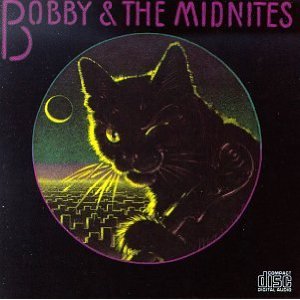
The cover to the Arista album Bobby & The Midnites, released in November 1981
From 1977 to 1984, Grateful Dead guitarist Bob Weir made a conscious effort to be a rock star in the style of Steve Miller of Boz Scaggs. Now, Weir was already a rock star by any standard, but he was cloistered in a peculiar Grateful Dead world. Given that Jerry Garcia had already set out on a singular path for his own solo career, and that Weir already had both a solo album (1972's Ace) and had recorded an album as a member of another group (1976's Kingfish), a 'conventional' rock star solo album was not far-fetched. Weir's album Heaven Help The Fool was produced by Keith Olsen, who had produced the hugely successful 1975 album Fleetwood Mac, as well as the Dead's Terrapin Station. Rather than a detailed discussion of Weir's efforts to be a conventional rock star, this post will focus on the history of the bands Weir formed in support of that effort, the Bob Weir Band and later Bobby And The Midnites, covering most of Weir's non-Dead live appearances from 1978 through 1984.

I originally developed this material for my own research, and felt it would be most productive to share it. The numbering systems for the groups are arbitrary, and only intended to ease discussion in the Comments. Anyone with corrections, insights, additional information or recovered memories (real or imagined) is encouraged to Comment or email me.

The Bob Weir Band
Bob Weir had played Ibanez guitars since about 1975, and Ibanez rep Jeff Hasselberger introduced him to Bobby Cochran in mid-to-late 1977. Cochran was the nephew of famed rocker Eddie Cochran, and he had grown up in Hollywood and the Southern California studio scene. Not only was Cochran an accomplished guitarist, he was comfortable working in an industry context with established veterans. By the end of 1977, among many other projects, Cochran had been a latterday member of John Kay's Steppenwolf, and had also been in the Flying Burrito Brothers. During the period that Cochran was in the Burritos, they changed their name to Sierra and released an album of the same name. That album included the song "I Found Love," which Cochran regularly with both the Bob Weir Band and Bobby And The Midnites.

Some paperwork suggests that the original Bob Weir Band tour was supposed to take place in December 1977, which suggests an earlier planned release date for Heaven Help The Fool. However, since the album was not released until January of 1978, it makes sense that the tour supporting it did not take place until the month after. However, given the Dead's planned touring schedule, the Bob Weir Band must have been put together by Weir and Cochran in the Fall of 1977, probably shortly after November 6, 1977(when the Dead's tour ended in Binghamton, NY). Weir and Cochran probably anticipated going out in December 1977, but in fact they were delayed some months.

The cover to Bob Weir's Arista album Heaven Help The Fool, released in January 1978
Bob Weir Band #1
First show: The Roxy, Los Angeles, CA February 17, 1978
Last show: Nassau Coliseum, Uniondale, New York June 10, 1978
Bobby Cochran-lead guitar, vocals
Bob Weir-guitar, vocals
Brent Mydland-organ, keyboards, vocals
Rick Carlos-bass
John Mauceri-drums
Notes: According to some interviews I read at the time (probably in BAM Magazine), Bob Weir invited David Lindley to join him on his inaugural tour. Weir would likely have known Lindley from the various times that Lindley's 60s band Kaleidoscope had opened for the Grateful Dead. By the late 1970s, Lindley had become well-known as Jackson Browne's chief collaborator. However, the perpetually busy Lindley apparently turned Weir down--darn it--but recommended drummer John Mauceri.

Mauceri was auditioned and hired, and in turn brought in his partner Rick Carlos on bass. The pair had played together in various aggregations. They had backed up the duo Batdorf And Rodney on tour various times, and I had seen them backing up singer/songwriter David Blue in 1973 (along with future Eagle Don Felder). With the rhythm section intact, Carlos recommended his friend Brent Mydland to play organ. Carlos and Mydland had played together since high school, and Mydland had even played with Carlos behind Batdorf and Rodney (albeit not with Mauceri). By 1975, Mydland had ended up in the group Silver with John Batdorf, and they had released an obscure album on Arista.

Once Heaven Help The Fool was released in January 1978, The Bob Weir Band made an essentially traditional national tour in support of it, starting at the most high profile club in the industry, The Roxy in Los Angeles (on February 17, 1978). The band went on to play prestige rock clubs in major cities, and in between they played colleges or mid-sized cities where a winter appearance by any member of the Grateful Dead would always be welcome. In contrast to a typical Jerry Garcia Band tour, where a net profit was mandatory, the Weir Band's record-company supported was more focused on creating "buzz" and encouraging FM radio airplay.

After the national tour ended at the Old Waldorf in San Francisco on March 25, 1978, the Bob Weir Band still managed to sneak in a few high profile bookings. I know they played the Armadillo World Headquarters in Austin, TX on April 27, probably as headliners. They also played two shows opening for Jefferson Starship at Nassau Coliseum on June 9-10, 1978.

Bob Weir Band #2
First show: Rancho Nicasio, Nicasio, CA October 16, 1978
Last show: Paramount Theater  Northwest, Seattle, WA October 28, 1978
Bobby Cochran-lead guitar, vocals
Bob Weir-guitar, vocals
Brent Mydland-organ, keyboards, vocals
Dee Murray-bass
John Mauceri-drums
Although Heaven Help The Fool hadn't become a big hit, Weir hadn't given up. Weir and Cochran organized another brief tour by the Bob Weir Band. Former Elton John Band bassist Dee Murray took over on bass, replacing Rick Carlos. After a few warmup Bay Area gigs, the Bob Weir Band opened three shows for the Jerry Garcia Band in the Pacific Northwest (October 26-28, 1978). As I have discussed elsewhere, these shows were significant because Jerry Garcia got to hear Brent Mydland play and sing, and told Weir "hey, this guy might work." Garcia's reference was to the apparently unspoken concern that Keith and Donna Godchaux's time with the Grateful Dead had run its course. Indeed, a few months later, Mydland got the fateful call from Weir, and by April of 1979 he was a member of the Grateful Dead.

Bobby And The Midnites #0
Golden Bear, Huntington Beach, CA July 30-31, 1980
Bobby Cochran-lead guitar, vocals
Bob Weir-guitar, vocals
Brent Mydland-organ, keyboards, vocals
[uncertain]-bass
[uncertain]-drums
Bob Weir had been playing Ibanez guitars since the mid-70s, and as an Ibanez client he attended the National Association of Music Manufacturers (NAMM) conference in Anaheim, CA in January of 1979. Ibanez had held their own special event at a satellite site, the Knotts Berry Farm amusement park, and various Ibanez clients had performed. Bobby Cochran led an Ibanez All-Star band with bassist Alphonso Johnson and drummer Billy Cobham. They were joined by various guests including Steve Miller and Bob Weir. Weir performed "Minglewood" with Cochran, Johnson, Cobham and others (the dates referenced in this fascinating link are slightly off). There is actually video of Weir's performance, which I have seen, and which is apparently accessible on YouTube.

After the January 1979 Knotts Berry Farm performance, Weir, Cochran, Johnson and Cobham played a Summer NAMM event in Atlanta in either 1979 or 1980, and Weir approached Cochran with the idea of the band which became Bobby And The Midnites, featuring Johnson and Cobham as the rhythm section. However, the busy schedule of the band members meant that it would actually be years before they all got to actually play together. Deadbase IX uncovered a mystery date by Bobby And The Midnites, June 30, 1980, long before any other performance. I have to assume that this low-key show was a "proof of concept" show, for the band members to determine that they were onto something. Other than Weir and Cochran, however, I have no idea who actually played. I suspect that Brent Mydland, Alphonso Johnson and Billy Cobham were in the band that day, but given the peculiar history of the Midnites that is far from certain

[update: based on a poster in the Grateful Dead Archives, it appears that the "Bobby And The Midnites" show that Deadbase found for the Golden Bear was actually on July 30-31, 1980. Interestingly, the band was billed as "Kingfish with special guest Bob Weir, and Bobby Cochran, Tim Bogert and Gregg Errico." So it seems this was some kind of Weir Band/Midnites hybrid. I presume that Matt Kelly was part of the group, and plausibly Brent was along for the ride, too.]

Notwithstanding that both Weir and Cochran were named Bob, Bobby Cochran had been in a fairly successful teenage band called Li'l Willy Gee And The Midniters, so the name 'Midniters' seemed to be an homage to that band.

Bobby And The Midnites #1
First show: The Catalyst, Santa Cruz, CA September 18, 1980
Last show: Freeborn Hall, UC Davis, Davis, CA January 31, 1981
Bobby Cochran-lead guitar, vocals
Bob Weir-guitar, vocals
Matthew Kelly-harmonica, guitar
Brent Mydland-organ, keyboards, vocals
Tim Bogert-bass
Carmine Appice-drums
To Dead fans, Bobby And The Midnites seemingly appeared from nowhere, playing 3 dates in the Bay Area right before the Grateful Dead's Warfield shows. No explanation was offered in the press for what might have been planned, and the idea that Weir, Cochran and Mydland were playing with two members of Vanilla Fudge seemed unfathomable. Of course, there has never been any subsequent explanation, either. As nearly as I can figure out, Weir and Cochran had a concept of Bobby And The Midnites that they had worked out with Alphonso Johnson and Billy Cobham, but conflicting schedules forced them to initiate the Midnites with Bogert and Appice.

Bobby And The Midnites #1 played three club dates in the Bay Area (Sep 18-20, 1980), and then an eight or nine date tour of small theaters in the East Coast (November 1980). There was an encore of six more shows in January of 1981. Bogert and Appice have had such epic careers with the Fudge, Jeff Beck and a Who's Who of rock (not to mention a chance meeting with Don Preston in O'Hare International Airport) that they don't even mention playing with Weir in their various biographies. I have to assume that Bogert and Appice were high-class substitutes until Alphonso Johnson and Billy Cobham were available. Bogert and Appice had been in the band Cactus, who had opened for the Grateful Dead on May 16, 1970, in Philadelphia (Jimi Hendrix was the headliner), but I don't necessarily think that Weir, Bogert and Appice ever made any more than a casual connection at that time.

update: it appears Billy Cobham took over the drum chair after the three Bay Area dates (hat tip Mark)

Bobby And The Midnites #2
Studio only (Bobby And The Midnites album)
Bobby Cochran-lead guitar, vocals
Bob Weir-guitar, vocals
Matthew Kelly-harmonica, guitar
Brent Mydland-organ, keyboards, vocals
Alphonso Johnson-bass
Billy Cobham-drums
Notes: The debut album by Bobby & The Midnites was produced by Gary Lyons for Arista Records. Lyons, the former producer of Foreigner among others, had just finished the Grateful Dead's Go To Heaven album. Weir's previous album had been produced by Keith Olsen, who had just finished Terrapin Station, so clearly the record industry saw plenty of potential in Weir as a rock star. The Midnites album was very well recorded, but I felt it suffered from unimpressive songs. The best song on the album, to my ears--and probably Gary Lyons' ears, since it led off side 1--was "Haze," with six co-writers. "Haze" was written by Weir, Cochran, Mydland, Kelly, Daoud Shaw and Essra Mohawk.

Shaw and Mohawk had been the drummer and backup singer for the Jerry Garcia Band in the Summer of 1981, and I have to suspect that the song came out of some sort of studio jam or rehearsal. Over the years, there was relatively little crossover between Garcia and Weir's extracurricular bands, so "Haze" was a notable exception. Essra Mohawk, an extremely interesting figure, was just a harmony singer for the Garcia Band for about a dozen shows in 1981, but she had a very interesting career as a solo artist and songwriter. I have to think that her contributions, whatever exactly they may have been, were a factor in making "Haze" a good song. I'm not aware, however, that the Midnites ever performed the song "Haze" in concert, and even if they did, they didn't do it very often.

Bobby And The Midnites were announced on the Grateful Dead hotline as performing as part of a large benefit concert for MUSE (an Anti-Nuclear Energy group), on June 14, 1981 at the Los Angeles Forum. Alphonso Johnson was announced as the bassist on the hotline, but I'm not certain whether Billy Cobham or someone else played drums. I assume they played a brief set, but the truth is, I'm not convinced a MUSE Benefit was held at the Forum on June 14 (this subject is kind of esoteric--anyone with any knowledge about this, please put it in the Comments).

Bobby And The Midnites #3
First show: Fox-Warfield Theater, San Francisco, CA January 12, 1982
Last show: Hammersmith Odeon, London, GB February 4, 1983
Bobby Cochran-lead guitar, vocals
Bob Weir-guitar, vocals
Dave Garland-keyboards, tenor sax, vocals
Alphonso Johnson-bass
Billy Cobham-drums
Notes: Bobby And The Midnites made their true stab at stardom starting in January of 1982. It wasn't a bad plan: Bob Weir was a genuine rock star, both Bobbys were good guitarists and handsome to boot, and the rhythm section featured two jazz fusion legends. Weir's peculiar status as a full-time member of the Grateful Dead seemed to suit the other members fine. Cochran had a career as a producer and studio musician, and Cobham and Johnson had plenty of jazz and solo projects to work on. In fact, the profusion of projects of those two may have delayed the 'official' debut of Bobby And The Midnites for some time after the quartet's first jam at the January, 1979 Ibanez NAMM show at Knotts Berry Farm.

Taking over the keyboard slot from Brent was Dave Garland, an experienced studio hand. Garland had also been in the Orange County band Big Foot, who not only released an album but also had opened for the Grateful Dead at Fillmore West back in February, 1970. Garland played keyboards and sang harmonies, and even added a little tenor sax. Matt Kelly had dropped out of the Midnites by this time, presumably more interested in working on his own music with Kingfish.

Bobby And The Midnites were a terrific live band. Although both Cobham and Johnson were great jazz players, they both genuinely enjoyed playing rock music.  Although Cobham had mostly played heavy jazz in the 60s (with Miles Davis, Horace Silver and many others), he had also played the Fillmore East with a fine jazz/rock group called Dreams in 1970, so he was plenty versatile. It was funny to hear guys who had played on Bitches Brew and with Weather Report work it on out to Marty Robbins' "Big Iron," but both Johnson and Cobham liked playing rock, and it showed on stage. 

Nonetheless, despite the charisma and talent of the Midnites, I felt that their material was sub par. There was nothing really wrong with any of their songs, but no number leaped out like Steve Miller's "Fly Like An Eagle" or Dire Straits "Money For Nothing," and the band hardly got any traction beyond Deadheads. Bobby And The Midnites #3 toured hard for about a year, and even had a brief European tour, with three dates (Feb 2-4, 1983) in Paris, Sheffield (Dingwall's) and London, but the album never got any airplay and the band was stuck in smaller places.

Bobby And The Midnites second album, Where The Beat Meets The Street, released on Columbia Records in January 1984
Bobby And The Midnites #4
First show: Keystone Palo Alto, Palo Alto, CA March 22, 1983
Last show: The Rio, Valley Stream, NY September 30, 1984
Bobby Cochran-lead guitar, vocals
Bob Weir-guitar, vocals
Dave Garland-keyboards, tenor sax, vocals
Ken Gradney-bass
Billy Cobham-drums
Notes: Alphonso Johnson left Bobby And The Midnites, but the band went right back out on the road. The Midnites toured as hard as the Jerry Garcia Band, a clear sign that Weir was taking the enterprise seriously. Now, granted, Grateful Dead finances were not great in the early 1980s, so Weir was benefiting from all the touring, but he could probably have made more money touring with less well-known (and thus cheaper) compatriots, so his effort was not inconsiderable.

Johnson's replacement on bass was Ken Gradney, formerly of Little Feat. Gradney was a fine player, but in a more economic, funky style than the jazzy Alphonso. I'm fairly certain that Gradney had been the bassist for Delaney And Bonnie And Friends back when they shared the Festival Express train across Canada with the Dead back in 1970, but I don't know for a fact that Gradney and Weir actually met back then (update: now I do. An alert Commenter pointed out some footage of Gradney and Weir hanging out on the Festival Express. Check out about 1:04 in).  It is interesting to reflect that by the 1980s, even though Weir was filling his band with Los Angeles session pros--Garland and Gradney--they both had opened for the Dead in different contexts over a decade before (as had Tim Bogert and Carmine Appice in Cactus).

As a footnote, although Gradney played on what I consider to be the best Little Feat albums, 1973's Dixie Chicken and 1974's  Feats Don't Fail Me Now, he had replaced original bassist Roy Estrada. Estrada, formerly of The Mothers Of Invention (surely you can all sing along to "Prelude To The Afternoon Of A Sexually Aroused Gas Mask" from Weasels Ripped My Flesh), had played on the Feat's first two albums. This means that Estrada, not Gradney, had played the original part on Lowell George's song "Easy To Slip," recorded by Weir on Heaven Help The Fool and a regular part of the Midnites live shows.

The last iteration of Bobby And The Midnites made another album, the largely forgotten Where The Beat Meets The Street. The album was released in early 1984 on Columbia, which would have been an interesting development had the album been a success. The album was produced by former Doobie Brother Jeff 'Skunk' Baxter, and featured not only the various Midnites, including both Gradney and Alphonso Johnson, but also some Hollywood session guys like Baxter, Brian Setzer (of The Stray Cats) and Steve Cropper. Oddly, Dave Garland is namechecked on the cover as a bnd member, but does not appear on the recording. Although the album featured a healthy dose of original material that the Midnites had been performing for some time, the record sunk like a stone, and even most Deadheads had no idea it was released.

Bobby And The Midnites continued to tour hard throughout 1984, but at a certain point it seemed like they were treading water. Any band featuring a member of the Grateful Dead always had a certain following, and having seen the last configuration of the Midnites twice, I can vouch for the fact that they were a good band. They even continued to play new, unreleased material as they kept touring. At a certain point, however, it was clear that the Midnites were going to remain second tier, and the band quietly ground to a halt in September, 1984. As far as I can tell, all the former members of Bobby And The Midnites remain friends, and there seems to have been various collaborations over the years.

The Bob Weir Band and Bobby And The Midnites were very serious efforts by Weir to do something separate from the Grateful Dead that was both popular and good. Very few professional musicians would play full time in a band as busy as the Grateful Dead and still find the time and energy to make the effort to record and tour with a completely different project over a period of four years. It's ironic, of course, that one of the very few musicians who would do such a thing was also a member of the Grateful Dead, so as a result Weir was constantly compared to Jerry Garcia and found wanting. Weir's not Jerry, but I saw Bobby And The Midnites four times, and they were terrific every time. For a "side project,' that's a rare result anywhere but in the Dead.

By the end of 1984, Weir seemed to have caught Garcia's bug permanently, and he has remained on the road ever since. After Bobby And The Midnites, Weir has never been without a performing entity for long, but the subsequent ensembles will be the subject of future posts. 

Appendix:
Bob Weir And Friends, Perkins Palace, Los Angles, CA March 10, 1983
Bobby Cochran-lead guitar, vocals
Bob Weir-guitar, vocals
Nicky Hopkins-piano
Tim Bogert-bass
Gregg Errico-drums
In 1983, Weir performed at a benefit for Medical Aid To El Salvador. I presume the full compliment of Midnites were not available, so Weir and Cochran used a pick-up band with a former Midnite (Bogert) and two former members of the Jerry Garcia Band (Hopkins and Errico). A tape circulates of this event, mostly consisting of enjoyable rockers.

Friday, December 2, 2011

Jimmy Warren-electric piano

The back cover to Jerry Garcia's 1982 lp Run For The Roses, with Jimmy Warren on piano
When Deadheads discuss the various musicians who played with Jerry Garcia in his many projects, the same words come up over and over: talented, professional, even legendary. Even younger players with less of a pedigree are generally identified as being promising and good accompanists. These adjectives are testimonies to the high musical standards of the Jerry Garcia Band in its various incarnations. Yet for many fans there's one significant exception to the rollcall of band members: Jimmy Warren. Warren played Fender Rhodes electric piano with the Jerry Garcia Band from January 1981 until June 1982, and no one has a good word to say about his playing. However, Warren was in the Garcia Band for 17 months, and the band made some great music, so Garcia and John Kahn must have felt he brought something to the band, even if fans didn't. As part of my series reviewing the musical biographies of people who played with Jerry Garcia, I will attempt to summarize what little is known about Warren's career, and pose a hypothesis as to what musical goals Garcia and John Kahn were trying to accomplish.

Background: Jerry Garcia Band 1980 vs 1981
In late 1979, Jerry Garcia and John Kahn had put together a compact version of the Jerry Garcia Band, a quartet that included keyboardist Ozzie Ahlers and drummer Johnny De Foncesca. When De Foncesca died in an auto accident, Gregg Errico was drafted for a Summer 1980 tour, but the Garcia Band went dormant for the balance of the year. When the Garcia Band re-appeared in January 1981, it was with an entirely new lineup. All the evidence suggests that Garcia and Kahn had completely re-thought the entire band. Besides a new drummer, Daoud Shaw, who had played with Van Morrison, the new JGB featured two keyboard players, organist Melvin Seals and Jimmy Warren on Fender Rhodes. Seals was somewhat known to rock fans. I myself had seen him play with Elvin Bishop in 1979, and I knew he was an excellent player. Warren, however, was a complete mystery.

Garcia rarely if ever said anything from the stage in those days, so for a long time I didn't even know the name of his electric piano player. I had somehow figured out that Seals was the organ player, but I think I saw a listing in BAM Magazine, which mentioned the new band members and I learned Warren's name some months after he began performing with Garcia. I looked all over for any hints as to what bands Warren might have been in, but I drew a blank. In fact, I drew a blank for the next fifteen years. During Warren's 18 months ith the Jerry Garcia Band, it was hard to see why he was in the band. While Melvin Seals' swirling Hammond organ provided a sophisticated counterpoint to Garcia and Kahn, Warren stuck to the beat on his Fender Rhodes. Sometimes Warren wasn't very audible, and over the years listeners have criticized him for seeming to tie the band down. Warren took the occasional, brief solo, but his role clearly wasn't tied to that.

Garcia and Kahn weren't deaf, so they must have had musical reasons for keeping Warren in the Garcia Band for eighteen months. Blair Jackson quoted Kahn as having said that Warren was a friend, but he stayed in the band "too long." Garcia and Kahn placed a high premium on easy social relations with fellow band members, so that might explain his personal presence, but what musical role did they see Warren as serving? I think that Garcia and Kahn were consciously trying to frame themselves in the style of groups like The Band and Procol Harum, both of them musically attractive to Garcia. Both groups had two keyboard players, with a "lead" organ player (Garth Hudson and Matthew Fisher, respectively) and "rhythm" piano player (Richard Manuel and Gary Brooker). It's a nice concept, but Warren was nowhere near the talent level of either Richard Manuel (from The Band) or Gary Brooker (from Procol Harum).

However, I think that Garcia and Kahn had broader plans for the Garcia Band that are only plain in retrospect. It turned out that the 1981 version of the Jerry Garcia Band seemed to be constructed to take the best elements of the Garcia/Kahn aggregations that preceded it. The 1981 JGB was designed to have a spare, flexible drummer like Ron Tutt (Daoud Shaw), an airy, soulful Hammond player like Merl Saunders (Seals), a piano player to keep the rhythm like Keith Godchaux (Warren) and two female singers to enrich the vocals, like Donna Godchaux and Maria Muldaur. However, the vocalists were not introduced into the band until June of 1981, five months after Warren had begun playing with the band. Nonetheless, I think vocalists were planned as part of the group from the beginning. With the exception of an electric piano, the basic formulation of the Jerry Garcia Band remained the same for the rest of Jerry's career, even though the drummers and singers changed periodically.

I think the concept of Jimmy Warren's role was twofold: Warren was providing some rhythm to free Garcia and Seals to improvise, and his straight-ahead playing was intended as an anchor for the vocalists, who might have found it hard to sing vocal parts in unison when no one in the band could be guaranteed to stick to the basic chords. Although Warren wasn't a high-end player, which Garcia surely knew, the simple role that he was intended to play would have bored a more sophisticated player like Ozzie Ahlers, so I think Garcia chose a younger, more basic player who would be happy to just play a role. Presumably, however, Warren's 'rhythm piano' role didn't bring enough and Melvin Seals was so good that Warren himself could be dispensed with. After a June 24, 1982 show, Warren left the Jerry Garcia Band and dropped off the musical map.

Who Was Jimmy Warren?
The question of Jimmy Warren's roots and branches are more problematic. The only trace I have ever been able to find about his pre-JGB career was his membership in a Marin County 'New Wave' band called Wet Nurse. My sole source of information is the excellent Bay Area Bands site, which focuses on mostly long-gone Marin County bands. The entry, in its entirety, apparently written by guitarist Ernie Stires, says
Wet Nurse was an offshoot of the band The Cascades. The Cascades, formed in 1976 played a mixture of originals, and soft rock. Ernie and Boom Boom went on to form Wet Nurse after the demise of the Cascades.
Wet Nurse was primarily punk, and was truly cutting edge at the time. The band was famous locally for their costumes, and wild antics on stage. Working with a limited repertoire, Wet Nurse was a band capable of extreme highs and lows. The band worked with many notable Bay Area groups including Huey Lewis, Nick "The Greek" Gravenites, and Clover.
In 1978 a demo 45 was produced with "Toots and Hot Tubs" on the A side, and "Bar Wars" on the B side. Huey Lewis produced, and the tracks were cut at the legendary "Church" in Marin County, and Different Fur, San Francisco.
At a time when well orchestrated, and arranged rock was all the rage, Wet Nurse broke through and added a little style, and volume to the Bay Area club scene in the late 1970's. (Ernie Stires)
Discography:
1978 "Toots and Hot Tubs" b/w "Bar Wars" (demo single)
The only other shred of information about Wet Nurse was on the site of Marin singer/songwriter Liz Stires, who besides being Ernie's sister, was one of the first two female singers in the 1981 Jerry Garcia Band. She was also Jimmy Warren's girlfriend at the time (the other singer, Essra Mohawk, was the wife of drummer Daoud Shaw). According to Liz Stires' Facebook page (she is still an active singer, performer and songwriter in Marin), she, too was a member of Wet Nurse. This seems likely, but she was not specifically mentioned on the Bay Area Bands site. The personnel of Wet Nurse was
  • Ernie Stires - guitar

  • Jim "Boom Boom" Hite - fretless bass

  • Steve Bajor - drums

  • Hunter Starbird - vocals

  • Jimmy Warren - keyboards

  • Warner Yull Thorton - percussion

I have never heard the 1978 single. I assume that Wet Nurse was somewhere in the general vein of Blondie, The Mutants or The Avengers, but of course I have no real idea. It does seem a strange background for a future member of the Jerry Garcia Band (I am aware that there is a YouTube video attributed to Wet Nurse, but it doesn't include a keyboard part, so whether or not it is the same band doesn't matter from the point of view of Jimmy Warren's history).  

Jimmy Warren's Entry Into The Jerry Garcia Band
Steve Parish alludes to Warren's peculiar entry into the JGB, in a Blair Jackson interview (thanks to LIA for finding this)
Blair Jackson asks him, "Who was Jimmy Warren, and how did he get that gig?"
Parish: Well, you know something, Blair, you're talking now about the "shadow people" that walk in and out of the scene of the Grateful Dead --
Jackson: It always seemed like a guy of limited talents, and you always wonder how a guy like that gets in a band like that...
Parish: Well, that's an interesting question.... Jimmy was a mystery to all of us. Jerry and him had a nefarious relationship, and one day we were at the rehearsal hall and Jimmy came down with a Rhodes and Jerry said, "Set him up. Set his Rhodes up." And I said "Where?" 'Cause we had a pretty tight little setup, you know. He said, "He's gonna come play with us tonight." I think we were playing at the Keystone in the city and...he had Jimmy play way in the back....behind Melvin's organ....He was set in the dark, in the
shadows and I thought at first he was just trying to learn the music, but it was the only time I ever saw Jerry put anybody in the band -- and understand this, Blair -- through the years, people ended up in that band that shouldn't have been there at times -- (Laughter) -- people that just came in and sat in and wouldn't leave (laughter). There were people brought in -- at one time, Tom Fogerty played in that band, and we had a great time with him. Merl [Saunders] would bring other people in, but Jimmy was something that Jerry and John [Kahn] -- they wanted him to play there, and it was for other reasons besides the music. It's the only time that ever happened. He didn't last very long, either.
To his credit, he tried to fit in and he was a wonderful guy, Jimmy -- he was really a good-hearted guy -- but he had other problems that were overshadowing him being able to go and be a full-on musician. And he did travel with us on the road, too.
David Gans: You're a diplomat, Steve.
Parish: He was a "shadow person," definitely a "shadow person."
Warren's peculiar entry into the band raises the spectre that Warren's friendship with Garcia and Kahn was predicated on certain bad habits, and they may well have been. I would point out, however, that with the exception of Melvin Seals and perhaps some short-timers, most of the keyboard players in Garcia's side bands apparently had a variety of unhealthy predilections as well, and I choose not to dwell on them in this blog. My interest in Jimmy Warren has to do with what musical part Garcia and Kahn thought he could play.

In fact, Steve Parish's then-20-years-past memory is a bit clouded, perhaps on purpose, which is understandable. In fact, Warren lasted considerably longer than some other members of the Jerry Garcia Band, but he seems to have had a small enough impact that Parish has fogged up the timeline. It is also interesting, in passing, to see Parish's remark that "people came and sat in and just wouldn't leave," but that clearly doesn't apply to Warren, since Garcia and Kahn wanted him to stay. Warren played piano on a few tracks on Run For The Roses, recorded in the Fall of 1981, and Garcia and Kahn could have easily used another player, or had Seals or Kahn overdub the parts, so it isn't as simple as to say that Warren was merely a mistake.

The other interesting part is the suggestion that the Garcia Band was performing with Melvin Seals prior to Warren's arrival, and that Warren was simply put on stage at a place like The Stone or The Catalyst without any rehearsal whatsoever. Are there any January '81 tapes of the JGB that only have Melvin Seals, and without Jimmy Warren? That might allow us to date Warren's arrival (update: the first two January '81 shows, on Jan 22 and 23 at Keystone Palo Alto,  appear to be without Warren. JGMF has determined that Warren's debut was at the Old Waldorf in San Francisco on January 27, 1981).

Jimmy Warren's Departure From The Jerry Garcia Band
Blair Jackson quotes John Kahn as admitting that "things got kind of out of control around then. Jimmy Warren was just sort of a friend. It didn't work out and it went on too long..." (p.321). Warren's last gig with the Jerry Garcia Band was June 24, 1982 at the Capitol Theater in Passaic, NJ. When the Garcia Band reappeared in October of that year, Seals handled all the keyboard chores himself. Liz Stires, Warren's then-girlfriend, seems to have left the band two days earlier, as her last show was on June 22 in Richmond. Whatever the reason that she left the band two days before the tour ended, it can't have been a good sign.

After June 24, 1982, I have seen no sign of Jimmy Warren as a professional musician, nor do I have any idea what he might be doing or where he might be living. Given Jerry Garcia's stature, playing with the Garcia Band seems to have been the peak of his musical career, and I hope whatever problems Kahn alluded to were resolved, and that his life has been happy enough since then. Although Garcia fans tend to be fussily resentful of Warren's playing in the Garcia Band, its important to remember that Garcia and Kahn wanted him there, for whatever reasons, and given his 18-month tenure we can't just dismiss him as a mistake. Here's to hoping that Jimmy Warren, a friend or family member will have some insight some time in the future about Warren's role in the Jerry Garcia Band.