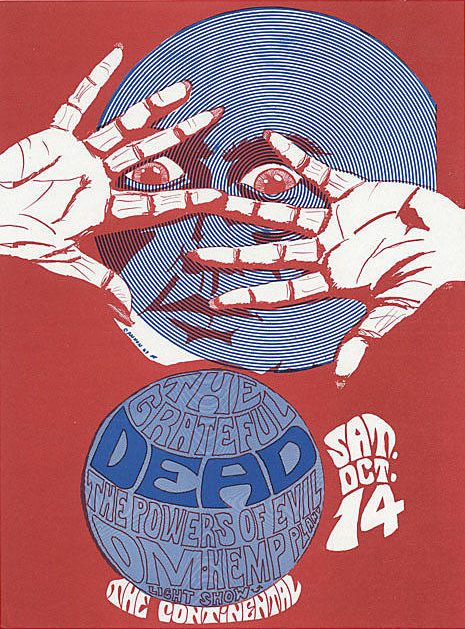
The major San Francisco bands felt that Bill Graham and Chet Helms were doing good business from their performances and the bands should make themselves the beneficiaries. Jefferson Airplane, Quicksilver Messenger Service and The Grateful Dead formed a sort of collective that would rent the Carousel Ballroom and share the profits. Big Brother and The Holding Company were not part of the collective, but they were supportive. Janis Joplin, though on board, tellingly, said "I give you hippies six months." She called it almost to the day.
The Dead and their compatriots negotiated a foolishly ruinous agreement with Irish Ballroom operator Bill Fuller to operate the Carousel Ballroom, at 1545 Market Street (at Van Ness). The Carousel had been in operation in San Francisco for many years. Naively, the Dead and Quicksilver put on a Wednesday night show and then went on tour for the next few weeks. Any possible momentum from a grand opening was frittered away.
January 20, 1968 Eureka Municipal Auditorium, Eureka, CA: Grateful Dead/Quicksilver Messenger Service (Sat)
The Grateful Dead and Quicksilver Messenger Service set out to conquer the Pacific Northwest. Eureka, CA, is far enough North that it is nearer to the Oregon border than San Francisco. Oddly enough, however, the band seems to have flown to Eureka, and presumably flown home. Its not clear to me whether the equipment flew home or was trucked up to Seattle. In any case, this was the Grateful Dead's first and only appearance in this part of California.
January 26-27, 1968 Eagles Auditorium, Seattle, WA: Grateful Dead/Quicksilver Messenger Service (Fri-Sun)
The Northwest tour began in earnest on the next weekend. The Grateful Dead had played Eagles Auditorium in July and September 1967. The Eagles Auditorium was at 1416 7th Avenue, at Union Street. It had been built in 1924 for The Fraternal Order Of The Eagles. By 1967, it had become Seattle's principal psychedelic ballroom (note: tapes labeled "Eagles January 22-23 '68" are clearly spuriously dated).
January 29, 1968 PSC College Center Ballroom, Portland State College, Portland, OR: Grateful Dead/Quicksilver Messenger Service/PH Phactor Jug Band (Mon)
With a week between relatively big weekend bookings in Seattle and Portland, the Quick and the Dead played some smaller college venues in Oregon. However small some of those college gigs may have been, the bands would have had the same expenses in any case. The Crystal Ballroom in Portland was the major venue, but it was too casually run to have (or to enforce) non-compete clauses at nearby places. The PH Phactor Jug Band, though not a major musical group, was a crucial fulcrum in the social network of Portland psychedelia.
With a week between relatively big weekend bookings in Seattle and Portland, the Quick and the Dead played some smaller college venues in Oregon. However small some of those college gigs may have been, the bands would have had the same expenses in any case. The Crystal Ballroom in Portland was the major venue, but it was too casually run to have (or to enforce) non-compete clauses at nearby places. The PH Phactor Jug Band, though not a major musical group, was a crucial fulcrum in the social network of Portland psychedelia.
 |
At most American universities, a student organization was required to "sponsor" an event in order for a promoter to use the facilities. SDS (Students For A Democratic Society) was a radical Anti-War group, but most of the long-haired hippies were probably in it |
February 2-3, 1968 Crystal Ballroom, Portland, OR: Grateful Dead/Quicksilver Messenger Service/PH Phactor Jug Band (Fri-Sat)
The Crystal Ballroom, at 1332 W. Burnside (at NW 14th), played a peculiar role in Portland rock history, as it was the highest profile venue in the city, but it was run on a shoestring basis. When the Crystal was functioning well, however, it provided some of the great memories of 60s Portland rock. When the Grateful Dead and Quicksilver tour hit the Crystal on a Friday and Saturday night, all the stars were aligned. After a few smaller shows at Portland State and U of O, hip Portland was primed for the shows at the Crystal.
According to Toody Conner, who was one of the volunteers who helped run the Crystal (per Tim Hills' book), there were lines around the block, and there was so much money in gate receipts that they had to borrow an equipment case to stuff it into, which she sat on during most of the show. The Crystal had had financial struggles throughout its entire existence as a psychedelic venue, but for this weekend, with the audience ready and the Dead firing on all cylinders--not to mention the formidable Quicksilver Messenger Service--everything happened the way it was supposed to, if only for a weekend.
We know how well the Grateful Dead played, too, because they taped it. Partial tapes of Dead sets from both nights circulate —the only live tapes I know of from The Crystal—and one track was released on a Grateful Dead vault cd in 2009 (“Dark Star” from 2/2/68, as a bonus track on Road Trips Vol. 2 No. 2: Carousel 2/14/68).
The Crystal Ballroom, at 1332 W. Burnside (at NW 14th), played a peculiar role in Portland rock history, as it was the highest profile venue in the city, but it was run on a shoestring basis. When the Crystal was functioning well, however, it provided some of the great memories of 60s Portland rock. When the Grateful Dead and Quicksilver tour hit the Crystal on a Friday and Saturday night, all the stars were aligned. After a few smaller shows at Portland State and U of O, hip Portland was primed for the shows at the Crystal.
According to Toody Conner, who was one of the volunteers who helped run the Crystal (per Tim Hills' book), there were lines around the block, and there was so much money in gate receipts that they had to borrow an equipment case to stuff it into, which she sat on during most of the show. The Crystal had had financial struggles throughout its entire existence as a psychedelic venue, but for this weekend, with the audience ready and the Dead firing on all cylinders--not to mention the formidable Quicksilver Messenger Service--everything happened the way it was supposed to, if only for a weekend.
We know how well the Grateful Dead played, too, because they taped it. Partial tapes of Dead sets from both nights circulate —the only live tapes I know of from The Crystal—and one track was released on a Grateful Dead vault cd in 2009 (“Dark Star” from 2/2/68, as a bonus track on Road Trips Vol. 2 No. 2: Carousel 2/14/68).
February 4, 1968 [gym], South Oregon College, Ashland, OR: Grateful Dead/Quicksilver Messenger Service (Sun)
The "Quick and The Dead" Northwest tour concluded with a Sunday night show in Ashland, OR at the Gymnasium of South Oregon College, 290 miles South of Portland. South Oregon College (today Southern Oregon University) had been founded in 1926. This was the Dead's only appearance in Southern Oregon, as their increasingly popularity in Oregon insured that they played the larger population centers around Portland the two largest State Universities for the rest of their career.
I assume the Dead and Quicksilver played McNeal Pavilion at 1250 Siskiyou Boulevard, since it was opened in 1957. The Pavilion was renovated in 1990, doubling its capacity to 1,400. Thus the Dead and Quicksilver played a tiny gym with 700 seats--and no doubt some people on the floor. Did they get to dance? No information or tape has ever surfaced about this interesting event, to my knowledge.
The "Quick and The Dead" Northwest tour concluded with a Sunday night show in Ashland, OR at the Gymnasium of South Oregon College, 290 miles South of Portland. South Oregon College (today Southern Oregon University) had been founded in 1926. This was the Dead's only appearance in Southern Oregon, as their increasingly popularity in Oregon insured that they played the larger population centers around Portland the two largest State Universities for the rest of their career.
I assume the Dead and Quicksilver played McNeal Pavilion at 1250 Siskiyou Boulevard, since it was opened in 1957. The Pavilion was renovated in 1990, doubling its capacity to 1,400. Thus the Dead and Quicksilver played a tiny gym with 700 seats--and no doubt some people on the floor. Did they get to dance? No information or tape has ever surfaced about this interesting event, to my knowledge.
February 14, 1968 Carousel Ballroom, San Francisco, CA: Grateful Dead/Country Joe And The Fish (Wed)
The Grateful Dead returned to San Francisco to play one of their most famous shows. The band's second appearance at the Carousel also featured Country Joe And The Fish, and sets from both bands were broadcast live on KMPX-fm. This was the first live remote FM broadcast of a Grateful Dead concert, and later released in 2009 as Road Trips Vol. 2 #2. Parts of this show were also used for side two of Anthem Of The Sun, as were pieces of the Northwest tour that had just finished.
The Grateful Dead returned to San Francisco to play one of their most famous shows. The band's second appearance at the Carousel also featured Country Joe And The Fish, and sets from both bands were broadcast live on KMPX-fm. This was the first live remote FM broadcast of a Grateful Dead concert, and later released in 2009 as Road Trips Vol. 2 #2. Parts of this show were also used for side two of Anthem Of The Sun, as were pieces of the Northwest tour that had just finished.
February 15, 1968 outside of San Quentin Prison, San Quentin, CA (Thurs daytime)
During this period, many rock musicians participated in ongoing protests against the Death Penalty on the grounds outside of San Quentin State Prison. San Quentin is on an isolated promontory of Marin County, just South of the Richmond-San Rafael Bridge. Some prison staff families live next to the prison itself, so there is a small park-like area. Protesters would bring a flatbed truck, and members of some rock bands would jam. Photos exist from this daytime event, and they show Jerry Garcia and bluesman Nick Gravenites on guitars, with Bob Weir playing bass.
 February 16, 1968 Turlock Fairgrounds, Turlock, CA: Grateful Dead/Crystal Syphon (Fri)
During this period, many rock musicians participated in ongoing protests against the Death Penalty on the grounds outside of San Quentin State Prison. San Quentin is on an isolated promontory of Marin County, just South of the Richmond-San Rafael Bridge. Some prison staff families live next to the prison itself, so there is a small park-like area. Protesters would bring a flatbed truck, and members of some rock bands would jam. Photos exist from this daytime event, and they show Jerry Garcia and bluesman Nick Gravenites on guitars, with Bob Weir playing bass.

The Grateful Dead played the Central Valley, starting out Friday night in tiny Turlock. Crystal Syphon was a local band, all of them friendly with Bob Weir's half-brother (not that any of them knew it at the time). The show (and the flyer) were recalled by Crystal Syphon and their friends (h/t JGMF for pointing this out).
February 17, 1968 Selland Arena, Fresno, CA: Grateful Dead/Country Joe and The Fish/Valley Fever (Sat)
The Grateful Dead played their first concert at Selland Arena, which had just opened. Valley Fever was a local band.
The Grateful Dead played their first concert at Selland Arena, which had just opened. Valley Fever was a local band.
February 22-24, 1968 Kings Beach Bowl, North Lake Tahoe, CA: Grateful Dead/Morning Glory (Thur-Sat)
Lake Tahoe was a few hours East and North of San Francisco, and had been the City's Sierra playground since the turn of the century. From Memorial Day to Labor Day, the area was full of vacationing families, and in the 60s there was an active rock scene that has mostly been forgotten. The hippest venue, the Kings Beach Bowl in North Lake Tahoe, attempted a Winter encore of the summer scene. Although these shows were recorded, and later mostly released, the economics in the winter must have been different, since there were far fewer Tahoe rock events than in the Summer.
Lake Tahoe was a few hours East and North of San Francisco, and had been the City's Sierra playground since the turn of the century. From Memorial Day to Labor Day, the area was full of vacationing families, and in the 60s there was an active rock scene that has mostly been forgotten. The hippest venue, the Kings Beach Bowl in North Lake Tahoe, attempted a Winter encore of the summer scene. Although these shows were recorded, and later mostly released, the economics in the winter must have been different, since there were far fewer Tahoe rock events than in the Summer.

March 1-2, 1968 Clifford's Catering, Walnut Creek, CA: Grateful Dead/The Looking Glass (Fri-Sat)
Underground psychedelic rock had plenty of teenage fans in the suburbs, but the suburbs weren't quite ready for venues. One early effort was Clifford's Catering, in Walnut Creek, then a pretty sleepy community. For years this event was misidentified, but JGMF finally tracked down the whole story, including eyewitnesses and the flyer.
March 3, 1968 Haight Street Fair, San Francisco, CA: Grateful Dead (Sun daytime)
The Haight-Asbury district had become more crowded and more dangerous since the Summer of Love, so the Grateful Dead moved out of 710 Ashbury. While the Haight was declining, however, 1968 saw the first Haight Street Fair, a free all-day event with bands that has been held regularly ever since. The Grateful Dead were refused a permit to perform, even though they lived there. No matter: they rented two flatbed trucks that drove up from different directions, blocked the street, and the band walked from their house onto the makeshift stage and let it rip for the 'hood. At concert's end, the band members vacated 710 Ashbury and did not return.
The Haight-Asbury district had become more crowded and more dangerous since the Summer of Love, so the Grateful Dead moved out of 710 Ashbury. While the Haight was declining, however, 1968 saw the first Haight Street Fair, a free all-day event with bands that has been held regularly ever since. The Grateful Dead were refused a permit to perform, even though they lived there. No matter: they rented two flatbed trucks that drove up from different directions, blocked the street, and the band walked from their house onto the makeshift stage and let it rip for the 'hood. At concert's end, the band members vacated 710 Ashbury and did not return.
March 8-9, 1968 Melodyland Theater, Disneyland, Anaheim, CA: Jefferson Airplane/Grateful Dead (Fri and Sat early and late shows)
During this period, Disneyland held regular weekend rock concerts with popular bands for teenagers. Somehow the Dead got on the bill with the Jefferson Airplane for two nights of double shows. The show was billed as "Jefferson Airplane and Friends," and the friends were the Grateful Dead. Neither band was invited back.
Meanwhile, back at the Carousel, the last booking from before the Dead's takeover was completed. Amazingly, it was Buck Owens, who played the Carousel on March 9, 1968. Who in San Francisco--besides Jerry Garcia and Bob Weir--would have predicted that Buck would be one of the biggest influences on the Dead going forward? And--it goes without saying--all he had to do was act naturally.
During this period, Disneyland held regular weekend rock concerts with popular bands for teenagers. Somehow the Dead got on the bill with the Jefferson Airplane for two nights of double shows. The show was billed as "Jefferson Airplane and Friends," and the friends were the Grateful Dead. Neither band was invited back.
Meanwhile, back at the Carousel, the last booking from before the Dead's takeover was completed. Amazingly, it was Buck Owens, who played the Carousel on March 9, 1968. Who in San Francisco--besides Jerry Garcia and Bob Weir--would have predicted that Buck would be one of the biggest influences on the Dead going forward? And--it goes without saying--all he had to do was act naturally.
March 11, 1968 Sacramento Civic Auditorium, Sacramento, CA: Cream/Grateful Dead (Mon)
The members of the Grateful Dead, like any other rock fans, were really excited by Cream. The Dead managed to get on the bill with them for a Monday night booking in Sacramento, just after the stand at Winterland that was the basis for the live lp on Wheels Of Fire (and Jerry and Mickey, at least, saw Cream that week). It was a credit to the Dead that they did not shy away from sharing the bill with great bands, even when economic realities required them to open the show. The Dead were willing to share the stage with greatness, and had no qualms about any showbiz maxims about always trying to headline.
There are no tapes, but can you imagine? 1968 Dead opening for 1968 Cream? Holy moley.
The members of the Grateful Dead, like any other rock fans, were really excited by Cream. The Dead managed to get on the bill with them for a Monday night booking in Sacramento, just after the stand at Winterland that was the basis for the live lp on Wheels Of Fire (and Jerry and Mickey, at least, saw Cream that week). It was a credit to the Dead that they did not shy away from sharing the bill with great bands, even when economic realities required them to open the show. The Dead were willing to share the stage with greatness, and had no qualms about any showbiz maxims about always trying to headline.
There are no tapes, but can you imagine? 1968 Dead opening for 1968 Cream? Holy moley.

March 17, 1968 Carousel Ballroom, San Francisco, CA: Grateful Dead/Blue Cheer
The Dead and the Airplane returned to The Carousel. Now, the groups were officially the leaseholders (as Headstone Productions). On Sunday night, the Airplane were replaced by Blue Cheer. The Grateful Dead's set on March 17 was released in 2005 as Volume 6 of the Download Series.
The Dead and the Airplane returned to The Carousel. Now, the groups were officially the leaseholders (as Headstone Productions). On Sunday night, the Airplane were replaced by Blue Cheer. The Grateful Dead's set on March 17 was released in 2005 as Volume 6 of the Download Series.
March 18, 1968 KMPX strike rally, outside 50 Green Street, San Francisco, CA (unclear)
The history of the Grateful Dead's possible performance at the KMPX strike is legendary, and so confusing that it is hard to say for certain exactly what transpired. I have written about it at length, based on information I had available at the time, and probably only succeeded in confusing the matter. So if you are interested in the truly fascinating subject of the KMPX strike, you should read the two best books on the subject, Hip Capitalism by Susan Kreiger (Sage Publications 1979) and Michael J. Kramer's Republic Of Rock (Oxford 2013). Everyone else will have to settle for my very basic summary.
KMPX-fm had started in San Francisco in early 1967, and it was the first free-form FM rock radio station, playing hip album cuts instead of Top 40 singles. It was an underground session, and was essential in making San Francisco the capital of the rock universe. By early 1968, however, the staff, led by programmer Tom Donahue, were angry that their rising station was still only paying subsistence wages. The KMPX staff went on strike at 3:00am on Monday, March 18, supported by all the San Francisco rock bands. Creedence Clearwater Revival, then not well-known, kicked off the strike at 3:05 am on the back of a flatbed truck outside the KMPX office at 50 Green Street (Krieger p.80, and also confirmed by John Fogerty). The Grateful Dead, who had appeared on the air a few hours earlier to encourage support for the striking djs, were scheduled to go on after Creedence. The police shut it down, and it has never been clear whether the Dead got in a few numbers before the shutdown. And don't ask eyewitnesses--Owsley was there, so the eyewitnesses have no idea who played or what happened. I tried to explain the sequence of events at one point, based on information I had at the time, but I'm pretty sure I got it wrong.
March 19, 1968 Lime Kiln, Big Sur, CA: Jim Stern and friends (with Jerry Garcia and Bob Weir) (Tues)
There was a Vernal Equinox event on March 22, 1968, attended by perhaps 3,000 hippies, which was far too many for Big Sur. The weekend had turned into a sort of wake for Neal Cassidy, who had died the month before. There were, however, low-key events leading up to the Equinox. Producer Jim Stern, then a local drummer, said in a Jake Feinberg interview that his band sort of freaked out and bailed on playing, and said that Garcia and Weir showed up in Big Sur to bail him out. This would have been a sort of jam, presumably with other players, and a sparsely attended thing. The exact date is unclear, but it would have been daytime (March 20 definitely a possibility, and March 21 not out of the question).
The history of the Grateful Dead's possible performance at the KMPX strike is legendary, and so confusing that it is hard to say for certain exactly what transpired. I have written about it at length, based on information I had available at the time, and probably only succeeded in confusing the matter. So if you are interested in the truly fascinating subject of the KMPX strike, you should read the two best books on the subject, Hip Capitalism by Susan Kreiger (Sage Publications 1979) and Michael J. Kramer's Republic Of Rock (Oxford 2013). Everyone else will have to settle for my very basic summary.
KMPX-fm had started in San Francisco in early 1967, and it was the first free-form FM rock radio station, playing hip album cuts instead of Top 40 singles. It was an underground session, and was essential in making San Francisco the capital of the rock universe. By early 1968, however, the staff, led by programmer Tom Donahue, were angry that their rising station was still only paying subsistence wages. The KMPX staff went on strike at 3:00am on Monday, March 18, supported by all the San Francisco rock bands. Creedence Clearwater Revival, then not well-known, kicked off the strike at 3:05 am on the back of a flatbed truck outside the KMPX office at 50 Green Street (Krieger p.80, and also confirmed by John Fogerty). The Grateful Dead, who had appeared on the air a few hours earlier to encourage support for the striking djs, were scheduled to go on after Creedence. The police shut it down, and it has never been clear whether the Dead got in a few numbers before the shutdown. And don't ask eyewitnesses--Owsley was there, so the eyewitnesses have no idea who played or what happened. I tried to explain the sequence of events at one point, based on information I had at the time, but I'm pretty sure I got it wrong.
March 19, 1968 Lime Kiln, Big Sur, CA: Jim Stern and friends (with Jerry Garcia and Bob Weir) (Tues)
There was a Vernal Equinox event on March 22, 1968, attended by perhaps 3,000 hippies, which was far too many for Big Sur. The weekend had turned into a sort of wake for Neal Cassidy, who had died the month before. There were, however, low-key events leading up to the Equinox. Producer Jim Stern, then a local drummer, said in a Jake Feinberg interview that his band sort of freaked out and bailed on playing, and said that Garcia and Weir showed up in Big Sur to bail him out. This would have been a sort of jam, presumably with other players, and a sparsely attended thing. The exact date is unclear, but it would have been daytime (March 20 definitely a possibility, and March 21 not out of the question).
March 20, 1968 Avalon Ballroom, San Francisco, CA: KMPX strike benefit (Wed)
(Grateful Dead/Blue Cheer/Kaleidoscope/Jeremy Steig and The Satyrs/Charlie Musselwhite and Southside Sound System/Santana Blues Band/Frumious Bandersnatch/Clover)
Since KMPX was the hippest radio station, bands and fans came out to support it. A benefit concert was rapidly put together at the Avalon Ballroom. Since it was a Wednesday, the Avalon was available. According to Ralph Gleason, $2400 was raised. The concert featured The Grateful Dead along with the various other acts listed above.
The KMPX Benefit reminds us of how formative the San Francisco scene was for West Coast rock music as a whole. As far as "future rock stars" go, Kaleidoscope had David Lindley, Harvey Mandel fronted Charley Musselwhite's Southside (of Chicago) Sound System, the Santana Blues Band had both Carlos and Gregg Rolie, Frumious Bandersnatch had some guys who ended up in the Steve Miller Band, plus Journey's manager (Herbie "Sy Klopps" Herbert), and even Clover featured John McFee (who played on "Pride Of Cucamonga," Elvis Costello's My Aim Is True and is still a member of the Doobie Brothers).
Since KMPX was the hippest radio station, bands and fans came out to support it. A benefit concert was rapidly put together at the Avalon Ballroom. Since it was a Wednesday, the Avalon was available. According to Ralph Gleason, $2400 was raised. The concert featured The Grateful Dead along with the various other acts listed above.
The KMPX Benefit reminds us of how formative the San Francisco scene was for West Coast rock music as a whole. As far as "future rock stars" go, Kaleidoscope had David Lindley, Harvey Mandel fronted Charley Musselwhite's Southside (of Chicago) Sound System, the Santana Blues Band had both Carlos and Gregg Rolie, Frumious Bandersnatch had some guys who ended up in the Steve Miller Band, plus Journey's manager (Herbie "Sy Klopps" Herbert), and even Clover featured John McFee (who played on "Pride Of Cucamonga," Elvis Costello's My Aim Is True and is still a member of the Doobie Brothers).

The Grateful Dead promptly flew off to Michigan for a weekend of shows. Russ Gibb was promoting shows at the Grande Ballroom in Detroit, having been inspired by a trip to San Francisco a few years earlier. This particular show was billed as "The Grande scene at the State Fair Coliseum." The poster says "Michigan Fairgrounds at Woodward and 8-Mile", for those of you young hipsters who recall the Eminem track.
Eric Burdon and The Animals were already friends from the previous year, an English band who had relocated to Los Angeles. Eire Apparent was an Irish band (formerly The People) who shared management with Burdon and Jimi Hendrix (they had an obscure-but-not-bad album produced by Hendrix). Apostles and Jagged Edge were Detroit bands who were regular at the Grande Ballroom.
Russ Gibb expected a huge crowd for The Dead and The Animals at the State Fair Coliseum, but in fact the crowds were disappointing. The second night's show (Saturday Mar 23) was moved back to the much smaller Grande Ballroom. There was also a blizzard coming, and Animals guitarist Vic Smith recalls that, like sensible Californians, the Dead flew back to San Francisco, leaving the Animals to headline the Grande without them. A Sunday. March 24 show with The Dead was scheduled for the Fountain Street Church in Grand Rapids, MI, but of course the Dead were already back in California (the Animals and Eire Apparent, per Briggs, flew on to a Sunday night show at CNE Coliseum in Toronto).
March 23 or 24, 1968 50 Green Street, San Francisco: Traffic with Jerry Garcia
Meanwhile, back in San Francisco, Traffic was headlining two weekends at Fillmore and Winterland. Although Traffic had no hit single, they were played so much on KMPX-fm that they were a big attraction in the city. This was a profound change in the music industry. On the morning of either March 23 (Saturday) or March 24 (Sunday), Traffic played a free outdoor concert outside of the KMPX offices at 50 Green Street. Jerry Garcia showed up to jam. There's no tape, but there's no doubt, as I found some photos taken by an art student at the time.
I confess right now that I confused the timeline by both finding the photos and then dating them incorrectly to the previous weekend of the strike (March 18). I believe some of the photos were later used in a Traffic boxed set.
During this period, Dan Healy, Jerry Garcia and Phil Lesh were probably spending a lot of time working on Anthem Of The Sun at Columbus Recorders, but that is outside of the scope of this post.
Meanwhile, back in San Francisco, Traffic was headlining two weekends at Fillmore and Winterland. Although Traffic had no hit single, they were played so much on KMPX-fm that they were a big attraction in the city. This was a profound change in the music industry. On the morning of either March 23 (Saturday) or March 24 (Sunday), Traffic played a free outdoor concert outside of the KMPX offices at 50 Green Street. Jerry Garcia showed up to jam. There's no tape, but there's no doubt, as I found some photos taken by an art student at the time.
I confess right now that I confused the timeline by both finding the photos and then dating them incorrectly to the previous weekend of the strike (March 18). I believe some of the photos were later used in a Traffic boxed set.
During this period, Dan Healy, Jerry Garcia and Phil Lesh were probably spending a lot of time working on Anthem Of The Sun at Columbus Recorders, but that is outside of the scope of this post.
The Dead headlined over the immortal Chuck Berry (1926-2017) for three nights. Because of rock 'n' roll orthodoxy at the time, headliners would not have backed an opening act, so Berry's backing band was almost certainly Curley Cooke's Hurdy Gurdy Band, mostly Wisconsin expats. Too bad. I mean--I'm sure Cooke's band did a great job, but it would have been more fun if Garcia and Weir had tried to work their way through "School Days" and "My Ding-A-Ling," And Chuck's penchant for not rehearsing, and just calling out the tunes and expecting the band to know them? It would have served Jerry right.
Moby Grape/Electric Flag/Grateful Dead/Youngbloods/Mother Earth/Malachi
There was yet another KMPX benefit, this time on a Wednesday night at Winterland. The Dead probably played a relatively brief set, an hour or less. Ralph Gleason mentioned the billing in the Chronicle, but we don't really have details of the show.
There was yet another KMPX benefit, this time on a Wednesday night at Winterland. The Dead probably played a relatively brief set, an hour or less. Ralph Gleason mentioned the billing in the Chronicle, but we don't really have details of the show.

April 14, 1968 Greynolds Park, Miami, FL: Grateful Dead/Blues Image (Sun afternoon free)
The Grateful Dead debuted in Florida with two weekends at Miami's Thee Image. They also attempted to remix Anthem Of The Sun at Miami's famed Criteria Studios. It's unclear to me if the Dead played the shows because they working at Criteria, or that the band was working at Criteria because they were booked in Miami. In any case, nothing much seems to have come from working at Criteria.
The South was slow to grab on to psychedelia, for any number of reasons, but Miami was and is both part of the South and yet somewhat independent of it. Thee Image was the first real psychedelic rock venue in the South that featured the same touring bands who played the Fillmores, and I have tried to tell the story elsewhere. Proprietor Marshall Brevetz became good friends with the Dead, and they played for him a number of other times, in Florida and later in Los Angeles.
For the very first weekend in Florida, however, the Dead did not apparently draw very well at Thee Image. They had their own solution, however. On Sunday, April 14, they played for free in Greynolds Park in Miami, an unprecedented event in Florida rock history. The Dead knew a thing or two about free concerts, and not only were the next weekend's Dead shows well attended, but Thee Image took to regularly presenting acts for free in the park.
The South was slow to grab on to psychedelia, for any number of reasons, but Miami was and is both part of the South and yet somewhat independent of it. Thee Image was the first real psychedelic rock venue in the South that featured the same touring bands who played the Fillmores, and I have tried to tell the story elsewhere. Proprietor Marshall Brevetz became good friends with the Dead, and they played for him a number of other times, in Florida and later in Los Angeles.
For the very first weekend in Florida, however, the Dead did not apparently draw very well at Thee Image. They had their own solution, however. On Sunday, April 14, they played for free in Greynolds Park in Miami, an unprecedented event in Florida rock history. The Dead knew a thing or two about free concerts, and not only were the next weekend's Dead shows well attended, but Thee Image took to regularly presenting acts for free in the park.
April 26-27-28, 1968 Electric Factory, Philadelphia, PA: Grateful Dead (Fri-Sun)
After Miami, the Dead went on to debut in Philadelphia. There had been a number of stabs at psychedelic venues in Philadelphia, starting in early 1967, but the venue that really took root was The Electric Factory, at 2201 Arch Street. The Electric Factory debuted in February 1968, and the Grateful Dead played just a few months later. This was the beginning of a long and complex history of Grateful Dead performances for the Electric Factory in and near Philadelphia, which I have described at length.
April 30, 1968 The Cheetah, Santa Monica, CA: Grateful Dead (Tues-early and late shows)
Amazingly, the Dead seem to have flown back to California. The Cheetah was on the Navy Pier in Santa Monica. and it was modeled on the New York venue of the same name. It was open every night, but they didn't always have live bands. [update] The Dead played two shows at The Cheetah on Apr 30 '67, with The Yellow Balloon and the New Generation, and I'm wondering if this isn't just a phantom.
After Miami, the Dead went on to debut in Philadelphia. There had been a number of stabs at psychedelic venues in Philadelphia, starting in early 1967, but the venue that really took root was The Electric Factory, at 2201 Arch Street. The Electric Factory debuted in February 1968, and the Grateful Dead played just a few months later. This was the beginning of a long and complex history of Grateful Dead performances for the Electric Factory in and near Philadelphia, which I have described at length.
April 30, 1968 The Cheetah, Santa Monica, CA: Grateful Dead (Tues-early and late shows)
Amazingly, the Dead seem to have flown back to California. The Cheetah was on the Navy Pier in Santa Monica. and it was modeled on the New York venue of the same name. It was open every night, but they didn't always have live bands. [update] The Dead played two shows at The Cheetah on Apr 30 '67, with The Yellow Balloon and the New Generation, and I'm wondering if this isn't just a phantom.
May 3, 1968 Low Library Plaza, Columbia University, New York, NY: Grateful Dead (Fri)
The Grateful Dead played an infamous free concert at Columbia University, at the height of very high profile campus protests against the Vietnam War and a segregated gymnasium. The story goes that the band was smuggled onto campus in a bread truck. Events like this gave the Dead a strong dose of underground credibility. The band had released one not-very-popular album, but their name was widely known. Yet here they were, sneaking into a campus protest to play for the long-haired college students. What other band was doing that?
While I'm certain that the members of the Dead were opposed to the Vietnam War and in favor of civil rights, I actually think the free concerts were mainly an opportunity to make the Dead popular. They had only one paying show in the New York metro area that weekend, at a college in suburban Long Island (the next night at SUNY Stony Brook, below). Unlike every other band, however, the Dead chose to bracket their only paying gig with two high profile free shows. In return, the band got huge press coverage and word-of-mouth that stood them in good stead when they returned later, even though most young Manhattanites had still not heard the Dead. I see Rock Scully's hand here. It's easy to laugh at Rock from a distance, but he had his finger on the pulse of rock fans before his contemporaries had a clue about what was going on.
While I'm certain that the members of the Dead were opposed to the Vietnam War and in favor of civil rights, I actually think the free concerts were mainly an opportunity to make the Dead popular. They had only one paying show in the New York metro area that weekend, at a college in suburban Long Island (the next night at SUNY Stony Brook, below). Unlike every other band, however, the Dead chose to bracket their only paying gig with two high profile free shows. In return, the band got huge press coverage and word-of-mouth that stood them in good stead when they returned later, even though most young Manhattanites had still not heard the Dead. I see Rock Scully's hand here. It's easy to laugh at Rock from a distance, but he had his finger on the pulse of rock fans before his contemporaries had a clue about what was going on.
May 4, 1968 Pritchard Gym, SUNY Stony Brook, Stony Brook, NY: Grateful Dead/Incredible String Band (Sat)
The Dead had played a sort of "stealth" show at SUNY Stony Brook, in Long Island, during their New York sojourn the previous year. The band must not have caused too many problems, because they returned for a more official show. The opening act was The Incredible String Band, a Scottish folk-rock ensemble who was also touring around. The ISB's manager, the legendary producer Joe Boyd, made sure that they were booked at places where they might be appreciated, rather than just billed with Vanilla Fudge or something out in the hinterlands.
The Dead had played a sort of "stealth" show at SUNY Stony Brook, in Long Island, during their New York sojourn the previous year. The band must not have caused too many problems, because they returned for a more official show. The opening act was The Incredible String Band, a Scottish folk-rock ensemble who was also touring around. The ISB's manager, the legendary producer Joe Boyd, made sure that they were booked at places where they might be appreciated, rather than just billed with Vanilla Fudge or something out in the hinterlands.
May 5, 1968 Central Park, New York, NY Jefferson Airplane/Grateful Dead/Butterfield Blues Band (Sun)
The Jefferson Airplane had headlined the weekend at Bill Graham's newly opened Fillmore East. Having played the four paying shows (Friday and Saturday early and late shows), the Airplane could play a free concert in Central Park. The Airplane, like the Dead, were savvy about the value of (what would now be called) "free media" in an entertainment capital like New York City. The Dead were in town, so of course they played Central Park as well. Also on the bill was the Butterfield Blues Band, who were booked at Fillmore East with the Airplane.
These Butterfield Blues Band shows were probably among the last for lead guitarist Elvin Bishop, who would turn up in San Francisco just a few weeks later. As another Bay Area footnote, Spencer Dryden was not available to play drums for the Fillmore East shows, having been replaced by Canadian drummer Jeff Cutler (from Toronto's John Lee And The Checkmates). I presume Cutler sat in for the Central Park shows, but it could have been anybody. Are there pictures of the Airplane in Central Park on this date? [update: Ruppi43 reports that there is a photo of the Airplane from this date with Dryden on drums].
 May 7-8-9, 1968 Electric Circus, New York, NY: Grateful Dead (Tues-Thur early and late)
Of course, the Airplane booking raises a different question. Since Bill Graham had just opened the Fillmore East, and the Grateful Dead were touring the East Coast, why weren't the Dead booked at Fillmore East as well? Why did the band play The Electric Circus instead? The Electric Circus was also in Greenwich Village (at 23 St Marks Place), near the Fillmore East, and the venues were more or less in competition for name acts.
The answer, of course, was that the Grateful Dead effectively ran the Carousel Ballroom, so they were a competitor of Bill Graham's as well, and it seems that they didn't want to play for Graham in another city. Remember, rock tours had to be booked 60 to 90 days in advance, so back in March the Dead may have felt a need to stand down Graham somehow, although none of it really makes any sense. The Jefferson Airplane were affiliated with the Carousel, and while they didn't play the Fillmore during this period, they had no problem playing the Fillmore East. Yet the Dead played three nights at a strange sort of discoteque for the Bridge-And-Tunnel crowd (read the whole story here).
In fact, Graham needed the Dead in New York as much as they needed him. Great bands played the Fillmore East, but there weren't that many of them. The Airplane and Butterfield had played Fillmore East on May 3-4, and for Friday, May 10, Graham had an historic booking of the Jimi Hendrix Experience and Sly And The Family Stone (can you imagine?). Yet on Saturday, May 11, with the Dead down in Virginia Beach, the Fillmore East just had a "free concert" with some unknown bands who had just released albums on RCA Records . Amusingly, one of those groups, Autosalvage, featured guitarist Rick Turner, who would also move to San Francisco, where he would work with Alembic to make Phil Lesh's bass (and, later, David Gans' guitar).
May 12, 1968 The Dome, Virginia Beach, VA: Grateful Dead/The Wild Kingdom (Sun-early and late)
Rather than play Fillmore East, the Grateful Dead instead began their assault on the Southeast with a concert at The Dome in Virginia Beach. Virginia Beach, in fact, had a legendary live music scene going back decades. The Virginia Beach area is pretty much the only (ocean) beach for all of the state, so it was a major summer destination for teenagers, young people and servicemen from nearby military bases. The Dome was one of the most established venues. When the British Invasion hit, and then psychedelia, Virginia Beach made the transition pretty easily. The Rolling Stones (1966) and Jimi Hendrix ('68) had also played The Dome.
The opening act, Wild Kingdom, was a popular local act that had evolved from another band called The Mustangs. There was apparently a jam session with Garcia and local musicians, and supposedly Garcia asked one of the local guitarists to leave the stage, as he simply wasn't good enough. While just a passing, and possibly apocryphal, event, I do not think it is an accident that around this time, Garcia goes from casual to organized jam sessions, to insure that the quality of musicians he was playing with was high enough.
May 17, 1968 Shrine Exposition Hall, Los Angeles, CA: Grateful Dead/Steve Miller Band/Taj Mahal (Fri)
The Shrine Exposition Auditorium was Los Angeles' premier concert venue in 1967 and '68 and worthy of a post of its own. The Dead had played there in 1967, but they had been second on the bill to Buffalo Springfield. This time they were headliners. Keep in mind, the Exposition Hall Auditorium was a big open room, like Winterland, not the more famous theater where the Academy Awards were often held. The Exposition Hall, although part of the same complex that included the Auditorium, actually had an entrance around the block at 700 West 32nd Street (at Figueroa).
There were concerts most weekends at The Shrine in this era, and while I'm sure the Dead had their fans, to some extent the locals were going just because it was the hip rock show for the weekend. The Steve Miller Band, with Boz Scaggs on board, had just released their debut album on Capitol, and were a great live band. Taj Mahal was on Columbia, and I think his debut album on Columbia had just been released, and was well known around Southern California in any case. Taj also had a great band, anchored by Jesse Ed Davis on guitar.
May 18, 1968 Santa Clara County Fairgrounds. San Jose, CA: Grateful Dead/others Northern California Folk-Rock Festival (Sat afternoon)
Jefferson Airplane/Big Brother and The Holding Company/Grateful Dead/Steve Miller Band/Youngbloods/People!/Sons of Champlin/Crome Syrcus/Transatlantic Railroad/Indian Head Band/Mourning Reign
In the wake of the hugely successful Monterey Pop Festival, there were similar events all over, particularly on the West Coast. The model seemed to be to take some County Fairgrounds for the weekend, and jam in a couple of dozen acts. Looking at the bills today, they seem really great, and there was probably some really good music played. Still, it turned out that Monterey was a one-time event and the model didn't really work.
The first problem was that Monterey had a sensational bill because all the acts agreed to work only for travel expenses. Come the next year, all the groups were working bands, and they needed to get paid. The second problem was that just about every act at Monterey had played no longer than 30 minutes. For crowds used to the Fillmore, a longer set was in order. An outdoor festival was a sort of compromise, with the bands playing 30-50 minute sets. If you sat through a whole day, you heard sets that were too long by bands that didn't impress you, and a set that was too short by your favorite band.
The final problem was that the crowds were simply too big. They had been too big at Monterey, actually, but the weekend had been so magical that it all kind of worked. Although there were no significant problems at the San Jose Fairgrounds, the city was unhappy with the crowd situation and didn't want to allow such an event the next year. The whole story is hugely complicated, and I have attempted to discuss the arc of outdoor concerts in San Jose from 1967 to '69, but it's too hard to even summarize here. Suffice to say, Rock Festivals at Fairgrounds were obsolete as soon as they were invented.
May 18, 1968 Shrine Exposition Hall, Los Angeles, CA: Grateful Dead/Steve Miller Band/Taj Mahal (Sat)
 May 21, 1968 Carousel Ballroom, San Francisco, CA: Tuesday Night Jam
May 31, June 1-2, 1968 Carousel Ballroom, San Francisco, CA: Grateful Dead/Charlie Musselwhite/Petrus (Fri-Sun)
Second on the bill were Ten Years After, on their very first American tour. TYA was a great live band, and they would go on to ride a great performance at Woodstock on to no less than 28 US tours, but back in '68, they were barely known. The Phoenix show isn't even included in the excellent Alvin Lee Gigography, but it fits perfectly into their tour schedule. The band's US tour had commenced with a June 14-16 booking at The Cheetah on Venice Beach, and the Phoenix show may have been just Ten Years After second or third booking in the States. An article in the Phoenix Republic (captured by LIA in Deadsources) tells us that the opening act were local heroes Thackeray Rocke, so all in all it must have been a pretty amazing evening out in the desert.
Reset
The Grateful Dead had been working on their new album throughout the first half of 1968, and Anthem Of The Sun was released in mid-July 1968. Paradoxically, the hard-touring Grateful Dead addressed the release of their new album by hardly playing at all. The band only played one weekend in July, and some California shows in August. Much was afoot in the Grateful Dead world, including the return of an old and notorious friend to the traveling ensemble, but all that will have to wait for the next installment.
The Jefferson Airplane had headlined the weekend at Bill Graham's newly opened Fillmore East. Having played the four paying shows (Friday and Saturday early and late shows), the Airplane could play a free concert in Central Park. The Airplane, like the Dead, were savvy about the value of (what would now be called) "free media" in an entertainment capital like New York City. The Dead were in town, so of course they played Central Park as well. Also on the bill was the Butterfield Blues Band, who were booked at Fillmore East with the Airplane.
These Butterfield Blues Band shows were probably among the last for lead guitarist Elvin Bishop, who would turn up in San Francisco just a few weeks later. As another Bay Area footnote, Spencer Dryden was not available to play drums for the Fillmore East shows, having been replaced by Canadian drummer Jeff Cutler (from Toronto's John Lee And The Checkmates). I presume Cutler sat in for the Central Park shows, but it could have been anybody. Are there pictures of the Airplane in Central Park on this date? [update: Ruppi43 reports that there is a photo of the Airplane from this date with Dryden on drums].

Of course, the Airplane booking raises a different question. Since Bill Graham had just opened the Fillmore East, and the Grateful Dead were touring the East Coast, why weren't the Dead booked at Fillmore East as well? Why did the band play The Electric Circus instead? The Electric Circus was also in Greenwich Village (at 23 St Marks Place), near the Fillmore East, and the venues were more or less in competition for name acts.
The answer, of course, was that the Grateful Dead effectively ran the Carousel Ballroom, so they were a competitor of Bill Graham's as well, and it seems that they didn't want to play for Graham in another city. Remember, rock tours had to be booked 60 to 90 days in advance, so back in March the Dead may have felt a need to stand down Graham somehow, although none of it really makes any sense. The Jefferson Airplane were affiliated with the Carousel, and while they didn't play the Fillmore during this period, they had no problem playing the Fillmore East. Yet the Dead played three nights at a strange sort of discoteque for the Bridge-And-Tunnel crowd (read the whole story here).
In fact, Graham needed the Dead in New York as much as they needed him. Great bands played the Fillmore East, but there weren't that many of them. The Airplane and Butterfield had played Fillmore East on May 3-4, and for Friday, May 10, Graham had an historic booking of the Jimi Hendrix Experience and Sly And The Family Stone (can you imagine?). Yet on Saturday, May 11, with the Dead down in Virginia Beach, the Fillmore East just had a "free concert" with some unknown bands who had just released albums on RCA Records . Amusingly, one of those groups, Autosalvage, featured guitarist Rick Turner, who would also move to San Francisco, where he would work with Alembic to make Phil Lesh's bass (and, later, David Gans' guitar).
May 12, 1968 The Dome, Virginia Beach, VA: Grateful Dead/The Wild Kingdom (Sun-early and late)
Rather than play Fillmore East, the Grateful Dead instead began their assault on the Southeast with a concert at The Dome in Virginia Beach. Virginia Beach, in fact, had a legendary live music scene going back decades. The Virginia Beach area is pretty much the only (ocean) beach for all of the state, so it was a major summer destination for teenagers, young people and servicemen from nearby military bases. The Dome was one of the most established venues. When the British Invasion hit, and then psychedelia, Virginia Beach made the transition pretty easily. The Rolling Stones (1966) and Jimi Hendrix ('68) had also played The Dome.
The opening act, Wild Kingdom, was a popular local act that had evolved from another band called The Mustangs. There was apparently a jam session with Garcia and local musicians, and supposedly Garcia asked one of the local guitarists to leave the stage, as he simply wasn't good enough. While just a passing, and possibly apocryphal, event, I do not think it is an accident that around this time, Garcia goes from casual to organized jam sessions, to insure that the quality of musicians he was playing with was high enough.
May 17, 1968 Shrine Exposition Hall, Los Angeles, CA: Grateful Dead/Steve Miller Band/Taj Mahal (Fri)
The Shrine Exposition Auditorium was Los Angeles' premier concert venue in 1967 and '68 and worthy of a post of its own. The Dead had played there in 1967, but they had been second on the bill to Buffalo Springfield. This time they were headliners. Keep in mind, the Exposition Hall Auditorium was a big open room, like Winterland, not the more famous theater where the Academy Awards were often held. The Exposition Hall, although part of the same complex that included the Auditorium, actually had an entrance around the block at 700 West 32nd Street (at Figueroa).
There were concerts most weekends at The Shrine in this era, and while I'm sure the Dead had their fans, to some extent the locals were going just because it was the hip rock show for the weekend. The Steve Miller Band, with Boz Scaggs on board, had just released their debut album on Capitol, and were a great live band. Taj Mahal was on Columbia, and I think his debut album on Columbia had just been released, and was well known around Southern California in any case. Taj also had a great band, anchored by Jesse Ed Davis on guitar.
May 18, 1968 Santa Clara County Fairgrounds. San Jose, CA: Grateful Dead/others Northern California Folk-Rock Festival (Sat afternoon)
Jefferson Airplane/Big Brother and The Holding Company/Grateful Dead/Steve Miller Band/Youngbloods/People!/Sons of Champlin/Crome Syrcus/Transatlantic Railroad/Indian Head Band/Mourning Reign
In the wake of the hugely successful Monterey Pop Festival, there were similar events all over, particularly on the West Coast. The model seemed to be to take some County Fairgrounds for the weekend, and jam in a couple of dozen acts. Looking at the bills today, they seem really great, and there was probably some really good music played. Still, it turned out that Monterey was a one-time event and the model didn't really work.
The first problem was that Monterey had a sensational bill because all the acts agreed to work only for travel expenses. Come the next year, all the groups were working bands, and they needed to get paid. The second problem was that just about every act at Monterey had played no longer than 30 minutes. For crowds used to the Fillmore, a longer set was in order. An outdoor festival was a sort of compromise, with the bands playing 30-50 minute sets. If you sat through a whole day, you heard sets that were too long by bands that didn't impress you, and a set that was too short by your favorite band.
The final problem was that the crowds were simply too big. They had been too big at Monterey, actually, but the weekend had been so magical that it all kind of worked. Although there were no significant problems at the San Jose Fairgrounds, the city was unhappy with the crowd situation and didn't want to allow such an event the next year. The whole story is hugely complicated, and I have attempted to discuss the arc of outdoor concerts in San Jose from 1967 to '69, but it's too hard to even summarize here. Suffice to say, Rock Festivals at Fairgrounds were obsolete as soon as they were invented.
May 18, 1968 Shrine Exposition Hall, Los Angeles, CA: Grateful Dead/Steve Miller Band/Taj Mahal (Sat)
Consider the Grateful Dead's weekend. They headlined a show in Los Angeles on Friday night, then flew back up to the Bay Area (probably via San Jose Airport) the next morning, to play a show in San Jose. Then they would have returned to the airport to fly back down to Los Angeles for their Saturday night show. There happened to be a price war between various airlines on the California route at the time, so Pacific Southwest Airlines, Air California and Hughes Air West were constantly undercutting each other. Tickets were never higher than $20 one way, and sometimes as low as $10. That wasn't a lot of money even in the 60s, so bands flew up and down California very casually. They couldn't fly out of state at those prices, because intrastate travel was regulated, and in-state travel wasn't. Note that the Steve Miller Band played the Santa Clara Fairgrounds in between Shrine shows, just like the Dead.
When the Dead returned to The Shrine, they returned with their friends, the Jefferson Airplane. The Airplane, a much more popular band than the Dead, were "special guests." The Airplane's appearance was probably announced on local radio. While I'm sure both the Dead and the Airplane had fun doing this, the fact that the Airplane were added for the second night was a clear sign that the Dead and Steve Miller didn't draw nearly enough to fill the Shrine for two nights.
When the Dead returned to The Shrine, they returned with their friends, the Jefferson Airplane. The Airplane, a much more popular band than the Dead, were "special guests." The Airplane's appearance was probably announced on local radio. While I'm sure both the Dead and the Airplane had fun doing this, the fact that the Airplane were added for the second night was a clear sign that the Dead and Steve Miller didn't draw nearly enough to fill the Shrine for two nights.

Jerry Garcia, Jorma Kaukonen, Jack Casady, Elvin Bishop, Steve Miller, Mickey Hart, others
The Grateful Dead had an uncanny knack for being in the center of events, so uncanny that you can hardly call it a "knack." A few years earlier, Garcia had been a regular at late night jam sessions with hippie musicians at places like The Ark in Sausalito. By 1967, however, with all the bands on tour and a lot of wannabes in town, it was harder for a player of Garcia's caliber to find a jam worth playing at. So the Dead instituted some organized high quality jam sessions of their own, at their own house, the Carousel Ballroom.
By the end of May, the Grateful Dead were pretty much running the Carousel Ballroom, but it wasn't going that well. One idea they had was to have a regular "jam session," for musicians like Jerry Garcia, while providing a sort of hippie hangout. At this time, there weren't really any bars for hippies to hang out in, certainly not ones with music, and the Matrix was closed, so there was nowhere for rock musicians to hang out, either. So why not use The Carousel? Tuesday was generally not a work night for rock musicians, and there wouldn't be much competition. Sure, the Carousel didn't serve drinks, but patrons would find other means to relax. So a Tuesday night was booked, a poster circulated, and fortunately a tape deck was running.
Rhoney Gissen describes this event in some detail in her book Owsley And Me, as she had a big part in organizing it. $1.00 got you in, and a good time seems to have been had. Lots of musicians showed up, including Garcia, Jorma Kaukonen, Jack Casady, the newly-arrived Elvin Bishop and most of the Steve Miller Band. It's not clear how many patrons showed up, but it was an intriguing concept that at least got off to a fine musical start.
The Grateful Dead had an uncanny knack for being in the center of events, so uncanny that you can hardly call it a "knack." A few years earlier, Garcia had been a regular at late night jam sessions with hippie musicians at places like The Ark in Sausalito. By 1967, however, with all the bands on tour and a lot of wannabes in town, it was harder for a player of Garcia's caliber to find a jam worth playing at. So the Dead instituted some organized high quality jam sessions of their own, at their own house, the Carousel Ballroom.
By the end of May, the Grateful Dead were pretty much running the Carousel Ballroom, but it wasn't going that well. One idea they had was to have a regular "jam session," for musicians like Jerry Garcia, while providing a sort of hippie hangout. At this time, there weren't really any bars for hippies to hang out in, certainly not ones with music, and the Matrix was closed, so there was nowhere for rock musicians to hang out, either. So why not use The Carousel? Tuesday was generally not a work night for rock musicians, and there wouldn't be much competition. Sure, the Carousel didn't serve drinks, but patrons would find other means to relax. So a Tuesday night was booked, a poster circulated, and fortunately a tape deck was running.
Rhoney Gissen describes this event in some detail in her book Owsley And Me, as she had a big part in organizing it. $1.00 got you in, and a good time seems to have been had. Lots of musicians showed up, including Garcia, Jorma Kaukonen, Jack Casady, the newly-arrived Elvin Bishop and most of the Steve Miller Band. It's not clear how many patrons showed up, but it was an intriguing concept that at least got off to a fine musical start.
May 24-25, 1968 National Guard Armory, St. Louis, MO: Grateful Dead/Public Service (Fri-Sat)
You have to wonder about the Dead's booking here. They flew to St. Louis for two shows, and flew home. It was either a really lucrative gig, or ill-advised. It's worth noting that Owsley wasn't yet their soundman at the time, so it was probably easier to fit the band's touring gear on an airplane.
You have to wonder about the Dead's booking here. They flew to St. Louis for two shows, and flew home. It was either a really lucrative gig, or ill-advised. It's worth noting that Owsley wasn't yet their soundman at the time, so it was probably easier to fit the band's touring gear on an airplane.
May 28, 1968 Carousel Ballroom, San Francisco, CA: Tuesday Night Jam
There seems to have been another Tuesday Night Jam at the Carousel, but we don't know anything about it.
There seems to have been another Tuesday Night Jam at the Carousel, but we don't know anything about it.
 |
| An ad in the Stanford Daily from May 28, 1968 (h/t Grateful Seconds) for the weekend's Carousel Ballroom show with the Grateful Dead, Charlie Musselwhite and Petris (nee Petrus) |
Jun 2, 1968 The Panhandle, San Francisco, CA: Grateful Dead/Charlie Musselwhite/Petrus (Sun afternoon free)
The Grateful Dead played yet another weekend at the Carousel Ballroom. Besides the familiar sounds of blues harpist Charlie Musselwhite, the intriguing Petrus opened the show. Petrus was based in El Granada, near Half Moon Bay, of all places, on the opposite side of the hill from San Mateo. The lead guitarist was Peter Kaukonen, Jorma's brother. Peter had been Jorma's first choice as electric bassist for the Jefferson Airplane back in October '65, but Peter had had to stay in Stanford to avoid the draft, so the bass chair had gone to Jack Casady instead.
More intriguingly, the lead singer and principal songwriter of Petrus was Ruthann Friedman. Friedman was an interesting Los Angeles songwriter, best known for writing "Windy," which hit #1 for The Association in July 1967 (when you hear it, you'll realize that everyone knows it's "Windy"). Friedman had hung out in the Haight Ashbury in Fall '66, so when her own songs became popular in Southern California she needed to form a band. Jorma recommended his brother, and Peter got the gig. This led to the formation of Petrus. If they had recorded, the combination of a famous songwriter and a talented Kaukonen could have been interesting indeed.
I have only found traces of a few Petrus shows in the Bay Area, and the Carousel one seems to be the most notable. Petrus broke up later in 1968, as did Peter and Ruthann. Friedman went on to release one interesting solo album in 1970, Constant Companion, which included some co-writing credits, guitar parts and cover art from Peter Kaukonen. Friedman only recorded and performed intermittently after that, but she is still around. Peter went on to play with Hot Tuna, Jefferson Starship and even the final version of the Jefferson Airplane, and has continued to have a long and interesting musical career. If there are any lost Carousel tapes in the Owsley Archives, I hope Petrus is one of them.
At the end of the run, the Dead tried an old trick, playing for free in the Panhandle to drum up interest. Petrus played, and I think Charlie Musselwhite did as well. I don't think the Carousel shows drew particularly well, but I'm not aware of any eyewitness accounts. ( Incidentally, on the circulating poster, the date is incorrect--it shows May 30 as Friday, when in fact May 31 was Friday).
The Grateful Dead played yet another weekend at the Carousel Ballroom. Besides the familiar sounds of blues harpist Charlie Musselwhite, the intriguing Petrus opened the show. Petrus was based in El Granada, near Half Moon Bay, of all places, on the opposite side of the hill from San Mateo. The lead guitarist was Peter Kaukonen, Jorma's brother. Peter had been Jorma's first choice as electric bassist for the Jefferson Airplane back in October '65, but Peter had had to stay in Stanford to avoid the draft, so the bass chair had gone to Jack Casady instead.
More intriguingly, the lead singer and principal songwriter of Petrus was Ruthann Friedman. Friedman was an interesting Los Angeles songwriter, best known for writing "Windy," which hit #1 for The Association in July 1967 (when you hear it, you'll realize that everyone knows it's "Windy"). Friedman had hung out in the Haight Ashbury in Fall '66, so when her own songs became popular in Southern California she needed to form a band. Jorma recommended his brother, and Peter got the gig. This led to the formation of Petrus. If they had recorded, the combination of a famous songwriter and a talented Kaukonen could have been interesting indeed.
I have only found traces of a few Petrus shows in the Bay Area, and the Carousel one seems to be the most notable. Petrus broke up later in 1968, as did Peter and Ruthann. Friedman went on to release one interesting solo album in 1970, Constant Companion, which included some co-writing credits, guitar parts and cover art from Peter Kaukonen. Friedman only recorded and performed intermittently after that, but she is still around. Peter went on to play with Hot Tuna, Jefferson Starship and even the final version of the Jefferson Airplane, and has continued to have a long and interesting musical career. If there are any lost Carousel tapes in the Owsley Archives, I hope Petrus is one of them.
At the end of the run, the Dead tried an old trick, playing for free in the Panhandle to drum up interest. Petrus played, and I think Charlie Musselwhite did as well. I don't think the Carousel shows drew particularly well, but I'm not aware of any eyewitness accounts. ( Incidentally, on the circulating poster, the date is incorrect--it shows May 30 as Friday, when in fact May 31 was Friday).
June 4,11, 18 1968 Carousel Ballroom, San Francisco, CA: Tuesday Night Jams
It's not even clear how many Tuesday Night Jams there were at the Carousel. There seems to have been more than one, and there couldn't have been more than five, but other than that it's hard to say. Producer Jim Stern, then an engineer and drummer, recalled (in a Jake Feinberg interview) being invited to one of them as the "house drummer" and meeting Dan Healy there. Healy was in his band Bycyle (aka Hoffman's Bycycle). It's uncertain which of the Tuesdays it was, but Stern alludes to the idea that it was a regular thing at the time.
June 7-8-9, 1968 Carousel Ballroom, San Francisco, CA: Jefferson Airplane/Grateful Dead/(Fleetwood Mac) (Fri-San)
The Airplane had little or no involvement in the operations of the Carousel, but they were still loyal to the idea that the bands would play there and split the take. The Airplane headlined over the Dead for the weekend, effectively giving up a more certain payday at Fillmore West. The Airplane were quite a bit larger than the Dead at the time, and thus a much bigger draw, but I don't know how well the weekend actually drew. Since the Carousel was only open for 10 more days, it couldn't have done that well.
The English band Fleetwood Mac was due to make their American concert debut at the Carousel this weekend. However, per Christopher Hjort's excellent chronology Strange Brew, the Mac's American tour was delayed due to visa issues. Fleetwood Mac's actual American debut was three weeks later (June 28) at the Shrine in Los Angeles.
On Sunday, June 9, the Dead and the Airplane tried to play Speedway Meadows in Golden Gate Park. According to the AP Wire story, 3,000 people waited three hours, but the police refused to let the bands play, since they had no permit. The Cub Scouts, who did have a permit, ended up getting to use Speedway Meadows.
The Airplane had little or no involvement in the operations of the Carousel, but they were still loyal to the idea that the bands would play there and split the take. The Airplane headlined over the Dead for the weekend, effectively giving up a more certain payday at Fillmore West. The Airplane were quite a bit larger than the Dead at the time, and thus a much bigger draw, but I don't know how well the weekend actually drew. Since the Carousel was only open for 10 more days, it couldn't have done that well.
The English band Fleetwood Mac was due to make their American concert debut at the Carousel this weekend. However, per Christopher Hjort's excellent chronology Strange Brew, the Mac's American tour was delayed due to visa issues. Fleetwood Mac's actual American debut was three weeks later (June 28) at the Shrine in Los Angeles.
On Sunday, June 9, the Dead and the Airplane tried to play Speedway Meadows in Golden Gate Park. According to the AP Wire story, 3,000 people waited three hours, but the police refused to let the bands play, since they had no permit. The Cub Scouts, who did have a permit, ended up getting to use Speedway Meadows.
June 14-15, 1968 Fillmore East, New York, NY: Grateful Dead/Jeff Beck Group/Seventh Sons (Fri-Sat early and late)
Whatever the tensions between Bill Graham and the Grateful Dead over the Carousel, they seem to have been resolved by the time the Dead debuted at Fillmore East on June 14. Of course, just as the May shows at the Electric Circus had probably been negotiated in February or March, when the Carousel was still promising, the June Fillmore East shows had probably been negotiated in April. At that point, we can determine that the Dead must have needed the paying gig at Fillmore East, and Graham must have needed the high profile headliners at his new Eastern rock showcase. The Grateful Dead weren't even that popular in June of '68, but they were legendary already. What kind of promoter would Graham have been if he came from San Francisco and couldn't bring out one of the city's most infamous bands?
The four shows at Fillmore East are rightly legendary, and I have discussed them at some length elsewhere. The shows were also the American debut of the original Jeff Beck Group, a mighty band indeed, with Rod Stewart on vocals and Ron Wood on bass (and Mickey Waller on drums). The Friday night early show was the high profile show at Fillmore East, with all the music press, and legend has it that the Beck Group blew away the Dead, who had barely gotten warmed up. I believe it, not least because for the late show, the Dead came out firing on all cylinders. Can you imagine a Dead show where Jeff Beck opened, and then the Dead came on about 1:30 am and opened with "The Eleven?" And followed with "St. Stephen>"Alligator">"Lovelight">"Caution?" Don't think Garcia wasn't competitive.
On the second night, for the only time that I am aware of, the Dead dedicated "Dark Star," and appropriately enough it was to Wes Montgomery, who had just died. Wes Montgomery has no equal, and it's just that no one else ever got a "Dark Star" dedication.
There was an ad in the Village Voice for a Grateful Dead appearance at some hippie festival in Staten Island, of all places, at somewhere called Daytop Village. There is no chance that Graham was going to allow the Dead to play some festival on his weekend, and in any case since the Dead's appearance was on a Monday, it has the whiff of something where the band (or Rock Scully) had said "we'll think about it and see what we can do" and that was taken as a commitment. In any case, there's no indication the band ever played Staten Island.
Whatever the tensions between Bill Graham and the Grateful Dead over the Carousel, they seem to have been resolved by the time the Dead debuted at Fillmore East on June 14. Of course, just as the May shows at the Electric Circus had probably been negotiated in February or March, when the Carousel was still promising, the June Fillmore East shows had probably been negotiated in April. At that point, we can determine that the Dead must have needed the paying gig at Fillmore East, and Graham must have needed the high profile headliners at his new Eastern rock showcase. The Grateful Dead weren't even that popular in June of '68, but they were legendary already. What kind of promoter would Graham have been if he came from San Francisco and couldn't bring out one of the city's most infamous bands?
The four shows at Fillmore East are rightly legendary, and I have discussed them at some length elsewhere. The shows were also the American debut of the original Jeff Beck Group, a mighty band indeed, with Rod Stewart on vocals and Ron Wood on bass (and Mickey Waller on drums). The Friday night early show was the high profile show at Fillmore East, with all the music press, and legend has it that the Beck Group blew away the Dead, who had barely gotten warmed up. I believe it, not least because for the late show, the Dead came out firing on all cylinders. Can you imagine a Dead show where Jeff Beck opened, and then the Dead came on about 1:30 am and opened with "The Eleven?" And followed with "St. Stephen>"Alligator">"Lovelight">"Caution?" Don't think Garcia wasn't competitive.
On the second night, for the only time that I am aware of, the Dead dedicated "Dark Star," and appropriately enough it was to Wes Montgomery, who had just died. Wes Montgomery has no equal, and it's just that no one else ever got a "Dark Star" dedication.
There was an ad in the Village Voice for a Grateful Dead appearance at some hippie festival in Staten Island, of all places, at somewhere called Daytop Village. There is no chance that Graham was going to allow the Dead to play some festival on his weekend, and in any case since the Dead's appearance was on a Monday, it has the whiff of something where the band (or Rock Scully) had said "we'll think about it and see what we can do" and that was taken as a commitment. In any case, there's no indication the band ever played Staten Island.
Black Man's Free Store Benefit (Wed)
By mid-June, the Carousel was falling apart financially. Bill Graham had probably already been to Ireland by this time to negotiate a new lease with owner Bill Fuller, so the Dead's time at the helm was counting down anyway, even if the band didn't know it. I have to assume that the original terms with Fuller were so naively ruinous (by the band's subsequent admission) that the lease would be in breach anyway. Graham had surely figured that out, and negotiated a shrewder deal. In any case, rapprochement had already been reached with the Dead, since they had just played the Fillmore East, but the tension would linger for a few more years, and occasionally rear its head.
The very last show at the old Carousel was a Wednesday benefit for the Black Man's Free Store, and it was a total debacle. Fleetwood Mac appears on some posters, but they were not yet in the States due to visa issues. There are descriptions of this show, and it seem to have been totally out of control (some versions of the story say that the marquee said "Free Beer." Could that have been a factor?). The venue was a mess, the Dead had no money, and the Carousel was done. Bill Graham took over the lease, and re-opened the old ballroom as the Fillmore West on July 5, 1968, with the Butterfield Blues Band and Ten Years After.
A tape circulates with the date of June 19, 1968, but an esteemed Grateful Dead scholar has made a definitive case that the correct date for the tape should be February 19, 1969 . What really transpired remains somewhat of a grim mystery, but the last night of the Carousel was a messy end to a noble experiment.
On Friday, June 21, 1968, the Grateful Dead were booked to play the San Jose Civic Auditorium with the Mothers Of Invention. What a show that would have been, but it was not to be. Apparently, the show was on track right up to the last minute, but as people walked up to the box office a sign was put up indicating the show was canceled. The leading scholar of Frank Zappa concerts, Chuck Ulrich, has confirmed this, so there's not any doubt about it. The promoter was James C. Pagni, whose main base was San Diego, and who would book the Dead many times in the future, but for this night the Mothers and Dead worlds did not collide.
June 22, 1968 Travelodge Theater, Phoenix, AZ: Grateful Dead/Ten Years After/Thackeray Rocke (Sat)
The very last show at the old Carousel was a Wednesday benefit for the Black Man's Free Store, and it was a total debacle. Fleetwood Mac appears on some posters, but they were not yet in the States due to visa issues. There are descriptions of this show, and it seem to have been totally out of control (some versions of the story say that the marquee said "Free Beer." Could that have been a factor?). The venue was a mess, the Dead had no money, and the Carousel was done. Bill Graham took over the lease, and re-opened the old ballroom as the Fillmore West on July 5, 1968, with the Butterfield Blues Band and Ten Years After.
A tape circulates with the date of June 19, 1968, but an esteemed Grateful Dead scholar has made a definitive case that the correct date for the tape should be February 19, 1969 . What really transpired remains somewhat of a grim mystery, but the last night of the Carousel was a messy end to a noble experiment.
On Friday, June 21, 1968, the Grateful Dead were booked to play the San Jose Civic Auditorium with the Mothers Of Invention. What a show that would have been, but it was not to be. Apparently, the show was on track right up to the last minute, but as people walked up to the box office a sign was put up indicating the show was canceled. The leading scholar of Frank Zappa concerts, Chuck Ulrich, has confirmed this, so there's not any doubt about it. The promoter was James C. Pagni, whose main base was San Diego, and who would book the Dead many times in the future, but for this night the Mothers and Dead worlds did not collide.
June 22, 1968 Travelodge Theater, Phoenix, AZ: Grateful Dead/Ten Years After/Thackeray Rocke (Sat)
The first half of the Grateful Dead 1968 concert year ended with the band's first trip to Arizona. On Saturday, June 22, the Grateful Dead headlined at the Travelodge Theater in Phoenix. This, too, was another James Pagni promotion. The Travelodge Theater (also known at the time as The Star Theater) had been built in 1964. It was a Theater-In-The-Round, with the stage slowly rotating, a very strange and alienating approach to a venue. The Travelodge Theater was at 440 N. 32nd Street (near Fillmore), and it is still there (now known as The Celebrity Theater).
Second on the bill were Ten Years After, on their very first American tour. TYA was a great live band, and they would go on to ride a great performance at Woodstock on to no less than 28 US tours, but back in '68, they were barely known. The Phoenix show isn't even included in the excellent Alvin Lee Gigography, but it fits perfectly into their tour schedule. The band's US tour had commenced with a June 14-16 booking at The Cheetah on Venice Beach, and the Phoenix show may have been just Ten Years After second or third booking in the States. An article in the Phoenix Republic (captured by LIA in Deadsources) tells us that the opening act were local heroes Thackeray Rocke, so all in all it must have been a pretty amazing evening out in the desert.
Reset
The Grateful Dead had been working on their new album throughout the first half of 1968, and Anthem Of The Sun was released in mid-July 1968. Paradoxically, the hard-touring Grateful Dead addressed the release of their new album by hardly playing at all. The band only played one weekend in July, and some California shows in August. Much was afoot in the Grateful Dead world, including the return of an old and notorious friend to the traveling ensemble, but all that will have to wait for the next installment.