Showing posts with label 1971. Show all posts

Friday, February 16, 2024

Chesley Millikin (1934-2001)


Jerry Garcia and Chesley Millikin, date and location unknown. I don't know the source of the photograph, nor even if Jerry was photoshopped into it. In any case, it could have been taken, or ought to have been.

The roots of 20th century rock music often gets described like ancient mythology, when gods and heroes roamed the earth, slaying dragons, freeing princesses and building castles. Figures like Jerry Garcia, Keith Richards or Bill Graham do seem almost mythical now, even if Keef is still actually with us. When industries are just starting, there are fewer participants, and they are more likely to cross paths. Yet mythological or not, even myths and legends do not cross each other's path by accident. Someone knew them both, and introduced them. Identifying the social and professional connections between historical figures is the study of prosopography. Rock Prosopography, as it applies to the Grateful Dead, and is practiced by me, focuses on how the paths of different musicians cross. It's rarely random. 

The name Chesley Millikin is only barely recognized in rock music history, half-remembered by people who have a lot of albums and read too many memoirs. Yet he was a very important guy, in Grateful Dead history, and in the histories of the Rolling Stones, Jackson Browne, Stevie Ray Vaughan and several other artists. He never wrote a memoir. Too bad--he was apparently quite a teller of tales, and what a tale he had to tell. Since Mr. Millikin (1934-2001) has traveled on, it's left to me to cobble together the pieces. I don't have anywhere near the whole Chesley Millikin story, so I'm just going to focus just on the Grateful Dead part. 

Chesley Millikin had a remarkable rock and roll career, and that isn't even the whole story. Despite only working for the Grateful Dead for a few years in the early 1970s, he made a number of important introductions for them before and during that time, and appeared to have remained in good standing with the band from 1966 through the 1990s, itself a remarkable achievement. A few, brief highlights:

  • Fall 1966: Millikin, from Dublin, IRL, was a Berkeley businessman when he saw the Grateful Dead and became friends with Danny Rifkin, Rock Scully and Pigpen
  • Summer 1969: Relocated to London, Millikin was the head of Epic Records’ European subsidiary. When Rock Scully arrived in London to meet the Rolling Stones, Chesley introduced him to Sam Cutler, who in turn introduced Rock to Keith Richards. Rock suggested a free Rolling Stones/Grateful Dead concert in San Francisco. 
  • 1971: Millikin had done some promotion work for the Grateful Dead after American Beauty. The Dead needed a laywer, and Millikin recommended his friend Hal Kant. Kant would remain the Dead's lawyer until the very end. 
  • 1972: Millikin was instrumental in working with Sam Cutler in putting together the Europe '72 tour. Afterwards, Millikin was Cutler's chief lieutenant in Out of Town Tours, booking the Grateful Dead and the New Riders of The Purple Sage and keeping the Riders on the road.  
  • 1973: Millikin gets the credit for turning Jerry Garcia on to the Chieftains, also from Dublin. The Chieftains opened for Old And In The Way, got taped by Owsley, and interviewed by Jerry, all in the space of a week or so. 
  • Summer 1974: After Sam Cutler was pushed out in a January, 1974 purge, and then the managers who replaced them (Jon McIntire, Richard Loren and Rock Scully) were then pushed out in France, Chesley Millikin and Hal Kant were left to manage the Grateful Dead, albeit only for two more months. 
  • 1979: Millikin was brought in to help manage the Manor Downs race track and concert venue, replacing old pal Sam Cutler. Millikin moved to Austin and booked the Grateful Dead there four times through the 1980s. While he was in Austin, he just happened to discover Stevie Ray Vaughan in some down and out Austin bar, and took on his management. 

So this post will review the history of Chesley Millikin and his history with the Grateful Dead, showing the prosopographical context for many seemingly random events in the band's history. I will provide some context for Millikin's history in general, though sadly not all of it. Suffice to say, there's a lot, and even I can only go so far down the rabbit hole. Anyone who has Millikin sightings, corrections, insights or fascinating speculation, please put them in the Comments.

Chesley Millikin co-managed the group Kaleidoscope. Their Epic Records debut in 1967, Side Trips, helped invent "World Music." David Lindley (RIP) upper left.

Back Story: How Did I Get Here?

The only substantial interview with Chesley Millikin that I am aware of was by no less than Dennis McNally, for his epic What A Long Strange Trip history. Although there is no transcript to my knowledge, McNally's book has more references to Millikin than any other source. Millikin's critical role can at least be discerned from McNally, and I will be referring to it often. I will proceed roughly in chronological order, but mostly I will go by topic, since otherwise the story will get diverted. The diversions are great, by the way--if only there'd been a book--but I will do my best to stay on the Grateful Dead track.

Millikin (1934-2001) was from Dublin, and he was on the Irish Olympic show jumping team. I do not know if he participated in either the 1956 (Melbourne) or 1960 (Rome) Olympics. The legend goes, however, that Millikin "jumped ship" in Vancouver, and somehow wound up in California. Millikin's older brother Cameron Millikin (1933-2013) had emigrated to New York and then Canada in 1956, making his way to Alberta by the sixties. Cameron had a long career in Alberta and Canadian politics, so I have to assume that his presence paved the way somehow for his younger brother. 

I don't know anything about Chesley Millikin's horse career, or if it is even true. I will note that Cameron Millikin escorted thoroughbred racehorses around the globe, so the Millikin family knew their horses. Googling around turns up various Millikins in the horse racing world. A Kerry Millikin, for example, won the bronze medal for the US in the 1996 Olympics. Make of it what you can, but I doubt it's a coincidence.

When industries are just being born, there aren't many practitioners and they usually are pretty closely connected. From a distance, we marvel how teenage Steve Jobs and Bill Gates knew each other, but that's just how it worked at the beginning of the Personal Computer era. 60s Rock and Roll wasn't much different. We think of a band like the Grateful Dead as separate from London and Los Angeles rock stars, but they were often only one step removed. Often enough, that single degree of separation was Chesley Millikin. 

Country Joe and The Fish and the Grateful Dead played Pauley Ballroom on the UC Berkeley campus on Friday, December 2, 1966. The show was produced by Bill "Jolly Blue" Ehlert, proprietor of Berkeley's Jabberwock coffee shop. This show was probably the one where Chesley Millikin met Rock Scully.

Berkeley '66
Our first firm sight of Chesley Millikin comes in 1966 Berkeley. McNally summarizes the first leg of Millikin's musical career:

Chesley was an interesting character on the Dead's scene. A little older than the band members, he'd fled his native Ireland to become a martini-guzzling businessman in Berkeley before going to a 1966 Dead concert on campus, where he fell in with Danny, Rock and Pigpen. After taking LSD for his alcoholism, he dropped out, eventually becoming the manager of a band called Kaleidoscope (which featured David Lindley), then the in-house hippie at CBS in 1968, and then Epic Records' European manager in 1969 (p437).

The source for this information was Millikin's interview with McNally. The likely date for the "campus" show was the December 2, 1966 show at Pauley Ballroom, but that's just a prudent guess. What business was Millikin in? How did he have a green card or work permit? Unknown as well. Nevertheless, the significant detail here was Chesley's early and lasting friendship with Rock Scully. Scully, of course had been the Dead's sort-of-manager since early '66, and was as close to Jerry Garcia as anybody until about '84, when he was pushed out of the Dead organization for being a "bad influence."

Some key events in Grateful Dead history seem to have happened as if by magic: the Altamont debacle, the abrupt arrival of Sam Cutler, the steadying presence of Hal Kant and so on. All of these events were not magic at all, however, but had depended on the initial friendship of Rock Scully and Chesley Millikin. Chesley introduced Rock and Sam Cutler, so while it triggered the ill-advised Altamont mess, it also brought Cutler into the fold so quickly. Hal Kant's legal advice was another steadying influence. If Rock hadn't gone back to 1966 with Chesley, none of these things would have happened.

Kaleidoscope's second album on Epic Records, A Beacon From Mars, was released in 1968

Los Angeles 1967-68

By 1967, Millikin was in Los Angeles, working in the music industry. Millikin was the co-manager of a truly legendary rock band from Claremont called Kaleidoscope. Kaleidoscope released 4 amazing albums on Epic from 1967 to 1970, and helped pioneer "World Music." No one was ready for it, unfortunately, except other musicians. Jimmy Page, for one, was a huge fan of Kaleidoscope. Once, in May 1968, the Yardbirds were playing the Fillmore, and Page later explained how between sets he walked the twelve blocks over to the Avalon just to catch Kaleidoscope. How Millikin came to be the co-manager of Kaleidoscope is lost to the mists of time.

Frazier Mohawk (l), born Barry Friedman, was Buffalo Springfield's first manager

Millikin's co-manager was another legendary character called Frazier Mohawk. Mohawk (1941-2012)--born Barry Friedman --had worked for KRLA dj Bob Eubanks (yes, of the Newlywed Game), and had done the promotion work for the Beatles 1964 appearance in Los Angeles, since the concert was promoted by Eubanks. By osmosis, Friedman then became the "house hippie" for Elektra Records, producing some early Butterfield Blues Band sides. He also helped his roommate, Stephen Stills, put together the Buffalo Springfield and he was the first manager of that band as well. Friedman had changed his name either to avoid bill collectors or because it sounded cooler. All the folkies-turned-rockers in LA knew Frazier Mohawk. He had suggested that Stills and Peter Tork audition for The Monkees, for example, and Tork got the gig (Stills had bad teeth). Jackson Browne slept on Mohawk's couch. Mohawk married singer Sandy Hurvitz, who changed her name to Essra Mohawk (she would turn up in the Jerry Garcia Band a dozen years later).

By the end of the decade, Mohawk had produced The Moray Eels Eat The Holy Modal Rounders and Nico's Marble Index, and in 1968 even got Elektra to finance an insane project in far Northern California called Paxton Ranch. The Paxton Ranch story is too nutty to believe (read Bob Segarini's summary for a taste), but the idea was that it was a remote communal studio to record Jackson Browne songs 24/7. Demos survived, but no album came of it. It was the 60s. 

The Poor, managed by Chesley Millikin, performing at Universal Studios in 1968. Future Eagle Randy Meisner is on bass, and future New Rider Pat Shanahan is on drums

Millikin, meanwhile, shared Kaleidoscope with Mohawk--and Jackson Browne slept some on his couch, too, which turned out to be important--but he also had his own gigs. Millikin was also the manager of a band of mostly Colorado transplants called The Poor. The Poor included bassist Randy Meisner, later in Poco and then the Eagles, and guitarist Allan Kemp and drummer Pat Shanahan. Shanahan, Kemp and Meisner were in Rick Nelson's Stone Canyon Band ("Garden Party"), and Shanahan and Kemp were both in the New Riders of The Purple Sage for several years in the late 1970s. Shanahan has described some of the adventures of The Poor with Millikin in an interview.
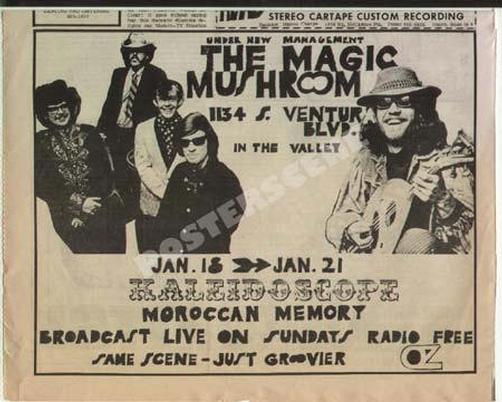

LA Free Press ad for The Magic Mushroom (111345 Ventura Boulevard), advertising Kaleidoscope performing on the weekend of January 18-21, 1968
By late 1967, Millikin was also the manager of a nightclub called The Magic Mushroom, out in Studio City, a sort of Fillmore for teenagers that was just outside of Los Angeles city limits.  The Magic Mushroom, at 11345 Ventura Boulevard, was between Sherman Oaks and Hollywood. Just to give a taste of the interconnectedness of the tiny rock scene at the time, the ontogeny of the club was that it was the former Cinnamon Cinder, a chain of teenage clubs owned by Bob Eubanks. Mohawk had run the clubs for Eubanks, insisting that bands had to play live rather than lip-sync. By the end of 1967, the Cinnamon Cinder was too uncool, so the anchor club in Studio City was transformed into the Magic Mushroom. Millikin was interviewed by the Los Angeles Times about the newly opened club on September 23, 1967. According to David Lindley, The Kaleidoscope played the Magic Mushroom regularly, as did the Hour Glass, featuring Duane and Gregg Allman.

As the Los Angeles Free Press ad above shows, Kaleidoscope, Millikin and Mohawk's band, played The Magic Mushroom on the weekend of January 18-21, 1968. Broadcasting on Sunday was "Radio Free Oz," a live comedy show on Eubanks' old station, KRLA. Radio Free Oz would evolve into the equally legendary Firesign Theater. All of these threads were in play at the same time, and Millikin was in the midst of band management with The Poor and Kaleidoscope, while running a nightclub at the same time. David Lindley said (in 2008) "Chesley was a prime mover in the whole California music thing."

Bang, Bang You're Terry Reid was Reid's 68 debut on Epic Records

1968-Epic Records London

By the end of 1968, Millikin and Frazier Mohawk were no longer managing Kaleidoscope, although the band soldiered on with an even better album (Incredible! Kaleidoscope) to even less acclaim. But Kaleidoscope had been on Epic Records, which had been conceived as a sort of specialty artistic imprint for giant Columbia Records. Columbia had decided to focus on the growing rock scene in London, so they hired Chesley Millikin to be in charge of Epic Records in London. Millikin relocated to London, leaving Kaleidoscope, The Poor and the Magic Mushroom behind.

Epic Records was a subsidiary of Columbia Records, founded in 1953 as a sort of prestige jazz and pop label. By the mid-60s, however, Epic had become the home for some more adventurous rock acts that didn't fit in with the staid entertainment professionalism of Columbia. Epic's biggest act in the US was Donovan, who was huge. We don't think of Donovan as "edgy," today, but back in 1966 he had been a long way from the Columbia mainstream. Epic was also the home of a number of "British Invasion" bands like the Dave Clark Five and The Hollies, as well as the Yardbirds. Millikin was hired to be the head of Epic in London, apparently to make them a hipper label. 

[Just to clarify some nomenclature: in the States, Columbia Records was a subsidiary of CBS, the parent company of the Columbia Broadcasting System TV and radio network. In the UK, however, the "Columbia Records" trademark was owned by EMI, so albums released on Columbia in the US were released on CBS Records in the UK. CBS Records UK was also a subsidiary of the US CBS parent. But—make a note—UK EMI-Columbia, not a CBS company, released their albums on Epic in the US.]

Sam Cutler, meanwhile, gotten into the rock and roll business, and was helping produce free concerts in Hyde Park in London. It's no surprise that Chesley and Sam would meet in the close-knit world of London rock and rollers, but we don't know how precisely that occurred. In the Summer of '68, Cutler had started working for the firm of Blackhill Enterprises, who managed Pink Floyd and promoted concerts. In the Summers of '68 and '69, Cutler had the principal duty of putting together free concerts in Hyde Park. Major acts headlined the Hyde Park shows, including the debut of Blind Faith (June 7 ‘69) and the debut of Mick Taylor with the Rolling Stones (July 5 ‘69). As a result of working with the Rolling Stones at Hyde Park, Cutler ended up as tour manager for the band’s 1969 US Tour.

Ralph Gleason's column in the SF Chronicle August 27, 1969
June 1969: Rock Scully Visits England
Grateful Dead co-manager Rock Scully's momentous visit to London in Summer '69 was described in detail in both Rock's and Sam's books. Sam Cutler had called Rock, probably bearing the imprimatur of Millikin, to propose that the Dead and the Airplane should come over to play a free concert in Hyde Park. Cutler said (as recalled by Rock, though not by anyone else):

"Wot abowt you bleedin' wankers commin' over 'ere and doin' a bit of jumpin' around wif guitars and other folly, eh darlin'?" Sam Cutler is on the line and wants to know what I think of the Grateful Dead and the Jefferson Airplane doing some free concerts in Hyde Park. They'll pick up the hotel costs and airfare and take care of the technical stuff...I am being sent as the front man, representing the Dead and the Airplane to "suss out" (in the phrase of the day) how the money would work, if it could really be done and whether it is worth doing." (p176).

Scully flies over to London in late June 1969, and gets busted by Customs for smuggling LSD. He is in the airport jail over the weekend, but fellow traveler Frankie Hart (later known as Frankie Weir) calls Cutler. Per Rock, "Sam calls Chesley Millikin" who's currently vice president of Epic Records in Britain, and on Monday Chesley gets me out." Cutler, in his book, tells the story slightly differently:

I got a call from my close friend Chesley Millikin, the former European head of Epic Records. He invited me to accompany him to Heathrow, where we were to collect an American friend he wanted me to meet. Though I was madly busy, Chesley wouldn't take no for an answer and he duly arrived in his wonderful old Bentley and we drove to the airport in magnificent style, smoking a large joint...

At the police station, we collected Chesley's friend, who turned out to be Rock Scully, one of the managers of the San Franciscan band the Grateful Dead....Rock was to swan around London and I saw very little of him, but he met up with Keith Richards, having been introduced by Chesley Millikin. It was at that meeting, at Keith's house in Cheyne Walk, that the idea of the Stones doing a free concert in California was first broached. No one seemed too enthusiastic as far as I could tell, but the idea would eventually come back to haunt the Stones [p.52]

Dennis McNally tells the story, too (p339), and his version in turn is slightly different than either Cutler's or Scully's versions. Even in my brief excerpts, you'll note that everyone's memory is fuzzy on the exact sequence of phone calls and meetings, but the essential fact was that Chesley was the link between Sam and Rock.

SF Good Times ad from September 5, 1969, where the Family Dog announces "a jam with members of 3 groups we're not allowed to name." Grateful Dead, New Riders and Jefferson Airplane played Friday, September 6, and the Dead played on the 7th as well. The 7th also featured jams with Jack Casady, Jorma Kaukonen, Jerry Garcia, Joey Covington and others.

On August 27, Ralph Gleason's column in the San Francisco Chronicle announced that the Dead and the Airplane (along with Crosby, Stills and Nash and Joni Mitchell) were going to play a free concert in Hyde Park on September 7. Needless to say, they did not, but Gleason's source was clearly an optimistic Rock Scully. In fact, the Dead and the Airplane played two stealthy weekend shows at the Family Dog on The Great Highway. Owsley had the foresight to tape the music.

The history of the Altamont concert needs no recounting here, but its one of the most infamous and influential events in 60s rock history. Without Chesley Millikin, there wasn't a link between Rock Scully and Sam Cutler, and no access to Keith Richards. That alone makes Millikin an important rock figure, and we aren't even out of the 1960s yet. 

In his excellent book (You Can't Always Get What You Want [2008: ECW Press]), Cutler describes in horrifying detail how Altamont goes bad, how he takes the blame, and how he ends up staying in San Francisco to become the tour manager of the Grateful Dead. It was Cutler who organized the Dead's chaotic finances and finds a way to tour profitably. Without Cutler, the Dead would not have recovered from the financial debacle wrought by manager Lenny Hart. Without Millikin, Cutler never meets the Dead, and the future of the band after 1969 would have been in question.

Terry Reid's second album, on EMI-Columbia in the UK released 1969. A different version of this album was released on Epic in the States as Superlungs My Supergirl

Terry Reid
Somewhere around the middle of 1969, Millikin had the responsibility of managing the career of the English guitarist and singer Terry Reid. Reid was signed to EMI-Columbia, but they were distributed by Epic Records in the States. It remains unclear whether Millikin was handling Reid on behalf of Epic, or was actually Reid's manager (you'll note that Scully and Cutler's quotes above state different things), and if so when his actual role switched. For our purposes here, it only matters that Millikin was close to Reid and actively assisted in promoting his career, whether as Record exec or manager. Cutler:

A couple of days later I was at dinner with Chesley and Jo Bergman, who managed the Stones' office. Chesley was the personal manager of Terry Reid, who although he was still very young, was in many people's opinion one of the greatest vocalists England had produced. Chesley was talking to Jo about the possibility of Terry getting a support slot on a Stones tour of America. The Stones were getting a lot of pressure from their record company to cross the pond [p52]  

Terry Reid (b 1949) was from greater Cambridge, and first became known as the guitarist for Peter Jay and The Jaywalkers, when they opened for a Rolling Stones UK Tour in 1966. He met Graham Nash, then of the Hollies, who helped get him a contract with EMI (Columbia in the UK).  Reid was an exceptional guitarist, a powerful singer and handsome as well. He had some chart success, and he came under the management of the famous hitmaking producer Mickie Most. Most (born Michael Hayes) had been a pop star in South Africa in the early 60s, which is how he acquired the stage name. By the mid-60s, he was a hugely successful pop producer, scoring big hits with Herman's Hermits, The Animals, Donovan and many others. 

Most's principal lieutenant was ex-wrestler Peter Grant, who acted as road manager for Most's bands. Most had signed the Yardbirds, and had taken Jeff Beck solo, but the Yardbirds were falling apart. Lead guitarist Jimmy Page, who played on many of Most's hits, was forming a band with bassist John Paul Jones, another veteran Most session man. Most was tired of rock groups, so Peter Grant was going to take Page's new band and manage them.

A Baltimore Sun ad for The Rolling Stones, BB King and Terry Reid at the Baltimore Civic Center, November 26, 1969

Terry Reid's eternal fame, for all his talent, stems from a Fall 1968 lunch he had with Jimmy Page, when Page offered him the job of lead singer in his new band. Reid was counting on money from touring with the Rolling Stones upcoming American tour, however, and didn't want to take a flyer on Page's new band. So--Terry Reid turned down Led Zeppelin. As a courtesy, however, Reid told Jimmy about a singer he had seen in the Midlands who kind of sounded like him. Page went to see the singer, signed up Robert Plant and his drummer John Bonham, and the rest was history. Reid was the opening on the Stones' US Tour, though. 

By 1970, Reid had toured America with both Cream (in 1968) and the Rolling Stones (in 1969) and played a bunch of rock festivals, and put out two really good albums that hadn't sold. Reid could see how rock was going, and he was ready to move towards sounding like Jeff Beck or Led Zeppelin, but his producer Mickie Most wouldn't have it. Most wanted Reid to make three-minute pop singles, and Reid refused, so Most wouldn't record him. The only way Reid could make any money was by touring, but his old band (organist Pete Solley and drummer Keith Webb) had left him. So Reid needed a new band, and only had a bass player. Lee Miles had played with Ike & Tina Turner when they, too, had opened for the 1969 Stones tour, and he had signed up with Reid. 

Meanwhile, in March, 1970, David Lindley had left Kaleidoscope, who promptly disintegrated anyway. Although Millikin was no longer Kaleidoscope's manager, he arranged to have Lindley write a letter to Reid offering his services. Lindley, along with about two dozen instruments, came over to England to tour with Terry Reid. Reid, Lindley, Lee Miles and various drummers (Bruce Rowland, Tim Davis and Alan White) toured the US and UK in 1970 and '71. 

Millikin had also facilitated the connection between Lindley and his former couch-surfer Jackson Browne. According to Lindley, back in 1968, when Millikin was still working with Kaleidoscope,  Lindley was at the CBS Record Convention in Century City with Chesley, and Lindley gave Jackson a ride home. Later, Millikin told Lindley "[Jackson]'s really good. [He] writes incredible songs." Subsequently (the exact timing is uncertain), Lindley played fiddle supporting Browne at the Troubadour, spontaneously, and later played with him in Cambridge as well. Jackson was in England recording, and Lindley was working with Terry Reid. They agreed to get together in LA if they had the chance. In 1972, they did. Chalk another one up for Chesley Millikin. 


1971: Return To The States
Whether Millikin was still working for Epic in London, Terry Reid's manager, or something else, we finally sight him again at the end of 1970. By the end of that year, the Grateful Dead were rather unexpectedly dealing with some success on FM radio, having released Workingman's Dead in June and American Beauty in November. "Truckin'" even has some hope as an AM hit single, and Rock Scully described the band's next step:

"Truckin'" is the first song we think could be a hit so we hire the best "hit men" in the business. First we hire Chesley Millikin away from Epic Records to help us make "Truckin'" a hit...and through Chesley I meet a guy who is one of the most successful record pushers and AM radio fixers in the business" (p193).

In the parlance of the time, Millikin would likely have been an "independent promoter," paid for by the Dead but neither their employee nor Warner Brothers’. In any case, this seems to have facilitated Millikin's return to the US. 

In 1971, Millikin's seemingly magical ability to know everybody you might need to know pays another huge dividend for the Grateful Dead. By 1971, the band were actually making money, with two hit albums and Sam Cutler leading a profitable touring operation. The Dead's unique approach to business and troubled managerial history made a good lawyer imperative. They hired Hal Kant, and he remained their attorney until the very end. And how did the band find out about Kant? McNally:

[Hal Kant] joined a small Beverly Hills law firm that happened to be next door to the William Morris Agency, and eventually began to add entertainment clients to his list. One day late in the 1960s, a "charming psychopath" friend of his from graduate school had brought to Hal's home another charming rogue, Chesley Millikin. Chesley was quite taken by Hal, and was a close friend of Rock Scully, so when the band sought an attorney in 1971, Hal's name came up. (p422)


Europe '72

It's not quite clear what Chesley Millikin was doing for the balance of 1971, or even what continent he lived on. Maybe he was still doing independent promotion for the Grateful Dead, or maybe something else. Yet he turns up again in Grateful Dead circles by early 1972. Sam Cutler had been working on the Dead's mammoth "Europe '72" tour starting in late 1971. As Jesse Jarnow's Deadcast series so aptly explains, Cutler had to effectively invent a network of promoters in different European countries to execute the tour. Millikin turns up in the tale by the time Europe '72 is in its final planning stages, so he may have been there all along. In any case, Millikin was Cutler's henchman in making sure that the Dead concerts in multiple countries came off on a timely basis.

A late 1973 flyer for Out of Town Tours. While it's a stretch to argue that The Band were OOT clients, The Band only played three live shows in 1973, and Cutler had booked all of them. Note that Merl Saunders' name has an incorrect spelling. The New Riders are not listed, as they had moved over to another booking agent by the end of 1973 (Ron Rainey of Magma).

1973: Out of Town Tours
Sam Cutler had always been a very active Tour Manager for the Grateful Dead. He had a hand in booking and arranging tours from the time of his arrival (February 1970), rather than merely just wrangling the crew from town to town. After the Europe '72 tour, the Grateful Dead decided to break free of ties to any record company, letting their Warner Brothers contract expire and starting their own labels. At the same time, they took their booking and travel in-house as well, starting a Travel Agency (Fly-By-Night Travel) and a booking agency. Thus the fees that would have gone outside the band's circle stayed inside, as friends, wives and girlfriends were the employees of the Travel and Booking agencies. 

Sam Cutler was the head of Out of Town Tours, but also remained the Grateful Dead's road manager. Chesley Millikin was Cutler's chief deputy, managing the office when Cutler was absorbed in Grateful Dead duties. Millikin also had principal responsibility for booking the New Riders Of The Purple Sage. Garcia had left the New Riders after Fall 1971, but Jon McIntire was still co-manager of the Riders. The New Riders were on Columbia rather than Warners, so there was an entirely different set of relationships. The New Riders followed the Cutler playbook, touring colleges and different regions in order to build an audience, and did so quite successfully. They scored a big hit with their Adventures of Panama Red album, released in October 1973. Millikin's presence allowed the New Riders to get the attention they deserved (I have discussed the New Riders 1972 and '73 touring schedule in great detail elsewhere). 

Out Of Town Tours had grand ambitions that were never met. It appears that some finance for the agency was provided by Cutler's girlfriend, Frances Carr. Frances Carr, inevitably described as a "leggy heiress," apparently came from a family made wealthy by oil, but I don't know how much access she had to the fortune. Carr had been part of what was known as "The Pleasure Crew," a loose bunch of wealthy dilettantes who could afford to simply follow the Grateful Dead around and stay high. One of the most infamous of The Pleasure Crew, "Loose Bruce" Baxter, was supposedly Carr's half-brother.

Chesley Millikin played a central role at Out of Town Tours from the very beginning. An early 1973 press release describes the original set-up (emphasis mine):

Press Release February 1973
Out of Town Tours was born during the European Tour of the Grateful Dead in 1972. The album "Europe 72" was recorded on that tour and bears our company logo on its cover.

After the tour, Sam Cutler, the Road Manager of the Dead formed Out of Town Tours to handle bookings for the band and to co-ordinate all personal appearance activities. The New Riders joined us in December, 1972 and the Sons in January of this year. Since then, the family has been re-united with Ramblin Jack, an old friend, and Terry Reid, who warbled way back in '69 on The Rolling Stones American tour.

Fine artists, with whom we enjoy a groovy relationship, are the backbone of our trip. All of the staff at Out of Town tours are folks who left the regular music business to create a more humane and meaningful trip.

A call to either myself or Chesley Millikin for the New Riders of The Purple Sage, Terry Reid & Jack Elliott will produce amazing results, and at the same time please rap to me regarding the Dead and the Sons Of Champion.

We keep our office open from 10 in the morning until 6 at night for five days a week. On the weekends we play!

Millikin had brought his old charge Terry Reid into the fold. Reid was based in Los Angeles, where he would mostly live from 1972 onwards. Ahmet Ertegun of Atlantic Records had purchased Reid's contract, freeing him from Mickie Most. Reid would release the album River in 1973, which included tracks recorded with David Lindley, even though Lindley had already begun his historic association with Jackson Browne in 1972. I'm not actually aware of any Terry Reid tour dates in 1973 (please advise in the Comments if you know of any), however. By year's end, based on the flyer above (with The Band), Terry Reid was no longer on the Out of Town Tours roster. Reid had a series of health problems that made his touring and recording intermittent, despite his undeniable talent. Millikin's loyalty to Reid, however, was a clear mark of how Chesley kept his friendships seemingly forever. 


October 1973: The Chieftains
The Chieftains had been formed in Dublin in 1962, and were the premier worldwide exponents of traditional Irish music. While The Chieftains would release their 4th album in 1973 (Chieftains 4), like all their records up to that time they were released on the Irish label Claddagh. Chieftains albums were only available as imported records in the United States. Although Millikin had not lived in Dublin for many years, thanks to his experience with Kaleidoscope and David Lindley, he would not have failed to be aware of traditional music from his homeland.

According to numerous accounts, Millikin introduced Jerry Garcia to the music of The Chieftains. The musically omnivorous Garcia loved them, of course, but in 1973 The Chieftains' albums were only available as imports, and they had never toured the States. It's a mark of Millikin's status that Garcia would listen to what Chesley suggested--you have to figure that half of Marin County was always ready to tell Jerry what album he should listen to. 

Garcia was so enthusiastic about The Chieftains, however, that he underwrote their initial US tour (which I take to mean that he guaranteed against any losses). He also arranged to have them open for Old And In The Way at The Boarding House, and interviewed some members of The Chieftains on KSAN. Garcia was a genuine San Francisco rock star, by any calculation, and for a band on their first tour his endorsement must have made a huge difference. The Chieftains music was so good, however, that once the word had spread, they went on to worldwide fame. In 2022, the Owsley Stanley Foundation released a cd set of The Chieftains's Boarding House show. 


1974-76: Grateful Dead Records
In January 1974, Sam Cutler and Out of Town Tours were pushed out of the Grateful Dead orbit. It's not really clear what happened, but there was some kind of internal power struggle involving money. Some parties seemed to feel that OOT was charging too much. Cutler was very angry at Jerry Garcia for not taking his side, and never spoke to him again. Decades later, with all surviving parties reminiscing on The Deadcast, everyone respects Cutler's professionalism, and his importance in the survival of the Grateful Dead. Cutler, for his part, doesn't overtly criticize his rivals, and only has kind words for Garcia.

With Out of Town tours removed, Rock Scully and Richard Loren took over the booking. Since the New Riders had left OOT some months earlier, thanks to new management (Joe Kerr, a college roommate of Commander Cody), that would seem to have left Chesley Millikin out in the cold. Yet the very opposite seems to have been the case, although I am hard pressed to say exactly what role Millikin played in the Dead’s operations.

From what little evidence I can find, Millikin played an important role in Grateful Dead Records, and probably its sister, Round Records. As one of the few people in the Grateful Dead organization with actual record company experience--possibly the only one--he would have been important. Since Millikin was seemingly friends with everyone and knew the players on multiple continents, it's obvious why he would have been important. But it's hard to find out what anyone did at or for Grateful Dead Records, not just Chesley.

After Sam Cutler was pushed out in January 1974, the Dead were managed by Jon McIntire. I believe Rock Scully had the dominant role in booking, but I'm not even certain of that. The members of the Dead were not happy with the situation, however. When the Dead toured Europe in 1974, albeit rather briefly, things really fell apart. In Munich in September, a temptestuous meeting led to Bill Kreutzmann forcing out McIntire, who simply quit. The rest of the band went along with Kreutzmann. McNally describes the scene, based on Millikin's recollection:

One night in Munich there was a confrontation between Lesh and Kreutzmann on the one hand and the management--McIntire, Loren and Scully--on the other, "a knock-down-drag-out," as Millikin put it. Kreutzmann was at this time part of what John Barlow called the "neo-cocaine cowboy aesthetic" that characterized one chunk of the crew, and the aesthetic had no affinity for an intellectual like McIntire. After plenty of abuse, McIntire had had enough and quit.

The next morning Chesley met Hal Kant in the hotel lobby and asked him "What are you looking so forlorn for?"
"Don't you known, didn't you hear?""No, what?" said Chesley.
"The band fired their management last night."
"No kidding. Who's management now?" Asked Chesley.
"You are," said Hal. [p476]

Chesley and Hal Kant shepherded the Dead through the three remaining European shows, and the "Last Five Nights" at Winterland.  

After October 1974, the Grateful Dead saw themselves as a recording entity with a record company, not a performing band. The individual members performed, at least some of them, but the Dead weren't a touring entity. Millikin played an important part, whatever it might have been.

The Paxton Brothers 1975 album on Anchor Records. This is Chesley Millikin's only credit on Discogs (as "Coordinator") save for an archival Stevie Ray Vaughan album

We get another sighting of Chesley Millikin in an unexpected place. A lengthy post by singer James Paxton, of the Paxton Brothers, fondly recalls Chesley and his career. The Paxton Brothers were a sort of country-rock duo, and they released a self-titled 1975 album on Anchor Records. Chesley Millikin gets a credit on the back of the album, as "Coordinator" (old buddy David Lindley also appears on the record). For the record, this is Millikin's only appearance on Discogs.com save for an archival Stevie Ray Vaughan album. 

James Paxton says that Chesley Millikin booked the Paxton Brothers during the 1974-76 period, although he assigns him to Out of Town Tours, which no longer existed. This means that Millikin's booking was kind of a "side hustle," a relatively common thing in the record industry. Grateful Dead Records wouldn't have paid much, so working on something else makes sense. Millikin may have had a role in helping to book some of the other Round Records act, too, like Keith & Donna or Robert Hunter, but that's just an assumption on my part. 

In any case, Grateful Dead Records collapsed in mid-1976, with Ron Rakow taking off with most of the money (around $225,000). McNally said "the most disappointed person in the whole mess was possibly Chesley Millikin, who had actual record company experience and who was a true believer in the Dead" (p492). So Millikin was part of Grateful Dead/Round right up until the end, having survived the peaks and valleys until the money finally ran out. From 1976 to '79, I can't find any indicator of what Chesley Millikin might have been doing or even where he lived.

The Manor Downs team, ca 1977. Sam Cutler with cowboy hat, and Frances Carr is on the far right (Watt Casey photo via Michael Corcoran)
Meanwhile, Back In Texas
Sam Cutler had been pushed out of the Grateful Dead orbit in January 1974. Out of Town Tours, needless to say, was closed for business. A year later, however, Cutler turned up outside of Austin, TX. Cutler and Frances Carr's new venture was restoring a quarter-horse track called Manor Downs, east of Austin and just outside the small town of Manor. This was a very peculiar project, in many ways decades ahead of its time and of course, fated to be fondly remembered and financially dubious. Naturally, a good time was had by everyone.

The best summary of the Manor Downs saga has been provided by journalist Michael Corcoran, part of his ongoing work at writing the history of the Austin, TX, music scene. 

Out of Town partner Frances Carr, an oil heiress from Corpus Christi, came back to Texas and bought a dormant 1960’s horse track 12 miles east of Austin called Manor Downs. She was “through with show biz,” she told the Statesman in March 1975, which is what the regulatory boards and conservative Manor neighbors wanted to hear.
Managed by her boyfriend and O.T.T. partner Sam Cutler (of Altamont notoriety) the Downs would be an equine-training facility, with quarter horse racing on weekends. It was also pitched as the new home for the Travis County Fair and Livestock Show, which Austin’s City Coliseum proved woefully inadequate to handle. The renovated Manor Downs debuted in May 1977, and just five months later, the Dead played the infield of the racetrack for the first of five shows there in the next eight years. The track’s new slogan was “Horse Racing and Rock and Roll.” ...

The setup at Manor Downs was unconventional, but Cutler as usual saw the future before others did. Manor Downs was a "quarter horse" track, where the horses raced in a quarter mile sprint, rather than the  oval typical of the Kentucky Derby-like "thoroughbred" races. Thoroughbred races, what most people are referring to when they think of "horse racing," typically range from 5/8 of a mile to 1 1/2 miles. The Kentucky Derby, for example, covers 1 1/4 mile. 

Quarter Horse racing, however, uses a much shorter track, and the races are generally 440 yards (a quarter of a mile, hence the name of the sport). The straight, 400-meter Quarter Horse track thus provides a form of Equine drag racing. Quarter Horses race much faster than Thoroughbreds, though obviously for shorter distances. Manor Downs was a quarter horse track. Cutler's idea was to re-establish the horse racing, and use the races as entertainment while presenting rock and roll concerts. Cutler had effectively hit on the Indian Casino model, several years before it became conventional around the country. The expanding rock market needed venues, but at the same time rock fans wanted something more to do at a concert site than just enter, listen and leave. The original concept, apparently, was that Manor Downs would be a horse training (and boarding) facility as well as a kind of fairgrounds, and the concerts and horse racing fit into the fairgrounds model.

One peculiar barrier for Manor Downs was that it did not have a gambling license. So patrons could watch the horses race, but couldn't gamble on them. This defies any economic logic. I can't help but think there were kindly locals willing to take a wager on any of the horses, and that perhaps these kind locals had some agreement with Manor Downs management. I have no evidence, of course, but all I can say is that if I can figure it out, the perpetually shrewd Mr Cutler was no doubt way ahead of me. Because of Texas racing rules, Manor Downs could only have horse races 44 calendar days a year. 


The first major concert at Manor Downs featured no less than the Grateful Dead, on October 12, 1977. In some ways this was historic, the Grateful Dead presented by Sam Cutler, the re-introduction of one of the most critical figures in the Dead's touring history. All was clearly not golden, however. Cutler does not mention the event at all in his book. He also pointedly says, after he was fired, that his anger was such that he never spoke to Garcia again. It's striking to think that he ran the venue the Dead played at, and somehow never actually spoke with Jerry, which tells me it was a conscious choice. 

The first Manor Downs show must have gone alright, because the band returned, but not for four more years, when Cutler had departed for Australia. Draw your own conclusions. The real connection between the Grateful Dead and Manor Downs seems to have been Frances Carr. Apparently there was a large house (or group of houses) attached to the Manor Downs site, and Carr lived there. When the Grateful Dead played the venue, they stayed there rather than a hotel, a fairly unique arrangement. 


For the purposes of this story, however, the key event seems to be that around 1979 Cutler left Manor Downs, moving to Australia. Presumably he and Carr were no longer a couple. To replace him, Carr brought in Chesley Millikin. Millikin, you will recall, not only had a great rock and roll pedigree, he was a veteran horseman as well. His experience on the Irish Jumping team must have served him well in managing a racetrack. The timing is a little uncertain--Millikin may have come on board in 1978, and Cutler may not have left until 1980, but in any case Chesley became an Austin resident. 

Millikin and Carr promoted the Grateful Dead at Manor Downs (in association with John Scher, of course) four times: July 4 '81, July 31 '82, September 13 '83 and August 31 '85. The shows are fondly remembered on the Archive, Dead.net and elsewhere. After 1985, the Grateful Dead were not only too large for Manor Downs, but basically gave up on Texas. They did not play Texas after 1988.

Manor Downs’ last really big concert was Farm Aid II, on July 4, 1986, which was also Willie Nelson's annual picnic. It was shown live on VH1, and it featured Willie, Stevie Ray Vaughan and many others. Afterwards, Frances Carr converted Manor Downs to a horse racing track with parimutuel betting, and it was a full thoroughbred track, not just quarter horses. Rock and roll was no more at Manor Downs. 

Stevie Ray Vaughan opened for Bobby & The Midnites at Manor Downs on May 31, 1982. Stevie Ray was unsigned at the time, but Chesley Millikin had made him known to Mick Jagger and the Rolling Stones

1980-93: Chesley Millikin in Austin
Millikin had moved to Austin, TX, in 1979 or '80 in order to help manage Manor Downs. Yet he had a huge impact, far beyond just the concert site. Even a casual search of Austin music during that period turns up Millikin's name in numerous places. His impeccable taste, legendary connections and universal charm made him an important man to know. The Austin music scene is worthy of a book in itself (Michael Corcoran may be writing it, I hope), so I will limit myself just to a few Millikin notes.

The most important story about Millikin in Austin was that Chesley and Frances were interested in management. Carr had capital, and Chesley had Chesley. Millikin's most famous discovery was Stevie Ray Vaughan, playing blazing blues guitar every night in crummy Austin bars. Millikin heard Vaughan at some dumps (The Steamboat and The Rome Inn) and signed him to Classic Management, his firm with Carr. Around April 1982, Mick Jagger and his wife Jerry Hall came to Manor Downs to watch the horses, and Millikin showed Mick a VHS of Vaughan playing in some club. We'd all like to show Mick a video of our favorite artist, but Millikin actually got to do it. An intrigued Jagger wanted to see Vaughan live. 

Millikin flew Stevie Ray and his band to New York to play a private showcase for the Stones, with an eye to getting them signed to Rolling Stones' Records. The tiny show was written up in New York papers, and even though Jagger passed on signing him ("blues doesn't sell"), Vaughan became a name of sorts. Millikin managed to get him on the bill at the Montreaux Jazz Festival in Summer '82. Recording contracts and success followed. Plenty of musicians and managers had already heard and recorded Stevie Ray Vaughan prior to 1982, but it took Millikin to get him in front of the Rolling Stones and on to the Montreaux Jazz Festival bill. 

By 1986, Stevie Ray Vaughan was a huge success, but he was struggling with drug and alcohol addictions. Millikin regretfully stepped away from managing Vaughan, because he did not want to get the phone call that Vaughan had destroyed himself. As it happened, Vaughan died in a helicopter crash in 1990 on the way to a performance, a sad ending way too soon.

All The Rage, Ian McLagan's tale of Small Faces, Faces and all his friends. A must read.

1990 Coda: Ian McLagan
After 1986, Chesley Millikin was no longer running Manor Downs, nor was he managing Stevie Ray Vaughan's career. Still, he was an important man in rock and roll Austin. His most prominent client was English legend Ronnie Lane, who had moved from England to Houston in '84. in the hopes of managing his multiple sclerosis. Lane, much beloved by Pete Townshend, Eric Clapton and others, had been hugely successful in the Small Faces, The Faces and as a solo artist until his MS had slowed him down. When Houston didn't pan out, Millikin persuaded him to move to Austin for the mild climate, and also managed Lane's musical career. Lane's final performance was in 1992. He moved to Colorado (funded by Rod Stewart, Ronnie Wood and Jimmy Page), and died in 1997.

Chesley Millikin wasn't managing major acts after '86, but he still knew everybody. Unlike many people in the entertainment business, all friends of Chesley Millikin always remained thus, and he could always get his phone calls returned. Ian McLagan was the keyboard player for both the Small Faces and Faces, and he had also toured with the Rolling Stones, Bob Dylan, Bonnie Raitt and too many others to count. In his must-read autobiography All The Rage (2000), McLagan mentioned that in 1990 Millikin called him with the opportunity to audition with the Grateful Dead for the chance to replace Brent Mydland. Despite Millinkin's promise of a minimum o f$250K a year, McLagan turned it down (I wrote about the auditions elsewhere), but the point for this saga was that 15 years after working with the Dead, living 2000 miles away, Millikin was still in the band's loop.


In 1993, Millikin was diagnosed with cancer and retired to Indian Wells, CA. He made it to 2001. His departure was much mourned, but not as widely as it should have been. Millikin was a crucial link for the Grateful Dead, Jackson Browne, Stevie Ray Vaughan and many others, all of which must make up for Altamont somehow.


Friday, December 17, 2021

James And The Good Brothers: Overview and Performance Listings, 1970-71 (Next Riders I)

An ad from the Oct 16, 1970 Berkeley Barb for upcoming shows at The New Orleans House. James and The Good Brothers "Courtesy Of The Grateful Dead" are booked for the weekend of October 23-24

James And The Good Brothers
James And The Good Brothers were a Canadian acoustic trio who were an extended part of the Grateful Dead family. Guitarist James Ackroyd had teamed with twin brothers Brian and Bruce Good, on guitar and autoharp, respectively. All sang, and their music was in a country-folk style, but without a pronounced Southern twang. The trio had met the Grateful Dead when they played on the infamous Festival Express cross-Canadian tour. The Dead invited them to San Francisco, and the group came down to San Francisco, where the Dead helped them get gigs.

James and The Good Brothers sang original songs, more or less in the vein of Crosby, Stills and Nash or America. They were more country than either of those bands, but since they had Canadian accents rather than Southern ones, their music had a different resonance with  American listeners. Also, since the Good Brothers used an autoharp, a rarely used instrument, their music had a different feel to it. It's no surprise that James And The Good Brothers were signed to Columbia, since major label record companies were snapping up any band in the CSN vein. 

According to Bruce and Brian Good, in a 2015 interview, they went into one of the "music cars" on the Festival Express train, and wound up picking with Garcia. They played bluegrass with him, and Garcia took a liking to them. Per Bruce, at the end of the train tour, the Dead would invite them to San Francisco record an album at their studio. Now, the story is a little more complicated than that, but for a broad brush 40-some years later, it was an accurate description.

James And The Good Brothers would record at Wally Heider's with Grateful Dead engineer Betty Cantor. Jerry Garcia and Bill Kreutzmann likely played on the initial sessions, although their tracks were not used on the final album. Ultimately, parts of the album seems to have been re-recorded in Toronto. Columbia would release the James And The Good Brothers album in November, 1971.

By March, 1971, however, the band had opened a weekend for the New Riders Of The Purple Sage at Fillmore West (on February 25-28). When they had played there, Jerry Garcia (pedal steel guitar), Jack Casady ("balalaika" bass) and Spencer Dryden (drums) had joined the trio. Now, Garcia and Dryden were playing with the New Riders that night anyway, but the fact that a trio of heavyweights joined them got the band mentioned in a review. It also made their status as Grateful Dead "family members" apparent. 

Ultimately, James Ackroyd would stay in California, and the Good Brothers would return to Canada, where they had a successful musical career along with their banjo-playing younger brother Larry.


Rock Music Economics ca. 1970: New and Next Riders

In early 1970, the Grateful Dead had been in dire economic straights. In March, 1970, they had fired their manager Lenny Hart because he had absconded with $150,000 of the band's money, an enormous sum at the time. Their previous studio album had run way, way over budget, so they weren't getting royalties from that. The recently-released Live/Dead was promising, but it wasn't going to be any kind of conventional hit. All of the band members were functionally broke. Throughout 1970, under the guidance of road manager Sam Cutler, the Grateful Dead played there way back into solvency. Along the way, they had put out an album that was cheaply recorded and widely played on FM stations across the country. The album in turn increased concert receipts, so the Dead were finally doing pretty well. By the end of the year, band members had bought cars, and they had stopped living in overcrowded communal quarters.

The Grateful Dead and Jerry Garcia did things in their own manner, but they always had an entrepreneurial streak. Unhappy with Bill Graham and Chet Helms, they had taken over the Carousel Ballroom in 1968. Though it had failed, they had nearly merged with Helms and his Family Dog in early 1970, until Helms had demurred at the idea of being in business with Lenny Hart. The Dead had also been instrumental in the formation of Alembic Engineering, creating a business where Ron Wickersham, Owsley Stanley, Bob Matthews and others could focus on high quality sound gear for live performance. Various other schemes had gotten floated over the years (google "Deadpatch"), even if they hadn't gotten off the ground. So Garcia and the Dead always had big schemes, even if they didn't go the way that they planned.

One of Jerry Garcia's unconventional enterprises was appearing as a sideman in a group completely separate from his main band. Garcia had been playing pedal steel guitar for the New Riders of The Purple Sage since Summer 1969. It was rare enough for rock stars to play outside their own group for more than a single recording session, but Garcia had a whole different band. The only real comparison was Jorma Kaukonen and Jack Casady in Hot Tuna, but Jorma and Jack led that band. Garcia actually played a different instrument in the Riders and let John Dawson be the frontman. 

Still, Garcia's unorthodoxy had gotten the New Riders noticed. The Riders opened for Dead shows and played around the Bay Area, to the extent Garcia was available. By the Summer, Garcia knew that in order for the New Riders to thrive, they would need their full-time pedal steel guitarist, and he had spotted Buddy Cage. Cage was on the Festival Express tour playing with Ian and Sylvia Tyson's band Great Speckled Bird. Some sort of invitation resulted from the train trip, and Cage would join the New Riders in November of 1971, after relocating to the Bay Area. 

I don't think Garcia reflected much on what he was doing, but I am confident that he was conscious of what he was trying to do. Unlikely as Garcia's efforts with the New Riders were in the world of hippie rock, they were pretty common in the worlds of jazz or country music. Plenty of jazz musicians would play around New York outside of their usual combos, bringing attention to lesser known musicians. Similarly, most jazz fans had bought a jazz album by someone they hadn't heard of just because another, more famous musician was on the record. 

Generally, when a Nashville star toured, they usually brought along an ensemble of other singers and players, helping to build those careers. Porter Wagoner, a huge country star since the 1950s, had a singer in 1965-66 named Jeannie Seely, who was part of his show and duetted with him. No one really remembers her. But we all remember Dolly Parton, who replaced Seely in the Wagoner show (on TV and on tour) from 1966-74. So when the New Riders played on a Dead show, with Garcia in the band, there was an existing business model.

Other wings of the fledgling Grateful Dead enterprise were benefiting from the New Riders. Sam Cutler was organizing tours and booking shows, Jon McIntire was working with the record companies and Alembic was providing sound gear. With another band "in development," all these enterprises had a chance to benefit. In turn, those enterprises gave the New Riders access to people and equipment they would not have had without the Dead connection. So when Garcia invited James and The Good Brothers to come to San Francisco to help them make a record, he wasn't just being friendly--it was part of a plan.

Although only partly articulated, the pillars of the early 1970s Grateful Dead empire was built on three legs:

Generosity: at his core, Garcia was a generous man when it came to music and musicians. He didn't need much--a guitar, an amp, something to smoke, and a gig--and he was going to share what else he had. Garcia also implicitly realized that his status could help other musicians without any harm to his own future, so why not be generous? Garcia's attitude defined the entire Grateful Dead enterprise: if your own needs are met, look out for someone else.

Community: some parts of the Grateful Dead team were specifically interested in building community. Jon McIntire was an important voice here. Blair Jackson and David Gans quote him as saying his principal interest was in building community, not business (This Is All A Dream We Dreamed, p.214). The Grateful Dead grasped early that their own audience could be self-sustaining, if they were treated properly. In general, the Dead were interested in creating a tiny ecosystem where goods and services were largely supplied by an interlocking group of people. This could keep a lot of friends and family employed, without those people having to be musicians or have other rare skills. Old friends and band girlfriends could look after the warehouse or answer phones or any number of other roles, and they did.

Transactional: in order to function safely in the Capitalist world, the Grateful Dead had to thrive in it. Garcia, nor Cutler, nor McIntire, had no problem with any of this, beyond not wanting to wear a suit and tie. The businesses created by the Grateful Dead--, booking, tour management, recording studios, live sound equipment--still needed additional customers beyond the Dead. At the same time, the clients of these enterprises (Out Of Town Tours, Alembic, etc) benefited from the expertise of the likes of Sam Cutler, Jon McIntire or Ron Wickersham. 

So when Garcia invited James And The Good Brothers to come to San Francisco, it went beyond a musician helping some guys he liked who were a bit lower on the ladder than he was. Garcia was providing fuel for the Grateful Dead economy to thrive, and James And The Good Brothers were going to benefit. I'm not imagining this--Garcia would do exactly the same thing a few months later when he invited David Grisman, Richard Loren and the Rowan Brothers to relocate from Manhattan to Stinson Beach. On a larger scale, these pillars were the thinking behind Round Records. Garcia didn't have to risk his capital on albums by bluegrass bands, Robert Hunter or electronic composers, but he did. 

So the invitation for James And The Good Brothers wasn't just a generous suggestion by Jerry Garcia, but a test run of Garcia's new recognition that the success and fame of the Grateful Dead could be a magnet for the success of others. Thus, reviewing the performance history of James And The Good Brothers in the Bay Area isn't just archival, but a roadmap for Garcia to replicate his contribution to the New Riders on to another band, a Next Riders. It was only partially successful, but it was no less informative for that.

James and The Good Brothers: Canada 1970
Brian and Bruce Good were from Richmond Hill, Ontario, part of greater Toronto. They had formed a country-folk quartet called the Kinfolk with Marty Steiger and Margaret McQueen, playing traditonal country with a distinct Canadian flavor. They played the coffeehouses in Toronto and fairs in Ontario. By early 1970, two members of the Kinfolk had left (well, McQueen married Bruce, but she did leave the band). The Good Brothers would meet guitarist James Ackroyd by chance in a Yorkville (Toronto) coffee shop called The Penny Farthing around February of 1970. Ackroyd, from Winnipeg, had been the lead guitarist in groups such as Barry Ennis and The Keymen and The Knack. The trio re-named themselves James And The Good Brothers. After playing around Ontario, the trio was then invited on the Canadian Express Train Tour with the Grateful Dead, Janis Joplin and others

April 3, 1970 Maple Leaf Gardens, Toronto, ON Grand Funk Railroad/James and The Good Brothers
The band's initial performance was, apparently, opening for Grand Funk Railroad at the Maple Leaf Gardens. Presumably they also played other shows around Ontario. James And The Good Brothers had been advertised as part of the Festival Express Tour as early as May 4 (from a wire service article in the Los Angeles Times).


June 27-28, 1970 Canadian National Exhibition, Toronto, ON
Festival Express Tour
It's unclear if James And The Good Brothers played one day at the stadium or on both.
June 28, 1970 Coronation Park, Toronto, ON (Sunday) Free Concert
The Grateful Dead agreed to play a free concert in a Toronto park on Sunday afternoon, between the paid shows, in order to assuage the feelings of hippies who thought music should be free. The Dead and The New Riders played, but it's unclear who else performed. Since James And The Good Brothers were an acoustic trio, it may have been easier for them to play the free show in the park.
 
After the Toronto show, the musicians boarded the infamous train, and the trio met Garcia during a bluegrass jam. Apparently the actual invitation to come to San Francisco was extended by Gail Hellund, who was sort of an operations manager (I'm not sure of her official title). Some evidence suggests that Hellund acted as the manager of James And The Good Brothers along with any Dead or New Riders duties. This would fit in with the model of cooperation and expansion outlined above. Gail Hellund's time and skills could be usefully distributed to another enterprise.
 
July 1, 1970 Winnipeg Fairgrounds, Winnipeg, MB (Wed) Festival Express Tour
 
July 4-5, 1970 McMahon Stadium, Calgary, AB (Saturday-Sunday) Festival Express Tour
By the end of the train trip, Ackroyd and the Good Brothers had been invited to San Francisco. Presumably the band played other gigs around Toronto until their Fall arrival in the Bay Area.

James And The Good Brothers in San Francisco, Performance Listing 1970-71
October 15, 1970 The Matrix, San Francisco, CA: James and The Good Brothers (Thursday) "Courtesy of The Grateful Dead"
The first booking we can find for James And The Good Brothers is on Thursday, October 15 at the Matrix. The tiny Matrix, capacity at most 150, while it had been the original San Francisco hippie club, had been bumped aside by larger clubs. By 1970, as I have documented, the Matrix was mainly a musicians' hangout. The most prominent of the musicians who regularly played there was Jerry Garcia, who used weeknights there for jamming explorations with Bill Vitt, John Kahn, Howard Wales and (by October) Merl Saunders. 
 
Garcia's stature at the Matrix was such that a request by the Grateful Dead office to book an unknown out-of-town band would be accepted on its face. At the same time, it's worth noting that the Matrix wasn't booking premier club acts in any case. The most intriguing thing about the notation in the San Francisco Chronicle Datebook listings was that James And The Good Brothers are noted as "Courtesy Of The Grateful Dead." On one hand, this was unprecedented. On the other hand, the sort of tuned-in hippie who went to the Matrix would have heard of the New Riders, so they could probably guess a little about what was going on.
 
The Inn Of The Beginning, at 8201 Old Redwood Highway in Cotati, CA, as it appeared in 2010

October 16-17, 1970 Inn Of The Beginning, Cotati, CA: Cat Mother/James and The Good Brothers
(Friday-Saturday)
The Inn Of The Beginning, at 8201 Old Redwood Highway in Cotati wasn't large, but it was still larger than the Matrix. The capacity of the club was about 200, and it was a regular gig for Bay Area bands. The New Riders of The Purple Sage had played there regularly since 1969. So a phone call from the Dead office would surely have gotten James And The Good Brothers booked. In this case, they were opening for Cat Mother. 
 
Cat Mother And The All Night News Boys were a Greenwich Village folk-rock band who had been making their second album (Albion Doo-Wah) at Pacific High Recorders, and had simply decided to stay in the Bay Area. Pacific High Recorders was at 60 Brady Street, right behind the Fillmore West, and would be sold to Alembic in 1971, although they would continue to use the name Pacific High Recorders on occasion.
 
October 23-24, 1970 New Orleans House, Berkeley, CA: Redwing/James and The Good Brothers (Friday-Saturday) "Courtesy of the Grateful Dead"
The New Orleans House, at 1505 San Pablo Avenue in North Berkeley, had been one of the first clubs in the Bay Area to book original rock bands, back in 1966. It had a capacity of around 250, but it wasn't in a central, accessible part of Berkeley, so it was feeling the pressure of the growing competition. The New Orleans House ad in the San Francisco Good Times says JATGB are "Courtesy  Of The Grateful Dead."
 
Redwing was a Sacramento group that had evolved out of a popular 60s band called The New Breed. The best known member was bassist Tim Schmidt, who by 1970 had joined Poco (and would later join The Eagles). Redwing had made an album in 1970 for United Artists, and some of their material had also been released under the band-name Glad.
 
October 26, 1970 Lion's Share, San Anselmo, CA: Janis Joplin's Wake (Monday)
Janis Joplin had died the night of October 5, 1970. As part of her will, she had a gigantic party thrown for her at the Lion's Share in San Anselmo. The Lion's Share was another musician's hangout, and about 10 minutes from downtown San Rafael. The Grateful Dead flew back from the East Coast to perform. In the 2015 interview, Bruce Good mentioned how honored they were to be invited. They had become friendly with Janis on the Festival Express train.

Every hippie in the Bay Area would have wanted an invite to Janis' wake, but James And The Good Brothers actually went. The fact that they got invited was a clear, if sad, indicator that they were part of the extended Grateful Dead family. I don't know if the band actually played, but it's entirely plausible they got up and sang a few songs (and plausible that no one, including the band, remembers for sure).

October 27-November 1, 1970 Troubadour James and The Good Brothers/Alliotta Haynes (Tuesday-Sunday)
Doug Weston's Troubadour in West Hollywood was one of the most important rock nightclubs in the 1970s. The club was essential to launching the careers of numerous iconic singer-songwriters in that era. Among the most prominent were James Taylor, Elton John, Cat Stevens and Kris Kristofferson--and that was just 1970. Yet it is all but entirely forgotten that in August, 1970 Weston opened a San Francisco branch of The Troubadour. Elton John even played there.
 

I have found no dates for James And The Good Brothers in November. Both Brian and Bruce Good had family in Canada, so it's possible that they took a trip back home.

Update: David Kramer-Smyth confirmed this. An article in the November 20, 1970 Ottawa Journal mentions an upcoming show at Le Hibou Cafe in Ottawa. It also mentions that the group had just played the Crypt and The Riverboat in Toronto.
 
The Lion's Share, at 60 Red Hill Avenue in San Anselmo, sometime in the early 1970s

December 4-5, 1970 Lion's Share, San Anselmo, CA: James and The Good Brothers /The Pipe
(Friday-Saturday)
Since the Lion's Share was a musician's hangout, James And The Good Brothers were probably known around town by this time. The Lion's Share sometimes booked prominent bands, but there were plenty of weekends where local acts headlined the club.
 
December 11-12, 1970 Inn Of The Beginning, Cotati, CA: James and The Good Brothers/Pamela (Friday-Saturday)
James And The Good Brothers returned to headline a weekend at the Inn Of The Beginning. They must have been good enough in October for the Inn to give them a chance to co-headline a weekend. Sonoma State College was probably out of session, so it would have been a less high-profile night, but coming back to a club two months later as a weekend headliner was still a healthy sign for the trio.
 
Co-headliner Pamela was almost certainly Pamela Polland. Polland was a singer-songwriter who had moved to Mill Valley after she had been signed to a solo contract by Columbia. Previously, she had been in a Los Angeles duo called Gentle Soul, who had released an album back in 1968. Polland's story is quite interesting (some readers may recognize her subsequent persona "Melba Rounds"), but it's mostly a sidelight to James And The Good Brothers.

 
In one post Sward described what faced local singers who weren't in a loud rock band:
Gigs in Bay Area coffeehouses were easy to get, but they didn’t make a lot of money for anyone, including the performers. They were able to get a few gigs in clubs at 8 or 8:30 p.m., prior to when many rock bands began setting up for a 9:30 show. I told club owners that my band would help warm up the audience, didn’t need a big stage setup (no drums, no big amps, no stage monitors) and would make them enough extra bucks selling drinks to pay us.

However rock fans and acoustic music fans didn’t always mix well. More often than not the audience would start getting impatient around 9:15. “We want Jerry (Garcia); we want Elvin (Bishop) and so on.”

I attended a lot of Lamb gigs and saw such other Bay Area acoustic performers as Lambert & Nuttycombe, Jeffrey Cain and Uncle Vinty. They were all bucking up against rock ‘n roll. The audiences for rock bands were larger; and that meant more money for the club owners.
Sward went on to find unique bookings for her acts, and helped them record as well. Still, her reflections point up an historically unnoticed barrier for James And The Good Brothers. In the 60s and 70s, San Francisco was renowned for breaking new and interesting bands: Jefferson Airplane, The Dead, Big Brother, Sly and The Family Stone, Santana, Tower Of Power and the Doobie Brothers, to name the most prominent. While those groups were not confined to a single genre, they were all loud, danceable bands that could rock the Fillmore and Winterland. 

Starting with the August 1969 release of the Crosby, Stills and Nash album, listeners, radio and record companies expanded their tastes to include rock musicians who, while writing original songs, were quieter. The new breed of singer/songwriters emphasized sincerity, acoustic guitars and sophisticated harmonies. James And The Good Brothers fit right into the vein that would lead groups like America and Seals And Crofts to huge success. A parallel success story at the time was The Band, whose first two albums sold well and got perhaps the best reviews any rock bands ever received. James And The Good Brothers were Canadian, too, so in acoustic way they evoked The Band's countrified harmonies.
 
Musicians from all over America had been coming to San Francisco to make it since the mid-60s, and James And The Good Brothers had relocated along with man others. It turned out, however, that for all its openness, early 70s San Francisco was a terrible place to break acoustic acts. Singer/songwriters who played the Troubadour in West Hollywood did great, but acoustic trios didn't make it out of San Francisco. Diane Sward, for one, had figured this out and was trying to crack the egg, but in the end San Francisco wasn't a good place for acoustic bands. But James And The Good Brothers, nor the Dead's management, would not find that out until later.
 
December 18, 1970 Burbank Auditorium, Santa Rosa Junior College, Santa Rosa, CA: James and The Good Brothers/Victoria/Tim and Jan (Friday)
The Junior College system in California was an outgrowth of both the GI Bill and the massive migration to California during and after World War 2. With numerous ex-GIs able to afford college, and a big population, California had to expand its college options. Not only did the University of California expand, and the State College system, too, but just about every county had a 2-year junior college with open admissions. Residents over 18 could go to college locally, effectively for free, and if they succeeded they could transfer to the State College or UC Systems.
 
In the case of Santa Rosa Junior College, it had existed since 1918, but had fully integrated into the State Junior College system by 1969. It was located downtown at 1501 Mendocino Road. Santa Rosa is in Sonoma County, 50 miles North of San Francisco.
 
A breathless article in the December 17, 1970 Oak Leaf, the Santa Rosa Junior College student newspaper, gives the band the full push (article courtesy of JGMF-transcribed as published)
The Christmas seasons festivities will begin tomorrow in Burbank Auditorium at 4.p.m when the student body of this campus will have the opportunity to hear three farout Canadians who call themselves JAMES AND THE GOOD BROTHERS.

Their manager, Gail, met them on the Festival Express while on a tour of Canada last summer, with the Grateful Dead and persuaded them to give California a go.

The first performance of James and The Good Brothers was two months ago at the Inn Of The Beginning. The audience response was so enthusiastically overwhelming that they are currently in the process of recording their first album.

According to one of the college sponsors of the group, the Grateful Dead, Eric Anderson, Gordon Lightfoot and countless others, who have heard James and the Good Brothers really freak out when they hear them.
The article goes on to say that the show's ticket sales will not even cover the costs, a sign that the school was dipping into its entertainment budget for this. In the early 70s, even Junior Colleges had entertainment budgets, and local bands could be the beneficiaries. It's likely that the fact that all three acts were acoustic, rather than full-out rock and roll, made them more palatable to the college. Tickets for the show were available at the Inn Of The Beginning, so it suggests that the Inn helped Gail Hellund book the band. Now, while I find it pretty likely that Gordon Lightfoot liked James and The Good Brothers, I doubt he would "really freak out" when he heard them. One can't help but suspect that a Mr. Rock Scully was helping to explain things to an eager cub reporter.
 
Although some comments in the article need to be taken with a grain of salt, note that there is already talk of a James And The Good Brothers album. At this exact moment, artists like James Taylor and Cat Stevens were hitting it big, so record companies would have been very interested in their sound. At the same time, the Grateful Dead had just released American Beauty, and with two hit albums in a row, their sponsorship of the band would mean a lot more to a record company.

Opening act "Victoria" (Victoria Domagalski) was a singer-songwriter, also part of the Bill Graham stable. Her debut album, Secret Of The Bloom, had been released on Graham's San Francisco Records label (distributed by Atlantic) in 1970. Victoria was a solo singer/songwriter, and one of the acts often booked by Diane Sward as part of her acoustic packages.
 
December 31, 1970 Winterland, San Francisco, CA: Grateful Dead/Hot Tuna/New Riders of The Purple Sage/James and The Good Brothers (Thursday)
The Grateful Dead headlined at Winterland on New Year's Eve, along with Hot Tuna and the New Riders. At this time, Bill Graham had lost the lease on Winterland, and New Year's Eve was handled by promoter Paul Barrata.  In a subsequent interview in the Harvard Independent (from March 11, 1971), manager Jon McIntire mentioned that James And The Good Brothers played the show. The trio was not on any of the ads, nor appeared in any broadcasts, nor mentioned in any review. Still, it's important to remember that an acoustic trio without a lot of equipment could be fit in during a set change, and a New Year's Eve show was a chance for big exposure. The promoter would have happily accepted James And The Good Brothers upon the Dead's request.

January 21, 1971 Freeborn Hall, UC Davis, Davis, CA: Grateful Dead/New Riders of The Purple Sage/James and The Good Brothers (Thursday)
The Grateful Dead played on a Thursday night at UC Davis, just outside of Sacramento. They were joined by both the New Riders and James and The Good Brothers. While the Dead no longer did the acoustic set and the full "An Evening With The Grateful Dead," they were providing four sets with an acoustic opener.

January 27-28, 1971 Keystone Korner, San Francisco, CA: Big Brother and The Holding Company w/Nick Gravenites/James and The Good Brothers/Gideon and Power (Wednesday-Thursday)
Big Brother and The Holding Company had disintegrated at the end of 1968 when Janis Joplin left the band. Still, the band had reformed at the end of 1969, with the four original (pre-Janis) members and guitarist David Schallock (although James Gurley and Peter Albin had switched to bass and guitar, respectively). They had released a good, but unnoticed album on Columbia in 1970 called Be A Brother. Nick Gravenites was their producer and sometimes sang with them. They were still a name around the Bay Area, but no longer a major act.
 
Keystone Korner was mainly a blues club, although the actual bookings ranged from white rock bands to soul to Chicago blues. Still, just about all the acts were loud and bluesy, and in that respect, James And The Good Brothers may have been a little out of place.
 
Gideon and Power was a sort of Gospel-Rock band featuring singer Gideon Daniels. He would release one album in 1972, and Gideon and Power became a sort of farm team for the Elvin Bishop Group. In later years, Gideon and Power would include backup vocalist Mickey Thomas and organist Melvin Seals, both of whom would join Elvin Bishop sometime later (and then Jefferson Starship and Jerry Garcia Band, respectively).
 
January 29-30, 1971 Inn Of The Beginning, Cotati, CA: Lamb/James and The Good Brothers (Friday-Saturday)
Lamb had initially been a songwriting duo featuring singer and pianist Barbara Lamb and guitarist Bob Swanson. They were another act managed by Diane Sward, and this booking fit her idea of pairing acoustic acts in nightclubs. I think Lamb had a bass player and a drummer by this time, but I'm not sure of that.
 
I think by this time James And The Good Brothers had been signed to Columbia and started recording. The absence of any shows in the next month, plus some other clues, suggest that the band recorded throughout the month of February. Their Columbia album would be released in November, 1971. The producer was long-time Grateful Dead engineer Betty Cantor. She shared the engineering duties with Bob Matthews, so the Dead had assigned the A-Team that had delivered Live/Dead and Workingman's Dead. Initial recording took place at Pacific High Recorders, at 60 Brady Street behind the Fillmore West. Later, the studio would be purchased by Alembic and used primarily for mixing. 
 
In late 1970, Columbia Records had signed the New Riders Of The Purple Sage. Columbia boss Clive Davis was high on Garcia (to coin a phrase). He had apparently tried to sign the Grateful Dead when their contract had come up in 1969, but Lenny Hart had extended the Warner Brothers deal for a few more albums. Davis was playing a long game, though. In his cosmology, the key to the Grateful Dead was Garcia--he wasn't wrong--so Davis took numerous steps to show Garcia favor. Not only did Davis sign the New Riders, a Columbia imprint (Douglas Records) had also signed Howard Wales to do an album. Columbia had also helped finance Mickey Hart's studio, according to Billboard. 

On one hand, we can see Columbia's signing of James And The Good Brothers as a continuation of Clive Davis' ongoing efforts to make Garcia feel wanted when the Dead's contract renewal came up. Although the Dead surprised everybody by going it alone in '72, when Grateful Dead Records crumpled a few years later, Clive Davis--by now running Arista Records--finally got his opportunity. It took a while, but eventually the Grateful Dead had a massive hit with In The Dark, and sold a lot of other albums in between. So whether or not Garcia specifically recommended James And The Good Brothers to Clive Davis, we know that Davis had a vested interest in making Garcia see him favorably. 

In 1970 and '71, Clive Davis signed the New Riders, James And The Good Brothers and the Rowan Brothers, all San Francisco bands with intimate ties to Jerry Garcia. In 1976 he got his man. Yet, to give Davis credit, he was also a pretty good record man. For one thing, the first four New Riders albums were pretty successful (NRPS, Powerglide, Gypsy Cowboy and Panama Red). Certainly Columbia turned a profit on those albums. So whatever Davis' motives for signing the Riders, it turned out pretty well financially for Columbia. 

As for James And The Good Brothers, they were not really a success and broke up in 1972, as we will see. Afterwards, however, Brian and Bruce Good returned to Canada and teamed up with their younger  brother Larry, and had a pretty successful career in Canada. So when Clive Davis had signed them in late 1970, he must have heard the talent and appeal. In that sense, Davis' signing of the band was retroactively justified by the Good Brothers' ultimate Canadian success. So while Garcia's "sponsorship" was essential for getting James And The Good Brothers' signing to Columbia, their own talent ultimately proved that the commercial sense of that investment, even if Columbia itself didn't benefit.
 
As for the album itself, I am pretty sure that Columbia was not pleased with the finished product, and took James And The Good Brothers to Toronto to re-record some different songs, without Bob and Betty. Contractually, Betty Cantor's name had to be on the album, but the record company seems to have overruled her mixes. Some cryptical details suggest that Jerry Garcia probably played on the initial sessions, but I suspect that any tracks that he played on were re-recorded in Toronto.
 
February 5-6, 1971 New Orleans House, Berkeley, CA: James and The Good Brothers/Abel (Friday-Saturday)  

A picture and listing from the Santa Rosa Press-Democrat of February 15, 1971 for the Saturday night (February 20) show at the Veterans Memorial

February 20, 1971 Veterans Memorial Building, Santa Rosa, CA: Bronze Hog/Cat Mother and The All-Night Newsboys/James and The Good Brothers/Abraxas Rising (Saturday)
Ace researcher David Kramer-Smyth found this date. All of these bands were local. Bronze Hog were effectively the "house band" at Inn Of The Beginning.


February 25-28, 1971 Fillmore West, San Francisco, CA: New Riders of The Purple Sage/Boz Scaggs/James and The Good Brothers
(Thursday-Sunday)
By early 1971, the Fillmore West was as legendary as ever, but it was starting to become too small for the booming rock market. Fillmore West's 2500-capacity had been 60% larger than the original Fillmore, but Winterland was over twice as big as the Fillmore West. Bigger bands didn't headline the Fillmore West as often as they had. They would still play for Bill Graham, but at bigger local venues.

At this time, the New Riders of The Purple Sage did not have an album. Save for some brief radio broadcasts, and a few demos on KSAN, the only people who had heard the New Riders had seen them in concert. Of course, Jerry Garcia was still their pedal steel guitar player. Boz Scaggs had released a fine debut on Atlantic in 1969, and he had a new release (Moments, on Columbia) coming out in March. So Boz was known, but he wasn't yet a major artist either. Thus the 4-day weekend at the Fillmore West was not anchored by acts that were currently big hits, either on FM radio or on tour.

One of these Fillmore West shows was written up in the suburban Hayward Daily Review by "KG", the team of Kathie Staska and George Mangum. The duo probably saw the Saturday (February 27) show. The most remarkable detail of the review was that James And The Good Brothers were joined by Jack Casady on "balalaika bass," Spencer Dryden on drums and Jerry Garcia on banjo. For one thing, the rhythm section would have helped the band go over in a rock hall like Fillmore West. 

For another, Garcia's presence means that he knew the songs, so he must have been around for the recording of the album, or at least some of it. This public performance is the key reason that I think Garcia played on the album sessions. He is thanked on the album, but not listed in the credits. On the other hand, the tracks with Toronto musicians include a banjo player (younger brother Larry Good), which is why I think the tracks with Garcia were re-recorded. The album would not come out for another 8 months, so Clive Davis must have been unhappy with the results. I should add that in such circumstances, record company complaints were generally oriented toward the actual sound of the recording--particularly focused on how it would sound on the radio--rather than the musical quality itself. To a record guy, if the sound wasn't right, it wouldn't matter how Garcia or anyone else played on the tracks. 

There's every reason to assume that Garcia played with James And The Good Brothers all four nights at Fillmore West. Thus Garcia was following the model of the New Riders, playing with them to let them benefit from the glow of his status. Garcia would do the same a few months later with the Rowan Brothers, playing a few local gigs and then joining them for their Fillmore West show when they opened for the Grateful Dead. The Rowan Brothers had also been signed to Columbia by Clive Davis. Was it a coincidence that Garcia played a similar role for all three Columbia bands? I doubt it.

March 7, 1971 Burl Theater, Boulder Creek, CA: Commander Cody and The Lost Planet Airmen/James and The Good Brothers (Sunday) 2pm show
By 1971 Commander Cody and His Lost Planet Airmen were a popular local band, and had probably already been signed to Paramount Records. But they had not yet recorded their debut album (it would be released in November '71), so the Airmen weren't that well known outside of the East Bay. Cody and his crew had already played with the Dead and New Riders many times, however, so linking up with James And The Good Brothers was pretty logical.

Boulder Creek is on Highway 9 in the Santa Cruz Mountains, 13 winding miles from downtown Santa Cruz, about halfway to Saratoga. I don't know anything about the Burl Theater, but since Boulder Creek is in a forest of Redwood trees, it's easy to guess. At the time, the area was full of hippies, loners, bikers, pot growers and other peculiar characters. Many of the residents would have fit more than one of these categories. The show was booked for 2pm, leaving plenty of time for the band to get to Berkeley for their show later that evening.

March 7, 1971 Mandrake's, Berkeley, CA: James and The Good Brothers/Lizard (Sunday)
Mandrake's, at 1048 University Avenue in Berkeley, was near the corner of University and San Pablo Avenue, nearly two miles from campus. During World War 2, with the Oakland and Richmond shipyards booming, tired workers with money in their pockets needed to relax. San Pablo Avenue was known as "Music Row," with clubs from one end to another. Mandrake's was a remaining legacy. The 200-seat room had opened in 1965, initially a pool hall that sometimes booked music. It focused on blues and jazz, initially, but rapidly expanded to include rock. The little club served beer, wine and food, and was a good place for bands to build an audience.

March 10-11, 1971 Mandrake's, Berkeley, CA: Cat Mother/James and The Good Brothers (Wednesday-Thursday)
March 12-13, 1971 New Orleans House, Berkeley, CA: Cat Mother/James and The Good Brothers (Friday-Saturday)
Cat Mother, a much more established band, played four nights in Berkeley, supported by James And The Good Brothers. The two clubs were about a half mile apart, both on San Pablo Avenue.
 
The Boarding House, at 960 Bush St in San Francisco

March 26-28, 1971 Boarding House, San Francisco, CA: James and The Good Brothers/Melissa
(Friday-Sunday)
James And The Good Brothers had been the last group to headline at Doug Weston's ill-fated San Francisco Troubadour, back in October. It must have gone well, since when the club opened up four months later as The Boarding House, they were the first group to headline the new club. Weston's house manager, David Allen, had re-opened the room as an "acoustic music salon," in his words. Over the next year, the Boarding House became a nexus for local acoustic acts who didn't really fit at noisy rock clubs. 

The Boarding House was at 960 Bush Street (at Taylor), and I have written about its opening at some length. The Boarding House was an important club for the San Francisco music scene throughout the 1970s. In this initial version, however, the club was in the same space as The Troubadour, a downstairs dining room with long tables and a stage at one end, seating about 225. Most Bay Area rock fans from the era recall something different. That is because somewhere around 1972, Allen moved the club upstairs into what was initially called "The Boarding House Theater." The Theater was an elegant bowl-shaped room, with great sightlines and good sound. It had the same address, though, so the shows that we all recall are from the upstairs room, not the downstairs one. The downstairs room was still occasionally used for comedy during the later era.
 
April 2, 1971 Inn Of The Beginning, Cotati, CA: James and The Good Brothers/Loose Gravel (Friday)
April 3, 1971 Inn Of The Beginning, Cotati, CA: James and The Good Brothers/Clover (Saturday)
James And The Good Brothers returned to the Inn Of The Beginning. On Friday night, they were paired with Loose Gravel, a band led by former Charlatans guitarist Michael Wilhelm. On Saturday night, it was the Marin band Clover. At the time, Clover was a quartet led by guitarists John McFee and Alex Call. They would release two albums on Fantasy (their 1970 self-titled debut and 1971's Fourty Niner) before they were dropped.

April 6-11, 1971 The Boarding House, San Francisco, CA: James And The Good Brothers/Jo Ellen Yester (Tuesday-Sunday)
Things must have gone well in March, because James And The Good Brothers returned for another week. 

April 29, 1971 Ives Hall, Sonoma State College, Rohnert Park, CA: Rick Taylor/CiCi/James and The Good Brothers/Lamb Peace Week Folk Festival (Thursday)
David Kramer-Smyth found a link to the Peace Week event.
 

May 29-30, 1971 Winterland, San Francisco, CA: Grateful Dead/New Riders of The Purple Sage/RJ Fox/James and The Good Brothers
(Saturday-Sunday)
Bill Graham had recaptured the rights to Winterland, and he had booked the Dead to headline two shows on Friday and Saturday, May 28-29. Support acts were the New Riders Of The Purple Sage, James and The Good Brothers and RJ Fox. Once again, this was effectively another Evening With The Grateful Dead, with the exception that James And The Good Brothers were doing the acoustic set, instead of Garcia and Weir. 

RJ Fox was a vocal trio with songwriters Joel Siegel and Richard Hovey, along with singer Sherry Fox. The trio apparently had remarkable harmonies, and had somehow talked their way into Wally Heider Studios in 1970 when David Crosby was recording. Crosby and producer Stephen Barncard were so impressed that they got them signed to Atlantic. Barncard would produce an album, scheduled for Fall '71, but due to politics at Atlantic the record was scrapped (it was eventually released some decades later). RJ Fox would split up, and Sherry Fox would go onto become the lead singer of the band Cookin' Mama. In 1973, Siegel and Fox would reunite as Oasis. 

Thus the entire booking was part of the Grateful Dead "Family." RJ Fox was present courtesy of Crosby and Barncard, but those two were family members if anyone was. As it happened, Garcia fell ill. The Friday, May 28 show was canceled, and the shows were moved to May 29 and 30 (Saturday and Sunday). Garcia did not play with the New Riders on Saturday night, a sign of how poorly he must have felt [update: as noted by LIA in the Comments, while James And The Good Brothers were advertised, they may not have played either night].

I have been able to find no James And The Good Brothers bookings from June through August. My assumption is that the band returned to Toronto to re-record parts of the album. Of course, since the Good Brothers were from Toronto, they probably had a vested interest in spending a few months there. Based on the credits, at least three tracks seem to have been recorded (or re-recorded) in Toronto. 
 
update: David Kramer-Smyth is on the case
July 27-31, 1971 Le Hibou Cafe, Ottawa, ON, Canada: James And The Good Brothers (Tuesday-Sunday)
We now know that the band was definitely in Canada. They were favorably reviewed in the Ottawa Citizen and the Ottawa Journal.
 

Remarkably, DKS also found the Fictitious Business Name Statement for James And The Good Brothers, published in the Santa Rosa Press-Democrat of August 1, 1971. The address given is 8201 Old Redwood Highway, the site of the Inn Of The Beginning. IOTB manager Ward Maillard is listed as their manager. This tells us when the band had to "get serious" as a California business, with an album on the way.
The James And The Good Brothers album was released on Columbia in November 1971

September 5, 1971 Pacific High Recorders (Alembic Studios), San Francisco, CA: James and The Good Brothers
(Sunday)
James And The Good Brothers reappeared in San Francisco, broadcast live on KSAN-fm, the biggest rock station in Northern California. At this time, KSAN had a regular Sunday night show where rock bands would perform live in the studio. KSAN supremo Tom Donahue would announce the studio as Pacific High Recording (at 60 Brady), but in fact by this time it was actually called Alembic Studios. I don't know exactly why there was this subterfuge, but I assume that Alembic did not want to attract attention, so that riffraff would not come to the studio "looking for Jerry." By using a name that didn't exist, it added a layer of obscurity to the location.

The weekly KSAN broadcasts have been the source of many great tapes from the era (Deadheads will be most familiar with the February 6, 1972 KSAN broadcast with Merl Saunders). On this particular night there were three bands. The headliner, so to speak, was Van Morrison, who played a 90-minute set with his band that was for the ages. The highlight was a cover of Bob Dylan's "Just Like A Woman" which was played on KSAN regularly for the next decade. The middle act was Joy Of Cooking, a Berkeley band with a good album on Capitol.

While KSAN controlled the broadcasts, there were always complicated record company politics behind the scenes. We don't know what they were of course, but considering that James And The Good Brothers did not have an album, their presence couldn't have been a coincidence. Of course, they were signed to Columbia and managed by the Grateful Dead organization. So whether there was an explicit quid pro quo (such as Columbia purchasing ads) or just some mutual backscratching, connections count. 

For us, however, the high quality 53-minute tape gives us a clear picture of how James And The Good Brothers sounded. The band has nice harmonies and an easy flow, and they are right in line with popular groups like America or Seals and Crofts. Their Canadian accents "de-countrify" the essentially country sounds. Since hippies and rednecks were not aligned at the time, the distinction was important. It's no surprise that Garcia liked their playing, nor that Clive Davis wanted to sign them. Success didn't happen, because the record industry is always a crapshoot, but it wasn't due to lack of talent.
 

September 7-12, 1971 Boarding House, San Francisco, CA: James and The Good Brothers/Cris Willliamson/Uncle Vinty
(Tuesday-Sunday)
James And The Good Brothers returned to headline another week at The Boarding House. It had to have helped to have played an hour on the biggest rock station in San Francisco. They were supported by Cris Williamson and Uncle Vinty, both of them further examples of the types of interesting acoustic acts that were struggling to find a foothold.

Cris Williamson, from Deadwood, SD, had put out three folk albums on Vanguard as a teenager in 1964-65. By 1971, she had released an album on Ampex, recorded in San Francisco and New York. She was getting the typical singer/songwriter push of the era, but getting nowhere. At this time, she was booked as "Chris" Williamson, whether by choice or not isn't clear. In 1975, having been dropped by Ampex, Williamson founded Olivia Records, a label run for women that was run by women. Olivia Records released excellent music for its own audience. For all Williamson's talent, the music industry in San Francisco (nor elsewhere) was unable to find that audience.

Uncle Vinty (Vinton Medbury, 1947-94) was essentially a performance artist who played the piano. He sang and played the piano, told jokes and did magic tricks. He often performed in a Viking hat. Originally from Rhode Island, he had come out to San Francisco around 1971. He ultimately ended up in Milwaukee, although he continued to tour around. He died early, but is fondly remembered on the internet. Uncle Vinty didn't fit into any pre-existing box, however, and San Francisco music scene didn't really know what to make of him.
 
September 17-20, 1971 Lion's Share, San Anselmo, CA: James and The Good Brothers/Cris Williamson/Uncle Vinty (Thursday-Monday)
The same bill went on for four days at the Lion's Share. The ads are confusing, and James And The Good Brothers may have done a night at the New Orleans House during this weekend.
 
September ?, 1971 The Ash Grove, Los Angeles, CA: James And The Good Brothers/Carol Hunter
David Kramer-Smyth found a review in a late September LA Free Press of a Good Brothers show at the The Ash Grove. The Ash Grove, at 8162 Melrose Avenue, had opened in 1958 and had been Los Angeles' premier folk club. By 1971, it had rock and blues bands at well, but it was being outshone by other clubs in the area. The Ash Grove would close in 1973, and a comedy club called The Improv took its place.

At this point, the performing trail of James And The Good Brothers goes cold. We know that Columbia released their debut album in November. Various websites say that the band toured around the country in 1972. The Good Brothers website mentions memories of playing the Troubadour in West Hollywood with Mother Earth and John Hammond. It's very hard to find out historical bookings at the Troubadour--I seem to be the only person who has tried--but I can't find a trace of a date for them in 1971 or '72. That in itself doesn't mean anything, but it makes it harder to track the band. Bookings at the Troubadour were generally two acts for six days (Tuesdays through Sundays), so they probably played two different weeks with different headliners.

Per the websites, James And The Good Brothers didn't like touring around. Also, the album didn't go anywhere, and it was very hard for a band to get much traction if their record company had lost interest in them. Bruce and Brian Good wanted to return to Canada and their families, so the band broke up. Jerry Garcia and the Grateful Dead had heard them, recognized their talent and kick-started their careers. Since the band had met Garcia in July 1970, James And The Good Brothers had released an album, played all over the Bay Area and then the country. That was a bigger bite of the apple than most bands got. The Grateful Dead would try the model one more time with the Rowan Brothers (the subject of a future post), before Garcia and the crew decided on an entirely new and different model for building their musical empire.

Pretty Ain't Good Enough, the 1977 lp by the Good Brothers

Aftermath
Bruce and Brian Good returned to Richmond Hill, outside of Toronto. They joined with their younger brother Larry Good, who mainly played banjo. Initially, they started gigging around in 1972 as The Good Brothers. By 1975, they had a thriving career in Canada. They put out numerous albums, many of them went gold in Canada,  and they won various awards in a career that extended over 40 years. Now, Canada isn't the States, and success there is on a narrower scale. Still, the goal of almost every professional musician is to make a living making music, and not have to get a real job, and the Good Brothers did that.

As if the Good Brothers success wasn't enough, if you will recall, singer Margaret McQueen had left the Kinfolk and married Bruce Good. Their sons Dallas and Travis Good formed The Sadies in 1994. They started recording in 1998. They, too, have had a thriving career. They have recorded numerous albums, as well as collaborating with artists like Neil Young, Neko Case and John Doe. 

In mid-72, when James And The Good Brothers broke up, James Ackroyd returned to California. Initially, he was the bass player for Canadian guitarist/songwriter David Rea and his band Slewfoot. This, too, was a Grateful Dead connection, as Bob Weir (of all people) had co-produced Rea's Slewfoot album for Columbia in 1973. Ackroyd stayed on as Rea's bassist until at least the end of 1973. By late 1974, Ackroyd was fronting the local band James And The Mercedes, which included Frankie Weir (Bob's then-wife). Ackroyd seems to have died in 1999, fondly remembered by his friends and former bandmates.