Friday, March 11, 2016

Greg Errico Career Overview 1965-1983

Greg Errico drumming in Sly And The Family Stone around 1968, laying it down for people who only need a beat
Grateful Dead fans have seen drummer Greg Errico's name over the years, sitting in on the odd album track here and there, or listed on tape boxes. Errico played on some projects with Mickey Hart, and periodically he was the drummer for the Jerry Garcia Band as well. Once he even played drums for Bob Weir. Some Deadheads are certainly aware that he was the drummer for Sly And The Family Stone, and some of them are aware that Errico has done more than that.  Like many musicians associated with members of the Grateful Dead, Errico in fact has a long and fascinating musical history with a wide variety of musicians and a panoply of musical styles.

Interspersing some of Errico's music history with his participation with the Dead gives a nice overview of how Errico was so much more than just another drummer. It will not provide an exhaustive list of all of Errico's music, since that post would be too long. However, despite his low-key presence, Errico has had a fascinating musical career, and the music he has participated in offers some surprising contrasts to the music he has played with members of the Dead.

A photo of San Francisco's VIPs, performing in the 1960s, from the site of saxophonist Donald DeWitt (Greg Errico is not the drummer in this photo).
The VIPs
Greg Errico went to Mission High School in San Francisco, and one of the hottest bands in town was a dance band called the VIPs, featuring lead singer Leon Patillo. The VIPs were a popular group, probably playing R&B hits of the day, and making decent money. Errico was still in high school, but starting in about 1964, when the regular drummer couldn't make a gig, Errico would deputize for him. So even before he had left school, Errico had played some relatively big shows for the time, and obviously acquitted himself well.

This post is as good a place as any to clear up some confusion about the first Bill Graham show at the Fillmore on December 10, 1965, (the second Mime Troupe Benefit), when the Grateful Dead were billed as "Formerly The Warlocks". Due to a mistake in Ralph Gleason's review of the show, the VIPs were credited with performing at the show. However, it was actually a Palo Alto group called The Vipers (a predecessor of Mt. Rushmore and Phoenix), so there's no chance that Errico actually played the Fillmore that night, since the VIPs didn't play. The VIPs were a popular local group, and Leon Patillo went on to sing with Santana in the 70s, so it seems logical that they would play the Mime Troupe show at the Fillmore, but in fact it was The Vipers.

Freddy And The Stone Souls
Sometime after leaving high school, probably in mid-1965, Greg Errico joined a group with guitarist Fred Stewart, later to become famous as "Freddie Stone." The group was mostly known as Freddy And The Stone Souls, and apparently mostly played R&B covers. They were a very popular group locally (they played the Fillmore on Sunday evening, April 3, 1966, with the VIPs and The Invaders). They played around the same circuit as Freddie's brother Sylvester, then known locally as the popular DJ Sly Stone on KSOL-am ("K-Soul") out of Oakland. Sly's band was known as Sly And The Stoners, but they did not play around as as much, In early December 1966, Errico went to a Stone Souls rehearsal, only to find Freddie and Sly hanging out, and plans afoot to start an entirely new band.

Sly And The Family Stone, early 1967. Drummer Greg Errico is back row, middle
Sly And The Family Stone
Joel Selvin, quoting saxophonist Jules Broussard, said "there was Black Music before Sly, and there was Black Music after Sly" (Sly And The Family Stone: The Oral History. 1997: Dell Books). It couldn't be said better. Sly And The Family Stone were one of the most essential groups of modern music, not just the sixties. They merged all the virtues of sixties rock and sixties soul. They were a self-contained writing  and performing unit, they were stylish and hip, and they could make any crowd dance to the music. Sly And The Family Stone's music still sounds great today, a fact we know because we hear it constantly on commercials and oldies stations.

Sly And The Family Stone began performing very quietly, in December 1966. Initially they only played one venue, a new joint called The Winchester Cathedral, on El Camino Real in Redwood City, a few miles North of Palo Alto. They played what were then called "Breakfast Shows," from 2-6am on Saturday and Sunday mornings (Friday and Saturday late night). In California, the bars close at 2am, so all the musicians would come to the Breakfast shows to hang out. Officially, liquor was not served at Breakfast Shows, but I'm sure some turned up somewhere. In any case, Errico played drums for the band. Brother Freddie Stone played guitar, cousin Larry Graham played bass, friends Jerry Martini (saxophone) and Cynthia Robinson (trumpet) were the horns, and Sly himself played keyboards and was the principal singer (sister Vaetta "Rose" Stone didn't join on vocals and piano until the end of 1967).

One of the many musicians who saw the formative Sly And The Family Stone at Winchester Cathedral in the early days was Mickey Hart. At the end of 1966, Hart was managing a drum store in San Carlos, with his father. Whether or not Mickey had any drum gigs at the time--a subject that has been elided over the years--like other musicians he found his way over to Winchester Cathedral for the Breakfast Show. Joel Selvin has written a great book about Sly And The Family Stone, full of eyewitness accounts, and Hart is quoted at length describing how powerful the original lineup was, a full year before the world found out.

According to an interview for a Jerry Garcia Band retrospective release that David Gans was kind enough to share with me, Hart and Errico became friends in about 1968. Hart simply invited himself over to Errico's house in Mountain View and introduced himself. They were both drummers, both in major Fillmore bands, and clearly had a lot in common, so they hit it off. In those days, both of them were constantly on the road, so they may not have had too many opportunities to spend time together, but the connection was made.

Rolling Thunder, Mickey Hart's solo album, released on Warner Brothers in September 1972
1971 The Barn, Novato, CA: Rolling Thunder sessions
Greg Errico left Sly And The Family Stone in 1971.  Although the band was more popular than ever, there were numerous financial and chemical problems swirling around Sly, and Errico decided to step aside. Having toured non-stop for years, Errico chose to focus on studio work, as both a producer and session musician. Around 1970, Errico had spent some time living on Mickey Hart's ranch in Novato. Hart and Errico already went back a ways, but this brought Errico more directly into the Grateful Dead orbit. Errico worked on some projects and appeared on a few albums throughout 1971-72, but mostly he kept a low profile.

Errico is credited with performing on the track "Blind John," on Hart's '72 Warner Brothers album Rolling Thunder. The song was written by "Curly Jim" Stalarow (who introduced Bob Weir to the song "Me And My Uncle") and Peter Monk (nee Zimmels) who would later write the lyrics to "Passenger" with Phil Lesh. Members of the Jefferson Airplane played on the track, and the Airplane even performed it live a few times in 1972.
The credits for "Blind John" were:
  • Steven Schuster - flute
  • Grace Slick - piano, vocals
  • Mickey Hart - field drums, tympani
  • Greg Errico - drums
  • Tower of Power Horns
  • Barry Melton - guitar, vocals
  • David Freiberg - guitar, vocals
  • Paul Kantner - vocals
Thus the track included members of The Grateful Dead, Sly and The Family Stone, Jefferson Airplane, Quicksilver Messenger Service, Tower of Power and The Fish--a true SF All-Star lineup.

Carlos Santana & Buddy Miles Live!, recorded in Hawaii on New Year's Eve 1971, and released on Columbia in 1972. Santana and a few members of his band sat in with the Buddy Miles Express, while Errico played drums.
The 1970s
By the end of 1972, Santana, another legendary San Francisco band, was falling apart as well. Santana guitarist Neal Schon teamed up with Errico and expatriate bassist Pete Sears and they informally had a kind of band. San Francisco had a thriving recording industry at the time, and the original idea was that the trio would become the SF version of the Muscle Shoals Rhythm Section, a recording unit for visiting artists. It was a good idea, but it never came to fruition in the way the members expected.

The Schon/Sears/Errico band played at least one show, on January 27, 1973, which was broadcast on FM radio.Whatever their plans, Pete Sears moved on, and seems to have been "replaced" by former Sly bassist Larry Graham. Graham had also left the Family Stone, and had agreed to produce a local funk band called Hot Chocolate (no connection to the British group of the same name). However, Graham liked the group so much, he ended up joining the band, and they changed their name to Graham Central Station.

However, before Graham Central Station became well known, they would play gigs at Keystone Berkeley, co-billed with Schon and Errico. It appears that Graham Central Station would play a set, and Schon, Graham and Errico would play some sort of funky jam set as well. Graham went on to huge success with Graham Central Station, and Errico faded away from working with Schon. Schon found other players, and they went on to form the monumentally successful Journey. Thus, Errico seems to have had opportunities to work with two hugely popular 70s bands in their infancy, and appears to have happily let them both pass by.

The debut album by Betty Davis, released in 1973 on Just Sunshine Records, produced by Greg Errico
Betty Davis
Betty Davis, though not a well-known singer in her day, has a considerably higher historical profile now. Greg Errico produced her debut album, now an influential record that is widely sampled. At the time, Davis was known as being Miles Davis' ex-wife (she was pictured on the cover of Davis' 67 album Filles De Kiliminajaro). In fact, Davis was a remarkable composer and artist, years ahead of her time. Errico recorded her debut album at Wally Heider's studio in San Francisco in 1972 and 73, with a variety of San Francsico heavies. Musicians included Errico and Larry Graham from The Family Stone, Doug Rauch and Neal Schon from Santana, Pete Sears, Merl Saunders and numerous other hot players.

Weather Report
In mid-1973, Errico was asked to join the groundbreaking fusion band Weather Report. This was a real departure for both Weather Report and Errico. At the time, Weather Report was playing very forward-looking music, picking up where Miles Davis had left off with Bitches Brew. The hiring of Errico was the first whiff that Weather Report's founders had any funky interests. Errico toured with Weather Report for the balance of 1973. Though the band never released any material with Errico, some fine live tapes of Errico and Weather Report can be found at Wolfgang's Vault. Weather Report's late 1973 lineup was:
Wayne Shorter-soprano and tenor saxophones
Joe Zawinul-electric piano, synthesizers
Miroslav Vitous-electric and acoustic bass
Greg Errico-drums
Dom Um Romao -percussion
Weather Report played electric jazz in a very open style, quite a departure for Errico at the time. Errrico had more or less replaced drummer Eric Gravatt, who was an excellent straight ahead jazz player. Head Weatherman Joe Zawinul recalled Errico's playing fondly, particularly on the song "Boogie Woogie Waltz"
Zawinul has called “Boogie Woogie Waltz” “a hip-hop in 3.” Long before “hip-hop” entered the vernacular, he described its structure to Jazz Forum magazine. “There are only five sentences. There is an introduction, an interlude and a dance at the end. And in between, everything is free.” [JF76]

He has also said that former Sly And The Family Stone drummer Greg Errico played ‘Boogie Woogie Waltz’ better than anybody. [DB01] Errico manned the drum chair for Weather Report between Sweetnighter and Mysterious Traveller, but never recorded with the band. He told Glasser, “[Zawinul] still tells me that to this day! He was talking about that song ‘Boogie Woogie Waltz.’ He said, ‘I finally stopped playing that song because I could never get someone to play it like that once you left the group!’ It was in 3/4, but not in the traditional way. I mean, it was in three but I would play four against it, and played it aggressively.” [IASW, 157]
David Bowie "Diamond Dogs" September 1974 tour
The ever-restless David Bowie had released the hit album Diamond Dogs in April of 1974, anchored by his classic song "Rebel Rebel." After an initial tour in the Summer, Bowie returned to the road for 12 dates in September of 1974, all in the Southern California area. His band included Errico on drums and Santana's Doug Rauch on bass. Guitarists Earl Slick and Carlos Alomar, and pianist Mike Garson headed up the front line, and there was an army of backing vocalists (including Luther Vandross). The tour continued on in October of 1974, but Rauch and Errico did not participate.

The July 1975 Keystone Berkeley calendar. When Ron Tutt was drumming, the band was billed as Legion Of Mary (such as on Sunday July 6
June 22, 1975 Keystone Berkeley, Berkeley, CA: Garcia/Saunders
Errico's first known live appearance with a member of the Grateful Dead was on June 22, 1975 at the Keystone Berkeley, with Jerry Garcia and Merl Saunders. It is not impossible, however, that Errico had already subbed at an occasional Garcia/Saunders show as far back as 1974.

At the time, shows billed as Legion Of Mary had to include Ron Tutt on drums, along with Garcia, Saunders, John Kahn and Martin Fierro. If there was a different drummer, as there was on occasion, the show was billed as Garcia/Saunders, even if the repertoire was the same. Errico was as high-class as you can get for a fill-in. Think about it for a minute: Jerry Garcia wasn't able to get Elvis Presley's drummer for a night, so he got Sly's instead, replacing the drummer for one American musical giant with another.

The Keystone Berkeley calendar for December 1975. Note that this is a revised calendar, which advertises the Garcia Band's performance on Wednesday, December 1975. If Ron Tutt had been booked, it would have been a contractual obligation to advertise it, but he is not listed for either the 17th or 31st
December 17 and 31, 1975 Keystone Berkeley, Berkeley, CA: Jerry Garcia Band with Nicky Hopkins
When the Grateful Dead were off the road in 1974 and '75, Jerry Garcia did not play New Year's Eve for Bill Graham. Instead, he played quiet shows for Freddie Herrera at the Keystone Berkeley both years. The Jerry Garcia Band did headline a weekend of shows for Graham at Winterland on December 19 and 20, supported by Kingfish, Keith and Donna Band and Clover. These were well attended, but not sold out. Per Graham's standard contract, the Garcia Band New Year's Eve could not be publicized prior to the 19th and 20th, but that was alright. Keystone tickets were only sold at the door, the place would be packed anyhow, and neither Herrera nor the City of Berkeley wanted a false rumor around that the Dead might be playing there on New Year's Eve. The Garcia Band New Year's Eve show was only publicized the regular way, by flyers on Berkeley telephone poles and notices in the regular newspaper listings of local papers like the Oakland Tribune.

However, on New Year's Eve, the JGB drummer had a conflict: his other employer, Elvis Presley, was playing the Pontiac Silverdome, to a crowd of 60,00 or so. Thus Garcia needed a substitute for that night, and Errico got the call. Bob Weir and Matt Kelly played guitars (and harmonica by Kelly) for the second set, and Mickey Hart joined in on cowbell, per Errico's interview . New Year's Eve 75 was Nicky Hopkins last show with the JGB, as his unreliability made him an impossible fit for the professionals in the Garcia Band. The entire show was released as an archival cd in 2014, and you can hear it for yourself (incidentally, both Jerry and Elvis played "CC Rider" that night). Errico has a different style than Tutt, but he handled the chair admirably.

It has recently come to light, via a Keystone Berkeley calendar (above), that the Jerry Garcia Band played the club on Wednesday, December 17, with Errico on drums. This was generally confirmed by Errico in the interview, although he didn't remember the exact date. Technically, listing Garcia on a Keystone Berkeley calendar was a violation of the band's proximity clause with Graham, but the Keystone calendar was just on Berkeley telephone poles, and a small mailing list, so even Graham would not have fussed about it. The Garcia Band's contract at the time required that Hopkins, Kahn and Tutt had to be named as performers along with Garcia, in type at least 75% the size of Garcia's name. Since Tutt isn't listed for either date, it is proof that he was not booked.

June 23, 1977 Santa Rosa High School Auditorium, Santa Rosa, CA: Maria Muldaur and Special Guest [Jerry Garcia Band] Benefit for Camp Meeker
[update] Commenter Nick reports that Errico sat in with the Jerry Garcia Band for a benefit show at the Santa Rosa High School Auditorium on June 23, 1977. JGMF has determined that the gig was probably added late, and since Ron Tutt was engaged with Elvis Presley in Des Moines, IA, Errico got the call.


War harmonica player Lee Oskar's 1978 Elektra album Before The Rain, produced by Greg Errico
Before The Rain-Lee Oskar (Elektra 1978)
In 1978, Errico produced a solo album for Lee Oskar, the harmonica player for the popular band War ("Why Can't We Be Friends," "Cisco Kid" and numerous other hits). Mickey Hart played on the record. Oskar actually had a variety of Bay Area connections from the '60s, but I believe the connection between Oskar and Hart came from the 1970s, possibly from Errico. The album was almost entirely instrumental, and covered a variety of jazz and funk styles. Of course, it was hardly the sort of hit that inspired a follow-up. However, since Errico produced the album, that seems to have been the connection that got Lee Oskar on stage with the Grateful Dead a few times at Winterland in late 1978.

December 31, 1978 Winterland, San Francisco, CA: Grateful Dead
In the Fall of 1978, starting at the October 1978 "From Egypt With Love" shows, it became common for various people to join Mickey Hart and Bill Kreutzmann during their drum duet. Errico joined in on some occasions. Certainly, Errico was onstage during the drum solo on December 31, 1978, as captured by the Closing Of Winterland video (from the KQED-tv broadcast). 

1979 Le Club Front, San Rafael, CA: Apocalypse Now sessions
In 1979, director Francis Ford Coppola invited Mickey Hart to create soundtrack music for his Vietnam War epic Apocalypse Now. Hart created a mainly percussion ensemble that improvised music to footage for the movie that was shown on a giant screen. Some of the music was edited into the movie, and a larger portion of the music was used on the 1980 album on Passport Records, The Rhythm Devils Play River Music. The sessions went on for some days.

The recording ensemble was:
  • Mickey Hart - percussion
  • Bill Kreutzmann - percussion
  • Airto Moreira - percussion
  • Michael Hinton - percussion
  • Jim Loveless - marimba 
  • Greg Errico - drums
  • Jordan Amarantha - congas
  • Flora Purim - vocals
  • Phil Lesh - bass
February 13-14, 1981 Marin Veterans Memorial Auditorium, San Rafael, CA: Rhythm Devils
Hinton was a former drum student of Hart's. Hinton, Loveless and Amarantha had played with the Diga Rhythm Band. In 1980, music from the Apocalypse Now soundtrack sessions was released as an lp on the jazz label Passport Records. To publicize the album release, Micky Hart organized a concert of musicians playing in the style of the album, although of course the music was mostly improvised. The ensemble played two nights at the Marin Veterans Memorial Auditorium in San Rafael, on February 13-14, 1980, billed as The Rhythm Devils. The shows were very well received. Musicians included Hart, Kreutzmann, Phil Lesh (on fretless bass), Airto Moreira and Flora Purim and Mike Hinton. Other musicians also joined in, and I wouldn't be surprised if Greg Errico had been one of them.

The Trio: Cochran/Bogert/Errico
Instrument manufacturers played a big, if hidden, role in the rise of rock music throughout the 1970s and '80s. Guitarist Bobby Cochran was a consultant for Ibanez guitars, and through Ibanez rep Jeff Hasselberger he met Bob Weir. Weir and Cochran initially performed together at some NAMM (National Association of Music Manufacturers) conventions in 1979. Cochran also had some bands that mostly played NAMM events, including a trio with bassist Tim Bogert from Vanilla Fudge and  Errico on drums.

In Atlanta in the Summer of 1979, Bob Weir had played with Cochran and his other NAMM trio, featuring Alphonso Johnson on bass and Billy Cobham drums. They had such fun that they conceived of the idea of Bobby And The Midnites. However, it took a few years for the band to come together. In the interim, Cochran played a few dates with Kingfish. On at least one of these dates (possibly the Golden Bear in Huntington Beach, CA on June 30-July 1, 1980), "The Trio," with Cochran, Errico and Bogert, opened for Weir, Cochran and Kingfish.

January 13, 1980 Oakland Coliseum Arena, Oakland, CA: Grateful Dead
The Grateful Dead headlined a benefit organized by Joan Baez for the relief of Cambodian Refugees. The show was broadcast on FM radio, and also featured Jefferson Starship, The Beach Boys and guest appearances by Carlos Santana. A telethon raised money between acts. Djs mentioned that Greg Errico joined the Grateful Dead on percussion for their encore of "U.S. Blues."

July 18-August 9, 1980 member, Jerry Garcia Band (11 dates)
Greg Errico's first regular drumming assignment with a Grateful Dead member was with the Jerry Garcia Band for their Summer 1980 tour. Errico played 11 dates in total, including a few Keystone shows and a brief East Coast tour (Jerry Garcia Band #11b). The Garcia Band was in a transitional state at the time. They had reformed as a stripped-down four piece, with keyboardist Ozzie Ahlers and drummer Johnny d'Fonseca. Sadly, d'Fonseca had died in a car accident in the Spring, so Errico got the call to fill in. Ultimately Ahlers went off to focus on his own band (The Edge, with Lorin Rowan), and Garcia and Kahn probably knew that the configuration was short-time. Thus Errico was a perfect fit. A friend and a proven professional, Errico would not be looking for a permanent slot in the Garcia Band.

October 13, 1982-June 5, 1983 member, Jerry Garcia Band (36 Dates)
Errico's brief stint with the Garcia and must have been successful, because he got a return engagement. Once again, the Garcia Band was in transition after June 1982. Both female harmony vocalists (Julie Stires and Liz Stafford) had left the band, as had electric pianist Jimmy Warren. Errico played a few dates with the JGB as a quartet (Jerry Garcia Band #15a) and he also played the first shows with the new vocalists, who had been chosen by Melvin Seals (Jerry Garcia Band #15b). Errico played 36 shows in all.

Once again, Errico seems to have been intended as a fill-in player. We know that John Kahn was calling Los Angeles producers, asking who was a good drummer. Eventually his old friend Michael Stewart suggested David Kemper, who debuted on July 20, 1983 and Kemper stayed in the JGB for 10 years (Jerry Garcia Band #21a and #21b). So Kahn and Garcia knew they were looking for a permanent drummer, and Errico did not seem to have any such aspirations.

March 10, 1983 Perkins Palace, Pasadena, CA: Bob Weir And Friends
Errico's last known performance with a member of the Grateful Dead was with yet another member, Bob Weir. Weir played a benefit for Medical Aid To El Salvador, and while he had most of his band on board, drummer Billy Cobham and bassist Alphonso Johnson were seemingly not available, so the band was billed as Bob Weir And Friends rather than Bobby And The Midnites. The show was put on at an 1800-seat venue called The Perkins Palace, on 129 N. Raymond Ave in Pasadena. Originally built in 1921 as The Raymond Theater, the building had an interesting music history (it was Van Halen's rehearsal hall from 1976 to 1978, before they were famous). However, the building was sold to developers in 1985.

On the hotline, Greg Errico was announced as the drummer, along with lead guitarist Bobby Cochran, bassist Tim Bogert and pianist Nicky Hopkins. Bogert had been in the Midnites in 1980-81, when Alphonso Johnson had not been available, and of course Cochran, Bogert and Errico had played as The Trio. A tape eventually surfaced, broadcast by David Gans on the KPFA 1986 Marathon (Jan 28 '06). The band rocked through mostly standard numbers that would not have needed much, if any, rehearsal. It turned out that Midnites member Dave Garland also played tenor sax and piano, and a few other guests sat in (complete details are below in the Appendix 2).

Coda
Greg Errico had a unique musical relationship with the members of the Grateful Dead. As a certifiable rock legend of the same vintage as them, he was a personal as well as a musical peer. Since his primary focus was on production rather than performing, he was only interested in part-time work, which suited the structure of Garcia's bands until the arrival of David Kemper. Unlike most of Garcia's other part-time associates, Errico had an ongoing relationship with Mickey Hart and thus performed onstage with the Dead on occasion, making him a singular contributor to the kaleidoscope of associates in the band's musical universe.

Appendix 1: Released Recordings with members of The Grateful Dead and Greg Errico
Rolling Thunder-Mickey Hart (1972 release on Warner Brothers, recorded ca. 1971)
Errico played drums on the track "Blind John"
Garcia Live, Vol. 5: December 31st, 1975, Keystone Berkeley-Jerry Garcia Band with Nicky Hopkins (2014 release on ATO, recorded Dec 31 '75)
Errico played drums for the Jerry Garcia Band on December 31, 1975. Both sets were released on an archival cd. Guests Bob Weir, Matthew Kelly and Mickey Hart (on cowbell) joined in for some numbers.
Closing Of Winterland-Grateful Dead (2003 release on Rhino/Grateful Dead, recorded Dec 31 '78)
Errico joined Mickey Hart and Bill Kreutzmann for the "Rhythm Devils" percussion jam on this 4 cd set. The concert was also released on DVD.
The Rhythm Devils Play River Music-Rhythm Devils (1980 release on Passport, recorded 1979)
Errico joined in Mickey Hart's percussion ensemble to help create soundtrack music for the movie Apocalypse Now.

Appendix 2: Bob Weir with Greg Errico
A Commenter sent in some details about the Weir show with Hopkins and Errico in Pasadena:

March 10, 1983, Perkins Palace, Pasadena, CA: Bob Weir and Friends with Nicky Hopkins Benefit for Medical Aid To El Salvador

d1t01 Minglewood
d1t02 Big Iron
dit03 Feel So Bad
d1t04 CC Rider
d1t05 Dance On Baby
d1t06 Youngblood
d1t07 Brother Bill
d1t08 Easy To Slip
d1t09 Book Of Rules
d1t10 I Found Love
d1t11 Women Are Smarter -> Drums//
d1t12 Josephine

Notes: 
-This show was also broadcast as part of the KPFA Marathon on Jan 28 '06.

Personnel:
Bob Weir - Guitar, Vocals
Bobby Cochran - Guitar, Vocals
Nicky Hopkins - Piano
Dave Garland - Keys, Sax
Tim Bogert - Bass
Greg Errico - Drums
Graham Smith - Harp
Freebo - Tuba
Mike Rogers - Steel Drums


Friday, February 5, 2016

Grateful Dead Performance List December 1965-June 1966

The poster advertising Bill Graham's third benefit for the Mime Troupe, and his second at the Fillmore Auditorium, on January 14, 1966. This was the first known instance of the Grateful Dead being advertised by that name, though now superseded by the Jan 4-5 flyer (below). Note that Graham, who hated the name, included "Formerly The Warlocks," apparently in an attempt to capitalize on their Peninsula following.
I have been working on this list for my own purposes, so I thought I would post it. Since there is no longer a definitive list of Grateful Dead shows that is easily accessible online, I have decided to post my own lists for brief periods of time. I will include links to where I have information on some dates that are not widely known, but I will be minimizing discussion of individual performances. In Tour Itinerary posts I have talked about even shorter periods of time, with the intent of creating a narrative that describes the Grateful Dead's activity during that window. This post is more of a simple list, however, to use as an anchor for research. My plan is to keep these lists up to date on an ongoing basis. Please suggest any additions, corrections or reservations in the Comments. For other posts listing Grateful Dead performances, see the link here. This post will list Grateful Dead performance dates from December 1965 through June 1966.
Prior to December 1965, the Grateful Dead had been known as The Warlocks. Elsewhere, I have made some efforts to look into Warlocks performances in the Fall of 1965, when they were still mostly working on the El Camino Real in the South Bay. This post begins my listing of performances of the Grateful Dead. While in general these lists do not include rehearsals and casual jams, for these earliest events there wasn't much difference between a show and a party, so I have taken a broader view of the listings. If people attended the show, I am considering it a performance, regardless of whether the event was scheduled or advertised. However, this is not a list of tapes, nor an effort to unravel spurious listings on tape boxes.

November 27, 1965 'The Spread", Dover Drive at Soquel Drive, (Ken Babbs' House), Soquel, CA: Soquel Acid Test
After a long series of LSD-infused parties, the Merry Pranksters decided to start inviting the public to them. The first effort was actually at Ken Babbs' property in then-rural southern Santa Cruz County. The house was torn down in the early 80s, but it was located on Soquel Drive in the town of Soquel, about a mile west of Porter Avenue, at Dover Drive. It is now the site of the 71 Dover bus stop, where a plaque commemorates the first official Acid Test.

Contrary to decades of rumor, the Grateful Dead did not in fact perform at this very first Acid Test. However, Jerry Garcia, Phil Lesh and Bob Weir were there, and the Pranksters--who were not musicians--had some instruments, and they picked them up and played them. While not a performance, if anyone had asked Jerry, Bob or Phil "what is the name of your band," they would have said "The Grateful Dead." They had found the name the week before, and they were no longer The Warlocks or The Emergency Crew or any other such thing.

December 4, 1965 43 S. Fifth Street, San Jose, CA: San Jose Acid Test
The second Acid Test was held the very next Saturday night, in San Jose. The Rolling Stones were playing the San Jose Civic Auditorium, and since that was where the hip young people would be going, it seemed that downtown San Jose would be the best place to go. There was no formula yet. A friend let the Pranksters use his house, and the Grateful Dead played in one of the rooms. Mysterious signs led people to the house, and they paid a dollar, and all was revealed, sort of. The event began after the late show by The Stones ended, and went on for about 50 years.

The Grateful Dead were not advertised or even announced, but anyone there who asked "who is the band" would have been told "The Grateful Dead." The house was at 43 S. Fifth Street, long since replaced by city hall. The actual house itself was moved, and can still be seen not far away, at 635 E. St. James St in San Jose

An ad from the San Francisco Chronicle of December 5, 1965, for the forthcoming SF Mime Troupe Benefit upcoming on Friday, December 10. "9 P.M. Till Dawn". The Warlocks were one of the many, many others.
December 10, 1965 Fillmore Auditorium, San Francisco, CA: Jefferson Airplane/Great Society/Mystery Trend/Grateful Dead/Gentleman's Band/Vipers Mime Troupe Appeal 2
Mime Troupe Financial Director Bill Graham had promoted a benefit concert at a loft on Howard Street to offset legal expenses from a recent bust by the local political theater troupe. It had been such a success, he held another benefit, this time renting a dance hall from African American promoter Charles Sullivan, who held the master lease on The Fillmore Auditorium on 1805 Geary Avenue, at Fillmore Street.

Ralph Gleason mentioned the Warlocks as having been present in his December 13, 1965 San Francisco Chronicle column. Whether they were announced as the Grateful Dead or The Warlocks is unclear. Since Gleason mentioned them as The Warlocks, presumably they were announced that way, even though they had changed their name. Apocryphally, Graham did not like the name Grateful Dead when he first heard it, although it's not even clear if Graham even met the band that night. The John Handy Quintet was booked, but did not play (apparently Handy was late, and Graham did not take kindly to it). The Vipers were a Palo Alto band. Ralph Gleason mistakenly listed the local San Francisco band The VIPs in his column, but that was incorrect.


The Muir Beach Tavern and Lodge circa 1942
December 11, 1965 Muir Beach Lodge, Muir Beach, CA: Muir Beach Acid Test
The Pranksters put on two Acid Tests on consecutive Saturdays in Muir Beach and Palo Alto. There is some dispute as to what order the actual events occurred. Since neither of the events was publicized in any sort of periodical, and all the attendees were on LSD, it's hard to say with absolute certainty what order they occurred. I did look into it at one point, however, and a preponderance of evidence--enough for a civil jury, but not a criminal one--suggests that Muir Beach was right after the Fillmore (December 11) and Palo Alto the next weekend.

The Muir Beach Acid Test was originally scheduled for Stinson Beach, also in Marin County, but moved at the last minute to avoid the cops. LSD was not yet illegal, but the cops didn't like it, and plenty of the attendees would have weed, speed or outstanding warrants, so police avoidance was sound policy. Some theorize that it was a Prankster plan to schedule the event at Stinson Beach, probably at the Community Center, and then move it at the last minute, but Pranksters don't really plan.

Muir Beach is in West Marin, an area that was abandoned for agriculture back in the 1950s, due to problems with the groundwater. Existing buildings were left in place, but no new development was allowed. The Muir Beach Lodge was just a sort of big room in the middle of nowhere, next to a windy beach--perfect for what the Pranksters had in mind. The Grateful Dead definitely played.


The building at 998 San Antonio Road that housed The Big Beat, where the Palo Alto Acid Test was held on December 18, 1965. The photo is from August 2009. The building was torn down in 2011.
December 18, 1965 The Big Beat, Palo Alto, CA: Palo Alto Acid Test
The Big Beat was Palo Alto's first rock and roll nightclub, not set to open until the New Year. Prankster Ken Babbs managed to rent it prior to opening, and Palo Alto had its own Acid Test. The Grateful Dead definitely played, too, along with a now-mysterious or possibly imagined all female band. The building that housed the Big Beat (above) was intact until 2011.

January 1, 1966 Beaver Hall, Portland, OR: Portland Acid Test
The Portland Acid Test definitely happened, but when it happened is another issue. Following Prankster logic, it would seem that it would have been on a Saturday night, but that would make it either Christmas 1965 or New Years Day 1966. It could even have been as late as January 7 or 14, but then you have to make sense of the Matrix dates below. Everyone seems to agree that there were snowy conditions in Portland, and that points towards New Year's Day. Keep in mind that all of the Grateful Dead/Pranksters crowd had no real family connections, so being out of town for the holidays was no big deal. The exception may have been Ken Kesey, but of course his family actually was in Oregon.

Beaver Hall was a small room at 425 NW Glisan Street that could be rented fairly easily. It was used occasionally for local Oregon rock shows in the later 60s and into the 70s. I did find a reference that said the Portland Acid Test was at a different Beaver Hall on the other side of town:
Many of you will fondly remember Beaver Hall on NW Glisan. But, did you know there was once another place named Beaver Hall near SE Hawthorne around 1510 SE 9th Ave? And, it was at this Beaver Hall that Ken Kesey's Portland acid test took place. City directory listings back up several memories of the event. I love research projects: 
From George Walker: "Well, for starters, there was only one Portland Acid Test, in December '65. I don't know the exact date, but I don't believe it was on Christmas." 
From Joe Uris: "I was at the famous Acid Test. In fact, I hold the original acid test poster. It was at an upstairs hall, I think off of Hawthorne in a place I’d never been before or since. In those days, in order to have a dance with underage people, you had to have a matron. And they had this black woman who was a very nice lady but she had absolutely no idea what the hell was going on. And they had spiked various things with LSD which I thought was not responsible. The Warlocks which later became the Grateful Dead were there and the movies were playing endlessly."
A handbill for the Grateful Dead at the Matrix on Tuesday and Wednesday, January 4 and 5, 1966. This would be the first known formal public use of the name Grateful Dead for commercial publicity.
update: The Yellow Shark comes up with an astonishing find
January 4-5, 1966 The Matrix, San Francisco, CA: The Grateful Dead
A new handbill has surfaced advertising the Grateful Dead as playing The Matrix on Tuesday and Wednesday, January 4 and 5, 1966. The Matrix flyer would thus be the first formal use of the "Grateful Dead" name in a commercial advertisement. The flyer fits a number of timelines. For one thing, there was a vague weekday date for a Matrix show usually assigned to late December, but this makes more sense. For another, this points to the Portland Acid Test being over and done with. Christmas '65 in Portland is looking more and more likely.

January 7, 1966 The Matrix, San Francisco, CA: Grateful Dead
The entire subject of the Grateful Dead playing The Matrix in January 1966 is confusing and contradictory. Labels on tape boxes are likely wrong, and mistaken details from a long-ago Owsley interview only confuse matters further. I am going with the best research on the performance dates of everyone at the Matrix, not just the Dead, so I am going with five dates, of which Friday, January 7, is the first. I look forward to any light anyone can shed on the subject (keep in mind that almost every link you find on the Internet will be of no value). update: the new handbill listing the Dead as playing January 4 and 5 makes January 7 more plausible.

January 8, 1966 Fillmore Auditorium, San Francisco, CA; Fillmore Acid Test
Kesey and The Pranksters finally held an Acid Test in San Francisco, and with historic prescience it was held at the Fillmore Auditorium. Although Graham had put on a show there, the room was still under the control of African-American impresario Charles Sullivan, and the Pranksters must have just paid his fee and gotten the date. The show has gone down in legend and need not be recounted here.

January 13, 1966 The Matrix, San Francisco, CA: Grateful Dead
I am assuming that the Dead played the Matrix on January 13 (Thursday), skipped Friday for the Mime Troupe Benefit at the Fillmore, and returned for Saturday and Sunday. This just seems plausible rather than based on any special knowledge.

January 14, 1966 Fillmore Auditorium, San Francisco, CA: Great Society/Mystery Trend/Grateful Dead/Sam Thomas and The Gentleman's Band Mime Troupe Appeal 3
The Grateful Dead were billed as Grateful Dead (formerly The Warlocks) because promoter Bill Graham did not like the new name, since he was apparently hoping for the commercial appeal of the locally popular Warlocks. It appears that January 14, 1966 was the first date for which the name "Grateful Dead" was formally advertised.

January 15-16, 1966 The Matrix, San Francisco, CA: Grateful Dead
I am positing for now that the Dead played these two nights at the Matrix.
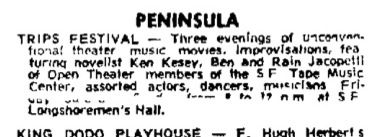
A notice about The Trips Festival in the Theater Listings of the Oakland Tribune, Sunday, January 16, 1966
January 21-23, 1966 Longshoreman's Hall, San Francisco, CA; Grateful Dead (22-23)/Big Brother And The Holding Company(22-23)/The Jazz Mice (21)/New Brothers (22)/Loading Zone (23)/others
The Trips Festival was the public, commercial version of the Acid Test. It was a three-day event held at a fairly large venue in San Francisco, and it featured music, lights, dancers, audience participation and a vision of a brave new world. It was not officially an Acid Test--no electric Kool-Aid--but it seems that everyone there was lit up. Not only did the Festival sell out, it invented the modern rock concert as we know it. Just two weeks later, Bill Graham and Chet Helms were promoting a weekend of shows at the Fillmore with the Jefferson Airplane, advertising "The Sights And Sounds Of The Trips Festival."

The Grateful Dead played Saturday and Sunday, January 22 and 23.

January 28, 1966 The Matrix, San Francisco, CA: Grateful Dead
This date is uncertain, but some other scholarship has made a pretty good case for dating a "mystery tape" as January 28, 1966, and the Matrix seems like a pretty likely venue.

On January 29, 1966 the Merry Pranksters had a recording session at Sound City Studios in San Francisco, CA. Jerry Garcia and maybe other Grateful Dead members participated, but this was neither a performance nor an Acid Test. The session makes a January 29 Matrix gig far more unlikely.

February 1, 1966 Fillmore Auditorium, San Francisco, CA: Fillmore auditions
This Fillmore performance was not exactly a public appearance. Bill Graham took over the lease on the Fillmore Auditorium from the retiring Charles Sullivan, and he seems to have held an audition at the Fillmore for underground San Francisco rock bands starting on Tuesday, February 1, his first day of control. David Nelson was there, and he described it in Robert Greenfield's book. The band had auditioned as the Warlocks a few times, but I believe this to be the only time they auditioned as the Dead. Nelson:
I went up to their Tuesday night audition at the Fillmore. The other bands that were auditioning that same night were The Great Society and The Loading Zone. I remember I took acid that night, too. I walked in real early and nobody was even there. Bill Graham used to put a barrel of apples out. I saw the apples. I thought "Hmm. Probably for somebody private or something." I said "I'm hungry. I'll steal one anyway." So I took an apple and was just biting into it when Bill Graham walked in. I didn't know who he was. I thought "I hope he's just a janitor." I just started cooling it and then he walked by and I looked at him and nodded. He looked and nodded and then he did one of those Bill things. He stopped, did a slow double take and said "Who are you? Who are you with?" I said "Warlocks." I knew this would make him know I really was with them. Because this was the first night they were auditioning as The Grateful Dead (p.68-69).” 
This must have been a pretty remarkable event, all the hip bands in the Bay Area hanging out in their future home, trying to get a gig. Bill Graham inaugurated his Fillmore shows with the Jefferson Airplane on February 4 and 5. The Dead seemed to have earned a booking on Saturday, February 12, but they went to Los Angeles with Owsley instead. Bill Graham probably wasn't thrilled.

February 5, 1966 Northridge Unitarian Church, Los Angeles, CA: Northridge Acid Test
The Grateful Dead joined Owsley in a mad adventure, in which he moved them to Los Angeles in order for them to make it in the record industry. Owsley financed this venture with his retail income. Owsley was no millionaire. The band lived together in a big three story house in Watts, and rehearsed there also. Any rehearsal tapes from this period were recorded in the Watts house. According to an equipment receipt (from the Grateful Dead Gear book), the address was 2511 Third Avenue, which as runonguinness points out, was just south of the Santa Monica Freeway (I-10) and not that near Watts (assuming the address is accurate--Owsley could have used an accommodation address--the 4bed/3bath 3,967 sqft house is currently valued at a mere $951K)

The first Acid Test in Southern California was at a Unitarian Church in Northridge. There is some confusion about this date. It almost certainly was on Saturday night, February 5, but the date on the tape box is February 6. However, Owsley was not there, so he didn't tape it. It is likely that the tape is from another date.
update: fellow scholar runonguinness informs us that
The "Northridge Unitarian Church" (more properly the Sepulveda Unitarian Universalist Society) is still at 9550 Haskell Ave, North Hills. It is well worth a look at the "Onion" on their website

The Grateful Dead (along with the Mystery Trend and Our Lost Souls) were actually advertised as playing the Fillmore on February 12, 1966, in the Feb 11 listings of the Berkeley Barb (h/t Yellow Shark)
Some mislabeled tapes have circulated with a date of February 11, with a venue of The Questing Beast. This cannot be correct. We have looked into the history of the Questing Beast, and the Dead did not play there, notwithstanding they were in Los Angeles on February 11. The Questing Beast was a folk club in Berkeley with a psychedelic mural on the wall, not far from Owsley's cottage. Owsley probably had some affiliation with the place, and if the Dead had not gone to LA they might have rehearsed there, but they never actually did.

February 12, 1966 Youth Opportunity Center, Compton, CA: Watts Acid Test
An Acid Test was held in Watts on Saturday, February 12 (update: JGBP tells us that the Youth Opportunities Center was at 9027 South Figueroa Street in Compton).

February 25, 1966 Cinema Theater, Los Angeles, CA: Sunset Acid Test
Another acid test was held two weeks later at an old theater in Los Angeles, at 1122 No. Western Avenue. The Cinema Theater was only a block off Sunset Boulevard, and this is sometimes called The Sunset Acid Test.
update: Scholar and Commenter JerryGarciasBrokendownPalaces reports that
The following information is from an email between myself and Lawrence Schiller, the photographer. I'll be speaking to him later today to confirm.February 25, 1966 Empire Studios, 7417 Sunset Blvd: Sunset Acid TestCinema Theater, Los Angeles, CA, the Sunset Acid TestMoved to Empire Studios, 7417 Sunset Boulevard, a few doors down from Schiller's photography studio at 7403 Sunset Boulevard.
March 3, 1966 AIAA Hall, Los Angeles, CA: The Grateful Dead/"Psychedelic Experience" (film)
This was probably not an Acid Test. The AIAA Hall was at 7660 Beverly Boulevard and was used for various underground events through 1966. The most infamous was a hugely successful event with The Mothers on July 23, 1966, with a poster inviting everyone to "Freak Out." The address is now the site of The Broadcast Center Apartments.

March 12, 1966 Danish Center, Los Angeles, CA: Grateful Dead
There is some mystery about the show, although there is a tape. Of course, dating the tape has been confusing, too, but it seems to me that David Lemieux has confirmed that there are different March 12 and March 19 tapes. It is unclear where the Danish Center was. Most likely it was a social hall associated with the local Danish church, but I can't find any good information about a likely location for the venue (update: apparently 607 S. Western Blvd, Los Angeles, CA)

March 19, 1966 Carthay Studios, Los Angeles, CA: Pico Acid Test
Amazingly, Hugh Romney had managed to book UCLA's brand new Pauley Pavilion for an Acid Test, but at the last minute UCLA caught on and canceled it [update: fellow scholar Douglas reports that the UCLA Acid Test was not scheduled for Pauley Pavilion, but at the Student Union (Ackerman) Grand Ballroom, across the street]. The event was moved to the Carthay Studios. I don't actually know what the Cathay Studio was--perhaps a film studio--or where it was located (update: apparently 5907 W. Pico Blvd, Los Angeles, CA. A purported handbill is here)

March 25, 1966 Troupers Club, Los Angeles, CA: Grateful Dead/Del Close/Tiny Tim
All Night Harmonica Store Presents
The final show in Los Angeles was not actually an acid test, but a regular concert. Hugh "Wavy Gravy" Romney, one of Owsley's distributors, seems to have put on the show. Legendary improvisational comic Del Close was on the bill, but he seems to have provided a light show rather than comedy. Tiny Tim, an associate of all of them, and not yet famous from Rowan & Martin's Laugh-In, may only have appeared in some kind of video or recorded accompaniment to the light show. The Trouper's Club was at 1625 North La Brea.

On the March 25 tape, Phil Lesh encourages the crowd to come out to the band's shows on April 6 through 9th (Wednesday through Saturday). Due to a cut in the tape, we do not where these shows were booked, and in any case they were canceled. Once Rock Scully had gotten a booking at Longshoreman's Hall, Owsley and the band abandoned the Pink House in Watts and returned to the Bay Area.

April 22-24, 1966 Longshoreman's Hall, San Francisco, CA: Grateful Dead/Loading Zone/The Answer
With the Bay Area rock underground booming, the Dead were offered $375 for three nights (per Rock Scully). This was enough money to get the band back from Los Angeles. Still, the group had no money, and band members couch-surfed until they could afford to move to Rancho Olompali on May 1.

<iframe width="420" height="315" src="https://www.youtube.com/embed/Ufls8DNTxPI" frameborder="0" allowfullscreen></iframe>
A radio spot has recently surfaced that may be for this show, with a dj apparently reading a press release. It is hard to verify "authenticity" with old radio spots, but this sounds right. The slight mistakes (like referring to Stewart Brand's presentation as "Columbus Needs Indians" rather than "America Needs Indians") point towards the real thing, as after-the-fact re-creations tend to be too perfect. The spot lists The Answer as a band, along with the Dead and The Zone. The Answer were a Berkeley band, and future Ace Of Cups singer Denise Kaufmann (aka Mary Microgram) sometimes sang with them.

Update: Chip Wright, former guitarist for The Answer (and now novelist), recalls that The Answer did indeed play The Longshoreman's Hall shows.

May 7, 1966 Harmon Gym, U. of California, Berkeley, CA: Grateful Dead/The Charlatans/Great Society/Billy Moses Blues Band
In 1966, a series of rock concerts were put on at Berkeley's basketball arena, Harmon Gym. The Gym was right off Bancroft Avenue, near Pauley Ballroom and the student union. Harmon Gym was built in 1931, and had a capacity of 6,500 (it replaced an older Harmon Gym, built in 1879, and expanded in 1900 to make the capacity 1,300, large for the time. The old site is now Dwinelle Hall). The middle Harmon Gym was replaced by a newer, larger facility (capacity 12,000) in 1999, and is now called The Haas Pavilion.

The band was billed as The Greatful Dead on the poster. As a sign that underground rock was not fully integrated into college campuses, even Berkeley, the show advertised an emcee, popular KYA-am dj Russ "The Moose" Syracuse. This was a typical teen show arrangement that had no part in the Fillmore/Avalon scene. Syracuse probably got a fee in return for hyping the show on his program. There was no FM rock radio at the time, so plenty of college students would have been listening to AM rock radio.

The Veteran's Memorial Building at 1931 Center Street in Berkeley (at Grove, now MLK Blvd), ca. 1940s. Provo Park and Berkeley Community Theater are just across the street. The Grateful Dead played the tiny auditorium on May 14, 166.
May 14, 1966 Veterans Memorial Auditorium, Berkeley, CA: Grateful Dead/Final Solution
One of the dynamics of the 1966 rock concert market in the Bay Area was that there was a huge audience for hip rock shows around the UC Berkeley campus. Numerous local promoters attempted to use various venues, Campus locations were usually limited to Friday and Saturday nights, and had all sorts of schedule conflicts and time restrictions. Various impresarios attempted to use in-town venues.

The Berkeley Veterans Memorial Auditorium was at 1931 Center (between Milvia and Grove, now MLK), right downtown and within walking distance of campus. I don't know who promoted the show. The building was only used a few times for 60s rock concerts. In 1994, I saw a concert there for a reunion of some old-time Berkeley bands (Country Joe Band with David Cohen, Bruce Barthol and Chicken Hirsh, Joy of Cooking and Lazarus) and I understood why. The room only hold a few hundred patrons, and was rapidly outgrown by the booming rock market in the area. Since a suitable Berkeley venue was never found, all of the students had to go over to the Fillmore and Avalon, and this was one factor in the success of the 1966-67 scene, before most of the bands had become famous.

The Final Solution was a hip band featuring some scenemakers like Ernie Fosselius, who played a big role in the TV show Sesame Street, providing animated films. He also made the movies Porklips Now and Hardware Wars. But back in 1966, Fosselius and his friends, all San Francisco State students, had an underground band that only played weird minor-key songs. On a whim, they named the group Final Solution while having no idea what it meant. They are rightly ashamed of that, and Fosselius and the others have refused any efforts to have an archival release.

May 19, 1966 Avalon Ballroom, San Francisco, CA: Grateful Dead/Wildflower/The Outfit Benefit for The Straight Theater
The Dead, the Wildflower and The Outfit all rehearsed at the old Haight Theater at 1702 Haight. The plan was to turn it into a rock concert venue, so the Haight hippies would have a place to see bands in their own neighborhood. Only in 1966 San Francisco would a benefit be held at one venue, the Avalon, for another venue that would compete with it, but such were the times.

Wildflower were a pretty good band who had formed at the California College of Arts And Crafts in Oakland. The Outfit were an interesting band, who at the time featured lead guitarist Bobby Beausoleil, now doing life in prison as a result of murders committed at the behest of Charles Manson, another Haight Street resident.

May 22, 1966 Rancho Olompali, Novato, CA: Grateful Dead/Loading Zone
The Dead had moved into the crumbling Rancho Olompali mansion on May 1, and there was an almost continuous party there through the end of June. Equipment was probably more or less permanently set up next to the pool, and jam sessions with whoever was present seemed to have been frequent. Nonetheless, the official party, with invitations and all, was held on May 22, and there was some kind of regular (ish) performance by the Dead. This was the event where the BBC camera crew was present. and the famous (and now probably illegal) photos of Julia Bridgen (aka "Girl Freiberg") casually lounging around naked circulated far and wide, even without an internet.

May 28, 1966 Avalon Ballrom, San Francisco, CA: The Leaves/Grass Roots/Grateful Dead
The Dead's return to the Avalon on Saturday May 28 was also their debut at an official Family Dog show for Chet Helms. Over the years, people have assumed that the Dead also played on Friday (May 27), but a closer look at the poster shows a text box that says "Sat. only" next to the Grateful Dead.

The Leaves were a popular Sunset Strip band, and they had a popular hit single with "Hey Joe." The Grass Roots were produced out of Los Angeles by Phil Sloan and Steve Barri, who had written a hit song called "Where Were You When I Needed You." Sloan and Barri recorded the song, but then needed a band to become The Grass Roots and tour behind the single. A Bay Area band called The Bedouins got the call. The Bedouins winners of the 1965 San Mateo County Fair Battle Of The Bands, and mostly played R&B and Rolling Stones' type music. They added a few Sloan/Barri singles to their sets, and got much better bookings as The Grass Roots. The former Bedouins had a falling out with their producers later in 1966, and they were "replaced" by an entirely different band from Los Angeles, who went on to become the better-known version of the Grass Roots.

May 29, 1966 California Hall, San Francisco, CA: Grateful Dead/Charlatans LEMAR Benefit
The Grateful Dead headlined this benefit for LEMAR, a foundation for Legalizing Marijuana. Ahead of their time as always, perhaps the evil weed will become legal while members of the band who played the benefit are still around.

After the show, the Dead dragged their equipment to Gene Estibou's Buena Vista Studios, on the top floor of a mansion in the Haight. There they recorded the tracks that would be released as their debut single on Scorpio Records, "Don't Ease Me In"/"Stealin'".

June 3-4, 1966 Fillmore Auditorium, San Francisco, CA: Quicksilver Messenger Service/Grateful Dead/Mothers
The Dead had skipped out on their initial BGP booking (February 12) to go to Owsley in Los Angeles. It can't have sat well with Graham. However, once his competitor Chet Helms booked them, Graham couldn't let it lie, because Helms new better than Graham who was cool. One of these shows with Quicksilver Messenger Service was probably the one where Phil Lesh's amp broke, and John Cippolina invited their friend Dan Healy out of the crowd to fix it. When Garcia thanked him later, Healy criticized the sound system, and Garcia supposedly said "do you think you can do better?"

Frank Zappa's band was called The Mothers at this time. It was MGM who anxiously added "Of Invention" to their name. Besides playing one of the original Family Dog dances back in 1965, and the previous weekend at the Fillmore,  the Mothers had just finished a lengthy engagement at a rock club in Fremont called Frenchy's (where the Warlocks had been fired the year before).

An unseen flyer for the Grateful Dead shows at the Stockton Ballroom on June 7-9, 1966 (note that it is the "Greatful" Dead at the "Stocton" Ballroom)
June 7-9, 1966 Stockton Ballroom, Stockton, CA: Grateful Dead
(update: a new Grateful Dead booking has surfaced!)
In between the Dead's weekends at the Fillmore and Avalon, it appears they played three nights from Tuesday to Thursday at the tiny Stockton Ballroom. The show was put on by Green Grass Productions, three college students at Stockton's University Of The Pacific. The Stockton Ballroom was at 9650 Thornton Avenue, some miles from campus, but it was regularly used for campus events. One of the organizers recalls having to pick up Phil and Jerry in San Francisco on the first night--perhaps they were mixing their recently recorded single.

Green Grass Productions also seems to have produced the show at Stockton Ballroom on April 28, 1967, so I needn't repeat all the details about UOP or the Stockton Ballroom. There was apparently some question about the poster for the show (it was a reprint or something) but I found multiple confirmations that the show occurred. The 1966 event must have at least gone well enough for the band to accept a return booking the next year.

June 10-11, 1966 Avalon Ballroom, San Francisco, CA: Grateful Dead/Quicksilver Messenger Service/New Tweedy Brothers
The New Tweedy Brothers were from Oregon, but they had moved to the Bay Area for the summer. This was probably the show where the Dead's relatively massive--by 1966 standards--PA not only blocked the light show but made it impossible for Avalon soundman Bob Cohen to hear his team on the in-house intercom. Next time around (in August), the Dead had hung white sheets on the sound system to facilitate the lights, and Cohen had invented noise-canceling headphones.

June 12, 1966 [private residence], [Marin County], LSD Conference Party
Weed was illegal, but not LSD. The University of California at San Francisco, primarily a medical school located very near the Haight-Ashbury, seems to have hosted a conference on the medical benefits of LSD research from June 13-18. Apparently, there was a party at a Marin mansion with a swimming pool, and the Grateful Dead performed. Memories seem foggy.

June 17-18, 1966 Veterans Hall, Santa Rosa, CA; Grateful Dead/Jaywalkers
There is a poster for this show, but nothing else is really known about it. Thunder Machine Productions implicitly suggests the Pranksters, but Kesey was on the lam in Mexico, so it's not clear exactly who the promoters might have been. Santa Rosa was mostly a rural agricultural community at this time. However, there was an extension of San Francisco State College in Santa Rosa, and it was a tiny oasis of long-haired stoners. SF State Extension became Humboldt State within a few years, but the seeds--appropriately enough--had been sown by the SF State extension.

The weekend of June 24-25 seems a likely candidate for a "lost" date or two, but none have yet turned up.

Bob Weir's sister Wendy had a Debutante Dance at the SFO Airport Lounge on Friday, June 24, and the SF Examiner society columnist reported that Bob couldn't attend, as he had an engagement. That points pretty clearly to a Dead booking somewhere.


Friday, January 15, 2016

Fillmore West, January 12, 1969: Country Joe And The Fish And Their Friends (Plus Opening Acts)

In 1994, Vanguard Records released a double-cd of Country Joe And The Fish Live At Fillmore West. The album included both sets from Sunday, January 12, 1969. Jack Casady played on both sets, and for the second set the band was joined by Jerry Garcia, Jorma Kaukonen, Steve Miller and Mickey Hart
Myths and legends often become myths and legends because tales of things that happened get told and retold, until the telling exceeds the reality. The Fillmore and Fillmore West and San Francisco in the 1960s have an element of that. Wonderful times, wonderful music, for certain, but many nights were just another gig at the local ballroom, however glamorous it may seem today. People would go and see a few bands play some music, dance and hang out, and it was really fun, and then they would go home. Once in a while, however, the myths and legends were not just tales--there were things happened in San Francisco in the 60s that won't be repeated in the rock and roll firmament. In the case of the Fillmore West show of January 12, 1969, however, a remarkable evening of music by Country Joe and The Fish and their friends has been largely forgotten and is rarely recalled, even though a double-live cd of their entire show was released in 1994.

The Sunday SF Chronicle "Pink Section" from January 5, 1969 had a photo of Country Joe and The Fish to highlight their upcoming weekend shows, along with Taj Mahal and Led Zeppelin
What Happened?
The original, psychedelic Country Joe And The Fish played their last stand at the Fillmore West on the weekend of January 9-12, 1969. Originally just the folk duo of Berkleyites Joe McDonald and Barry Melton, the band had expanded into an electric ensemble after the Butterfield Blues Band came to town in early 1966. By the end of '66, the band had been signed to Vanguard Records, and the first two Country Joe And The Fish albums were true San Francisco classics. To much of the world, Electric Music For The Mind And Body and Feel-Like-I'm-Fixin'-To-Die were just as important to San Francisco music history as Surrealistic Pillow or Anthem Of The Sun. By the end of 1968, however, Joe and Barry wanted to reconfigure the band. So while the group Country Joe And The Fish would continue on successfully for some more years, the January '69 Fillmore shows were going to be the last go-round for the original lineup that had arisen out of the Jabberwock coffee house in Berkeley.

If you're going to have a party, have a party. January 12 was a Sunday, and most musicians aren't working, so the last number of the final set of the original Country Joe And The Fish at Fillmore West was a 38-minute version of their song "Donovan's Reef," where the band was joined by their friends Steve Miller, Jack Casady, Jorma Kaukonen, Mickey Hart and Jerry Garcia. Yet no one seemed to recall it, and the event remained unknown until a 1994 cd release. How could such an event pass unnoticed? Could it be that the opening act, a new band from England with a guy who used to be in the Yardbirds, whose album hadn't even come out yet, overshadowed them?

Probably, yes. The mighty Led Zeppelin, young and strong, had only played 8 North American shows prior to arriving at Fillmore West.  Their first album was not officially released, but it was probably already available in a few stores--things worked differently then--and KSAN-fm was already playing numerous tracks from it. The buzz was on, and curious fans came to check it out, and were steamrolled by the Shape Of Things To Come. Some guys from the Dead and the Airplane jamming with that Berkeley band? Yeah, whatever.

Zeppelin's Fillmore West debut was mentioned in Rolling Stone and the like, but Country Joe and The Fish were dismissed as last year's news. Who knows how many people actually stuck around for the final Sunday night set, and the event seemed lost to history. This post will reconstruct what we can put together from what turns out to be a fair amount of information.

The exterior of the Fillmore West, at 1545 Market Street as it appeared in 1970. It was the former Carousel Ballroom, and that sign remained intact throughout it's life as the Fillmore West. Note the ad for Workingman's Dead above.
Fillmore West, 1969
Bill Graham's Fillmore West and Fillmore East were the twin pillars of the growing rock concert industry in the 60s. However, although Graham had moved from the intimate Fillmore to the Fillmore West, about a mile away, the industry was starting to get even bigger, and some of the biggest acts could play much larger places. The Fillmores still had very high profiles, however, so most bands began or ended tours at one or the other place, often beginning at one and ending at the other. Fillmore East had an early and a late show, but Fillmore West let its audiences stay for every set. Throughout 1969, Fillmore West had the now-unheard of setup where they went twice around the bill, so the headline act played both the 3rd and 6th set of the nights. This allowed suburbanites or teenagers to go home early, and night owls to come late, as well as allowing the most committed fans to stay for 6 or 7 hours of music.

The bill at Fillmore West for January 9-12, 1969 was Country Joe and The Fish/Led Zeppelin/Taj Mahal. On Thursday and Sunday night (Jan 9 and 12), CJF would have played the 3rd and 6th sets, while Led Zeppelin would have played the 2nd and 5th sets. On Friday (10) and Saturday (11), there was typically an unbilled act that opened the show, but did not repeat. This band was usually drawn from acts who had played the Tuesday "audition nights," another forgotten practice. On those nights, Zep would have played 3rd and 6th, and CJF 4th and 7th. Weekend shows at Fillmore West often ended very late, past bar-closing of 2:00am.

Friday night tended to be the big night for reviewers. Writers could watch the early sets and make a midnight deadline, which was important in the newspaper business. So killing it in the early Friday sets at Fillmore West or East could really make a band's careers. This was particularly true for tours that started at Fillmore East, as the Friday night early show was always reviewed in Billboard and other trade magazines, and it could affect bookings for the rest of the tour, if not a career. So any formal or informal coverage of Led Zeppelin's debut at Fillmore West was probably on Friday, January 10, and probably did not include the late set. And probably a good thing, since Zep members had caught the flu in LA the week before, and were apparently a little flat on Thursday night. No matter--by the weekend they were rocking the house, and mowing down everything in their path.

Led Zeppelin's immortal cover for their January 1969 debut album on Atlantic. The cover art was by former Yardbird guitarist Chris Dreja
Led Zeppelin, 1969
Led Zeppelin had formed in the Fall of 1968. Jimmy Page had led the Yardbirds for 1967 and '68, and he had played the Fillmore a number of times, so he knew all about West Coast psychedelic ballrooms. The Yardbirds had been a terrific band who were bottled up by their management and record company, and Page was determined not to repeat the mistakes. Along with veteran road manager Peter Grant, Page assembled some crack cohorts and set out to conquer the rock music world that was to come, not the one that had passed. Zeppelin would only release albums, not singles, and their albums were geared for FM airplay. Zeppelin was loud, really loud, and they could bring it in a way that would make every concert memorable. This was the new English rock world, not the old one of catchy singles and brief television appearances on Top Of The Pops.

Led Zeppelin's first album was not due until mid-January, so their tour was set to begin on the West Coast with a week at LA's Whisky-Au-Go-Go and then Fillmore West, both hip palaces good for creating buzz. However, the Jeff Beck Group canceled some American dates, so Led Zeppelin began their American tour, filling in for Beck while opening for the Vanilla Fudge in Denver (Dec 26), Seattle (Dec 27),Vancouver (Dec 28), Portland  (Dec 29) and Spokane, WA (Dec 30). After a few dates at The Whisky with local band Alice Cooper, some  Zep band members got sick and they were replaced by Buddy Miles for the balance of the Whisky dates.

The Grateful Dead and Led Zeppelin met only once, during this weekend. It was at a Herb Greene photo shoot--the Dead needed a promotional photo with their new organist, Tom Constanten, and Led Zeppelin had just finished their session. Herb Greene has written about the incident (via another scholar's research)
“The session was rolling along when I got a phone call. It was Rock Scully, telling me, "we got a new band member [Tom Constanten], so we need a picture right now – we're downstairs!"... I told him that I was kinda in the middle of something, but they came up anyway... Pigpen was wearing a little .22 revolver, in a holster, and he pulled it out and started firing it off into the theater seats. I guess I was almost done with the session when all this happened, because it was pretty disruptive, ha ha! Actually, it freaked Zeppelin out. They exclaimed, "these westerners and their guns!" In fact, Led Zeppelin got so distracted, that they quickly left and didn't pay me…
In retrospect, when the Dead called, I maybe thought OK, this is great, hands across the seas, we'll have a party, but that didn't happen. The Dead didn't want to hang out, they were just there to get a photograph. There was no interaction at all between them, no curiosity. Garcia didn't want to talk to Page, and I don't think Led Zeppelin even knew whom the Grateful Dead were.”
Hip record stores like Tower Records in Berkeley often had new albums before their "official" release date
The Record Industry, 1969
In those days, new albums did not have precise release dates. The supposed "date" of a release was just the time that promotion was planned. Long before FedEx, distributors would have had to have truck out their cardboard boxes weeks in advance. There was nothing preventing a hip record store from asking the local "rack jobber" if he had any copies of that new album by the so-and-sos. Accordingly, hip FM stations were also sent advance copies of new albums, in the hopes that they would play it before the promotional ads started.

The "official" release date of the first Led Zeppelin album is usually cited as January 17, 1969, but not surprisingly the biggest station in town, KSAN-fm, was already playing it. Thus listeners would come into the record store and ask for it, and distributors would let the stores have boxes. So plenty of people in SF (or any other hip town with an FM station) had the Zeppelin debut before it was "officially" released. Many people at the Fillmore West that night, even those looking to see Country Joe and The Fish, would have had some idea about how Led Zeppelin sounded, even if they didn't realize quite what they were going to see.

Taj Mahal, from Cambridge, MA but via Los Angeles, also had a new album. It was his second album on Columbia, The Natch'l Blues. Taj's first album, with Ry Cooder smoking on slide guitar, had been a sort of underground hit, even if he hadn't sold many records, so he would have gotten some airplay on FM as well. Ry wasn't touring with Taj, but it mattered little, since the great guitarist Jesse Ed Davis anchored his live band. Taj sang and played some harp and guitar, and Jesse Ed wailed over the rhythm section. Taj Mahal wasn't a big act, but he was worth getting to the show on time for.

Meanwhile, Country Joe and The Fish were an established act locally and nationally. The group had come out of the Berkeley folk underground in 1966 and "gone electric," establishing themselves as one of the classic Fillmore bands.  When Country Joe and The Fish toured nationally, they headlined over many groups that have since surpassed them in fame, not the least the Grateful Dead, with whom they had shared bills all over the country.

It didn't hurt that Country Joe And The Fish were a great live act, with great songs and a loony edge, but an R&B-inspired discipline that kept them from going off the rails. The band was a well-established headline act at both Fillmore West and East, with many fans all over the psychedelic world. They had released their third Vanguard album, Together, in August 1968. While it wasn't as big as the first two, it was still a popular record.

However, all was not well in Berkeley. The membership of the group had frayed when bassist Bruce Barthol, a dedicated pacifist, moved to England in September 1968 to avoid the draft. Replacement bassist Mark Ryan was arrested on tour soon after (for the devil weed, of course), and then got ill right before a European tour. In the short range, this had been OK, since former bassist Barthol was already in Europe and took over his old gig for the Fall 68 European tour. However, when the band returned to America, Country Joe McDonald and Barry "The Fish" Melton wanted to reconstitute the group entirely. Thus, although Country Joe and The Fish would continue on for two more years after the January 1969 Fillmore West shows, and numerous reunions, these shows were a farewell to the configuration of the Country Joe And The Fish band that made the group legends. Lacking a bass player, old buddy Jack Casady stepped in for most of the remaining dates (Mark Andes of Spirit filled in for two SoCal dates). Appropriately, a farewell party was planned. In retrospect, it should have been a legendary event, but today all that anyone recalls is that an unknown English band called Led Zeppelin blew the place out twice a night.

In January 1969, Country Joe And The Fish's current album was Together, released on Vanguard in July 1968
Party Number One, Friday or Saturday Night
The first whiff that something interesting had happened on that weekend came in the Summer of 1977. KSAN-fm had a radio special on the 10th anniversary of the Summer Of Love in 1967, called "What Was That" and at night they had three hours of concert tapes from the Fillmore and Avalon. At the time, the taper world was in its infancy--I myself did not yet have a cassette deck--and hearing tapes from the source was like time travel. All three nights of the radio special ended with a 3-hour "concert," featuring 15 or 20 minutes from different bands. All the tapes weren't from 1967, but they were close enough.

The KSAN special put 60s tapes from numerous bands into circulation. I believe it was the original source of a fragment of Grateful Dead Oct 68 Avalon tapes, although of course we have them in their entirety now (it was also the source for a mislabeled Feb 12 '67 tape, but I have written about that elsewhere). The dating of the tapes wasn't very good, however--the dj would just say "here's the Jefferson Airplane from the Fillmore in 1967," or something vague like that.

A Country Joe And The Fish tape was played on the special with little introduction. With a band vamping the blues, the tape had Bill Graham telling the crowd [I am paraphrasing here] "I just talked to the man, and he agreed to walk around the block. We can go on here, but this is now a private party. Please remain seated and we can keep going." He then introduced the band: Chicken Hirsh, Mickey Hart and Dave Getz (of Big Brother) on drums, Jack Casady on bass, and David Cohen (organ), Barry Melton (guitar) and Country Joe McDonald. The band launched into an extended version of the Country Joe And The Fish classic "Flying High."

It took me many years to figure out what this tape fragment actually was. The tape shows up on various lists under various incorrect dates. In fact, this tape was one of the final numbers of either Friday (Jan 10) or Saturday (Jan 11) night. Casady was already on stage, of course, but we didn't realize that at the time (the KSAN dj in 1977 would have had no idea either). Dave Getz was a pal of Joe and Barry, and in fact would join Country Joe and The Fish on tour starting in February. Hart was a friend of Melton's, too, so obviously they all came for the party and stayed to play.

Almost all Country Joe And The Fish fans consider the band's April 1967 debut album, Electric Music For The Mind And Body, to be a time-tested psychedelic classic. The cover photo insets were from a little-known venue called The Barn in Scotts Valley, CA, near Santa Cruz. 
Sunday Night, January 12, 1969
The final party remained a mystery until the 1994 release of the cd Country Joe And The Fish/Live! Fillmore West 1969 on Vanguard Records. There was no general awareness of the all-star San Francisco jam, much less the idea that it was professionally recorded. Yet with the rise of the archival cd market, here was a complete document of a remarkable event, previously unknown. Vanguard and CJF producer Sam Charters described the event itself in the liner notes:
When I look back in the last few months that Country Joe & The Fish were still trying to keep the band together and go on touring, I remember all the confusion and all the arguments and all the exasperation--but I also remember so many nights when they played with all their old magic and uniqueness. Since I'd been working with them for four years as their producer for Vanguard Records, I wanted to try to capture some of those last moments on tape, so with engineer Ed Friedner--who had worked with me on the album they did in New York [Together from 1968]--I stalked them for a number of nights on their last gigs. 
We did the first recordings of them live at Fillmore East, but we couldn't catch them at their best. They were headlining, a bill that opened with Procol Harum, continued with Ten Years After and then finished with Country Joe & The Fish [September 27-28, 1968]. By the time the first two bands had finished it was the middle of the night, and Joe both the audience and Joe and The Fish were too wiped out to make their music happen. 
We decided to make another try, so...we flew out to San Francisco to record what was to be their last gig together. Ed rented a moving large moving van and and set everything up outside the Fillmore [West] Auditorium on Market Street. The opening act was a new English band called Led Zeppelin, so we thought that there was a chance that the audience wouldn't be as limp for Joe and The Fish as they'd been in New York.
Since it was going to be the final night on stage together, the band decided to invite all their friends to join them and backstage there was a long party before they went out to play... 
Back stage the party went on for so long that the band and their friends finally came out to play in a blaze of excitement and a heavy accumulation of controlled substances. But on stage all of them immediately became the stars that they were, and after I'd made sure that everybody was playing and the sound in the van was working, I went out front and looked up at the stage. Here was one of the greatest line-ups of San Francisco musicians I had ever seen--and each of them was his own stage personality. Jorma was bent over his guitar, Steve was swaying up and down, Jerry was studying his strings, Joe was half-smiling Barry was striding around his stage...It was one of those moments in the 60s that would never come again--and listening to it after all these years, brings back that moment and so much of the mood of those chaotic years.
The double-cd set captures the final set in its apparent entirety, complete with pictures. The core band (Joe on guitar and harmonica, Barry on lead guitar, David Cohen on keyboards and Chicken Hirsh on drums) along with Jack Casady on bass, performs a 77-minute set of classic CJF songs. They are joined on one song ("It's So Nice") by David Getz on a second drum kit. For the finale, Mickey Hart takes over the second kit, and the band plays a 38-minute version of the song "Donovan's Reef," mixed in with jams based on "Flying High." Jorma Kaukonen, Jerry Garcia (playing a Gibson) and Steve Miller all get substantial turns on lead guitar, and Miller adds some bluesy harmonica as well.

On November 27, 1994, the original Country Joe And The Fish band (Joe, Barry, Cohen, Barthol and Chicken) were scheduled to play at the Berkeley Veterans Memorial Building at 1931 Center Street. They were also scheduled to play Fillmore the night before, to promote the newly released Vanguard cd from 1969. Due to some unknown dispute, Barry Melton made a brief solo appearance at Fillmore and did not appear in Berkeley. The balance of the group played a fine set, as did Joy Of Cooking and Lazarus (the photo is ca. 1940).
Coda
No one recalled the final night jam. The participants were--shall we say--distracted, but observers only remembered Led Zeppelin's first trip to San Francisco (although John Paul Jones recalls watching Country Joe And The Fish) Recollections are only about the the coming of the Zeppelin. An attendee recalls (from January 10)
I remember zep coming on after taj and the fish. Had heard zep records on kkzx, wanted more. Got it. They blew up the ballroom. Carousel/fillmore west was never same. Page, plant, bonham, jones were rock gods that night. Saw them 2 more times but nothing compared to that night in January 69.
Led Zeppelin had likely opened their first set with their only familiar song of the evening, a turbocharged version of the Yardbirds' "Train Kept A Rollin,'" and I assure you that the train indeed kept rolling. The last stand of Country Joe And The Fish was already history when it began, as the 1970s were underway in San Francisco by January 1969.

The jam finally came to light when Vanguard released the cd in 1994. Country Joe And The Fish were going to reform and play the Fillmore and Berkeley Veterans Hall, but some ancient dispute intervened, and Barry Melton did not perform with them. Melton actually performed solo at the Fillmore, but did not stay for the band, in order to fulfill his contract, perhaps afraid that the specter of the late Bill Graham would haunt him. In any case, the un-reunion dampened enthusiasm for the album, and it passed somewhat unnoticed. But as Sam Charters said, there was hardly anything like it. This one wasn't even legend--there's a professionally recorded tape, officially released, with great photos by Jim Marshall, and yet it passes us by hardly without recall. Sic Transit Gloria Psychedelia.

The Natch[l Blues, Taj Mahal's second album on Columbia, featuring the great Jesse Ed Davis on guitar, was released in December 1968
Setlists (As Known)
Taj Mahal
A tape circulates for Taj Mahal from Friday, January 10, 1969
Taj Mahal , Fillmore West,SF
January 10,1969

1-//Checkin' Up On My Baby
2-Easy Rider
3-Aint That Alot Of Love
4-The Cuckoo
5-Everybody Got To Change Sometime
6-Leavin' Trunk

Taj Mahal-vocals, harmonica
Jesse Ed Davis-lead and slide guitar
Gary Gilmore-bass
Chuck Blackwell-drums

Led Zeppelin
Led Zeppelin's general setlists from the Fillmore West are known, but not precisely which songs were played in which order, so there may be some variation. There is a partial tape of one of the nights, although it is not clear which night it is (the entire story is explained here).

Setlist:
1st set: Train Kept a Rollin', I Can't Quit You Baby, As Long As I Have You (incl. Fresh Garbage), Dazed and Confused, How Many More Times

2nd set: White Summer / Black Mountainside, Killing Floor, You Shook Me, Pat's Delight (drum solo), Babe I'm Gonna Leave You, Communication Breakdown, For Your Love.