Friday, September 12, 2014

Grateful Dead and Jerry Garcia South Bay Landmark Guide (So Many Roads I)

On Halloween, 1969, The Grateful Dead and The New Riders Of The Purple Sage played the newly-opened Loma Prieta Room at the Student Union at San Jose State University. In 2014, San Jose State University is co-hosting the So Many Roads Conference on the Grateful Dead with the University of California at Santa Cruz.
So Many Roads
San Jose and South Bay Landmark Guide
The So Many Roads Grateful Dead Conference on November 5-8, 2014 will be a celebration of the history and legacy of the Grateful Dead. The Conference is jointly hosted by San Jose State University and the University of California at Santa Cruz. Although the two universities are separated by the Santa Cruz Mountains, they are less than 25 miles apart. While the Grateful Dead are rightly recognized worldwide as a San Francisco band, the counties south of San Francisco played a huge part in Dead history as well.

Grateful Dead fans who visit the Bay Area don't always realize how near they often are to various sites where the Grateful Dead or its members performed, or at least plotted world domination. In honor of the So Many Roads conference, I am going to rectify this by writing posts that identify important sites in Grateful Dead history in geographic areas, starting with San Jose and the South Bay.

The "South Bay" Versus "The Peninsula"
The county just south of San Francisco is San Mateo County, running along San Francisco Bay from South San Francisco to Menlo Park. Just South of the Menlo Park line, Santa Clara County runs from Palo Alto to San Jose to Gilroy and beyond. Back in the 60s and 70s, and perhaps still, residents of most of the towns in San Mateo County along the Bay refer to their region as "The Peninsula." San Jose and some of its nearby suburban towns, like Santa Clara and Cupertino, were referred to as "The South Bay." Palo Alto residents, however, despite being part of Santa Clara County, generally thought of themselves as part of "The Peninsula." Palo Alto does have an outlet on San Francisco Bay, but the primary reason that Palo Alto assigned itself to the Peninsula and not the South Bay was snobbery towards San Jose.

San Jose had a long and prosperous history by 1965. However, its initial growth was primarily as an agricultural center, providing transport and markets for the many orchards and farms that surrounded it. Although the San Jose area had an increasing industrial base after World War 2, to the South Bay the city would always be the country cousin of sophisticated San Francisco. Thus a town like Palo Alto, invented in the shadow of Stanford University, looked North towards San Francisco and dismissed San Jose. As a result, Palo Altans insisted they were part of The Peninsula rather than the South Bay. Perhaps because of that, the South Bay had a pleasant and unpretentious air that remained intact until Silicon Valley moved in and changed the tenor and finances of the entire Santa Clara Valley.

The San Jose State University campus is a pretty old campus in the middle of a thriving downtown city
San Jose State University
What is now San Jose State University was founded in San Francisco in 1857, making it the first college in California. The school moved to San Jose in 1871. It was called the California State Normal School until 1935, when it adopted the name San Jose State College. In 1972 the school became San Jose State University. The school remains rooted at the same site it moved to in 1871, at Fourth and San Carlos Streets, right near downtown San Jose. San Jose State has always been central to professional and cultural life in the South Bay, and it remains so today. Downtown San Jose played a critical role in the early history of the Grateful Dead, so it is an appropriate place to start a survey of landmarks.

South Bay Landmarks In Grateful Dead History
All of the links direct to a Google map of the site, but readers should be warned that in many cases no trace may remain of the original edifice. A landmark map of Palo Alto, Menlo Park and Stanford will follow this one. I have already completed a post for Santa Cruz County. The sites are arranged more or less geographically, but I would be surprised if anyone could or should try to cover all of them in a day.
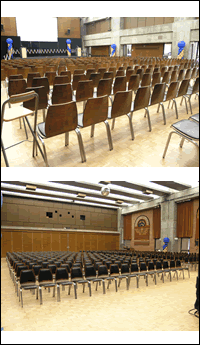
Do you think the 1969 Grateful Dead would have sounded good here? The Loma Prieta Ballroom in the San Jose State University Student Union.
Loma Prieta Room, Student Union, San Jose State University, 211 S 9th St San Jose, CA 95112
For anyone visiting a Grateful Dead scholarship conference held at the Student Union of San Jose State University, a good place to start visiting historical sites would be the Loma Prieta Room in the Student Union itself. On Halloween, 1969, the Grateful Dead played the Loma Prieta Room (see the poster up top). In its current configuration, the Loma Prieta Room has a capacity of 588. In a slightly larger configuration (known currently as the Ron Barrett Ballroom), it has a capacity of 728. In the early days, the names "Student Union Ballroom" and "Loma Prieta Room" seem to have been used interchangeably. Regardless: seeing the 1969 Grateful Dead in a 500-700 capacity room on Halloween would pretty well have melted your brain.

This hard-to-read clip from Ralph Gleason's SF Chronicle column of October 17, 1969 lists Jerry Garcia and the New Riders of the Purple Sage at the San Jose State Student Union ballroom that night (as well as the intriguing Venus Flytrap and Albino Blood double bill at the College Of San Mateo)
That isn't all. The Student Union Ballroom had only opened on October 13, 1969. On the very first Friday that the ballroom was open October 17, 1969, the new, unknown New Riders Of The Purple Sage played there and broke in the room. Whether the Student Union Ballroom was the larger (Ron Barrett) or smaller (Loma Prieta) is moot, at this point. The raw New Riders, with the cutting-edge fusion band Fourth Way on the bill as well, would have been memorable indeed.

As of this writing, the Loma Prieta Room is being remodeled, so the new configuration may have no relation to what came before.

Acid Test House, 43 S. Fifth Street, San Jose, CA 95112
The Grateful Dead's first known performance as The Grateful Dead was at an Acid Test at a house on 5th Street in San Jose, on December 4, 1965. The house was a short walk from the San Jose Civic Auditorium, where the Rolling Stones were playing, and flyers were passed out after the show. Supposedly Bill Wyman and Charlie Watts dropped by (per Wyman's diary update: apparently wishful thinking. Wyman went to a party, but not likely this one).

The house was on S. Fifth Street, near San Fernando Street. It is now the site of City Hall. The San Jose 60s hippie rock band Throckmorton lived in the house for a time.However, the actual house itself was moved, and can be seen here on Google Street View.  The current address is 635 E St. James St., San Jose, 95112. 

The San Jose Civic Auditorium, at 135 W. San Carlos Street, as it appeared in 2011. The Rolling Stones played there on Dec 4, 1965, and afterwards an Acid Test was held within walking distance. Jerry Garcia and then the Grateful Dead played the Civic in the Summer of '72.
San Jose Civic Auditorium, 135 W. San Carlos, San Jose, CA 95113
The San Jose Civic Auditorium, built in 1934, was the largest auditorium in the South Bay for many years, with a capacity of 3000. Besides the historic Rolling Stones concert (and Bob Dylan and The Hawks a few days later), the Dead themselves played the San Jose Civic on August 20, 1972. Jerry Garcia and Merl Saunders checked out the venue by playing a concert there on July 1, 1972.

The Offstage, 970 S. First St, San Jose, CA 95110
In the early 60s, there were little enclaves of rebellious long haired folk singers in every college town and big city, and they all had a little coffee shop hangout. All of the hangouts in all of the towns made up the "folk circuit." In San Jose, the folkies congregated at a place called The Offstage, at 970 South First Street. The club was run and sponsored by an engineer named Paul Foster. Jorma Kaukonen was one of the regulars at The Offstage, along with Peter Grant, Paul Kantner, David Freiberg and other fellow travelers. Jerry Garcia was booked there on occasion, too, but Foster thought he was snide to the audience. The Offstage folded when Foster went off to hook up with Ken Kesey's Merry Pranksters. Today the site is Vinh Hing Bakery.

Spartan Stadium, near the San Jose State University campus. Besides being the home of the San Jose State Spartan football team, the field has a long history with American professional soccer. For many years it was the home of the San Jose Earthquakes (Georgie Best even played at Spartan for the Earthquakes in 1981).
Spartan Stadium, 1251 S 10th St, San Jose, CA 95112
San Jose State has a pretty good sports tradition for a non-D1 school. Although the football team (The Spartans) are FCS (formerly Division 1AA), they have historically been relatively good, and they have had several players drafted into the NFL. The most famous Spartan football player was SJSU alumnus and TE/DE Bill Walsh, who played for the team in the 60s. The team plays at Spartan Stadium, which is not right on campus. It is a few blocks away in a big park, bounded by E. 10th and Alma Streets. The Grateful Dead only played the 30,000 seat Spartan Stadium one time, when Brent Mydland debuted with the band on April 22, 1979.
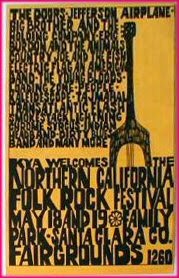
The Grateful Dead played on the first day (Saturday, May 18, 1968) of the first Northern California Folk Rock Festival at the Santa Clara County Fairgounds, at 344 Tully Road.
Santa Clara County Fairgrounds, 344 Tully Road, San Jose, CA 95111
The Santa Clara County Fairgrounds had a hugely important role in San Jose rock history, which I have discussed elsewhere. However, the Grateful Dead only played there once, on the first day of the 1968 Northern California Folk Rock Festival.


A flyer for The Grateful Dead's first performance at the Continental Ballroom, at 1600 Martin Avenue in Santa Clara, on December 21, 1966. Since December 21 was a Wednesday, the Dead seem to have played without a support act.
Continental Ballroom, 1600 Martin Ave, Santa Clara, CA 95050
The Continental Ballroom, under various names, was the principal rock venue for San Jose and the South Bay in the 60s. Apparently, it was a former rollerskating rink, but I don't know it's exact history. Because the Continental was generally not under the control of a single promoter, it doesn't have the storied history of places like the Fillmore. Don't doubt, however--many a great band played there back in the day, and memorable times were had. The Continental is actually in the town of Santa Clara, which though a separate municipality from San Jose, is an economic part of San Jose.

The Dead first played the Continental on December 21, 1966, and then 4 times in 1967. Among other things, in the summer of '67, Quicksilver Messenger Service manager Ron Polte hired the hall for 8 weekends, and booked every San Francisco band, including the Dead on July 21 and 22, 1967. Not only did all the great San Francisco bands play the Continental,  the Continental was also the primary home for great 60s San Jose bands like The Chocolate Watch Band, so it played an important part in South Bay rock history. Yet since no single promoter embellished the legend, the Continental is just a fond, fuzzy memory for fans and musicians of the era (80s peeps take note: The club One Step Beyond was in the same complex, but at 1400 Martin Avenue).

A contemporary photo of the pool at the Chateau Liberte, and its infamous tiled portrait of The Zig Zag Man.
Chateau Liberte, 22700 Old Santa Cruz Highway, Los Gatos, CA 95033
The Chateau Liberte was a former resort hotel that was turned into a hip entertainment enclave in the early 70s. Calling the Chateau Liberte "notorious" doesn't tell the half of it. Although the Liberte is in the Santa Cruz Mountains, and on the Old Santa Cruz Highway, it is actually in Santa Clara County, so it belongs on this list. In the early 70s, the Santa Cruz Mountains had plenty of cheap, inaccessible housing, so they were full of bikers, pot growers, entrepreneurs and layabouts. Many Mountain residents fit more than one of these categories, and all of them hung out at Chateau Liberte on weekends.

"The Chateau" had originally been a Wells Fargo stagecoach stop. From 1920 to 1945, it was a resort called Chateau Boussy, a French restaurant and resort, noted as a hideaway for important political figures to stash their mistresses. When it got taken over by hippies in the early 70s, it became infamous for its swimming pool, which had a tiled "Zig Zag Man." The Chateau had a deserved reputation for being a hangout for the Hell's Angels, but many people who went there claim that it was mostly a mellow scene.

In 1970, when The Chateau first got rolling, one of the regular bands was Mountain Current, led by Matthew Kelly and John Tomasi (John Tomasi was the former lead singer of The New Delhi River Band). Mountain Current often shared the stage with either The Doobie Brothers or Hot Tuna, who tended to alternate weekends. The cover of the first Doobie Brothers album was taken at the Chateau Liberte bar, and the second Hot Tuna album (First Pull Up, Then Pull Down) was recorded there in 1971 (for more on the story, see the great Metroactive article here).

An ad from the Santa Cruz Times for Kingfish and Jerry Garcia shows at the Chateau Liberte in 1974, This was the first known time that Bob Weir was publicly advertised with Kingfish. Note that there is no area code on the phone number, as 408 was simply presumed.
In late 1974 and early 1975, Jerry Garcia and Bob Weir each played a few shows at The Chateau. In Garcia's case, I think he was just filling in the date book for an empty weekend, as the venue was tiny even by his standards. Kingfish, on the other hand, seemed to have used the gigs to give Bob Weir a chance to get his sea legs with the band. According to various accounts, the sound man at The Chateau was quite willing to let tapers plug in, so even though the gigs were obscure, tapes from the venue circulated relatively widely.

One other unique piece of Grateful Dead history took place at the Chateau Liberte: a very rare showing of the Sunshine Daydream movie, way back in 1974. I know it was shown once at Stanford University around that time as well, as I recall not going because "how could it be any good if I hadn't heard of it?" Today, the Chateau Liberte is owned by a real estate agent, and the house is a private residence. It is hard to get to, and can't be seen from the road anyway. But the pool is still intact, apparently, so rock and roll history does live on.


The Naval Airship USS Macon above Moffett NAS in Sunnyvale, CA ca. 1934. If you look closely enough, and really want to see them, Shoreline Amphitheatre, Google Headquarters, Apple Headquarters and Highway 101 are all visible. Non-residents probably just see empty fields.
Shoreline Amphitheater, 1 Amphitheatre Pkwy, Mountain View, CA 94043
Although hardly the stuff of legends, the Grateful Dead played the Shoreline Amphitheatre in Mountain View 39 times. The first Dead show at the venue was October 2, 1987. Bill Graham Presents built the venue in order to not only have their own large concert venue, but to have one in Silicon Valley, where all the money was. The venue opened on July 29, 1986 (with Julio Iglesias and Roseanne Barr), with a maximum capacity of 22,500, and it has thrived ever since that day.

Shoreline is to the East of Highway 101 (nearer the Bay) between San Jose and Palo Alto. Heading north from San Jose, the unmistakeable Airship Hangar One of Moffett Field, the largest unsupported structure in the world, marks the spot. The hangar, the former home of the USS Macon, now houses the private planes for Google, Inc. The Google campus takes up the entire area leading towards Shoreline Amphitheatre.

A subsequent post will locate the Grateful Dead historical landmarks of Palo Alto, Menlo Park and Stanford University. For the landmarks of Santa Cruz, see my post on the history of Jerry Garcia and the Grateful Dead in Santa Cruz County.

Friday, July 11, 2014

Go Ahead and Bob Weir 1987-88 (Brent Mydland III)

Tipitina's, in New Orleans, where Go Ahead played in March 1987
Go Ahead 1987-88
The band Go Ahead, featuring Grateful Dead members Brent Mydland and Bill Kreutzmann, had begun as somewhat of a necessity in the Fall of 1986. Mydland and Kreutzmann had formed a little band called Kokomo that had played a bit in the Summer of 1985. However, when Jerry Garcia slipped into a diabetic coma in July of 1986, every employee of the Grateful Dead's various enterprises had to look around to find a source of income without the Dead. Kreutzmann had played a few gigs in the Summer with a cover band called The Kreutzmann-Margen Band. By bringing in Brent Mydland, club promoters had a chance to sell two members of the Dead rather than just the drummer.

Go Ahead had played 25 shows, mostly on the East Coast, from September through December of 1986. By the end, of course, Jerry Garcia was back in action and the Grateful Dead had played live. However, the Go Ahead shows had apparently been profitable, and the band members had apparently had fun. There were a lot of cities and college towns that were jonesing for the Grateful Dead experience, and a fun jam band with two Dead members seemed to fill a need. It's worth noting that at the time, there were few, if any, "Dead Tribute" bands like Dark Star Orchestra, so Go Ahead seems to have been welcome indeed. Thus Go Ahead reconstituted itself for a few shows in the beginning of 1987. The lineup was

A current photo of The Coach House in San Juan Capistrano
Go Ahead
Alex Ligterwood-vocals, guitar (former member of Santana and Oblivion Express)
Jerry Cortez-lead guitar, vocals (former member of the 80s Youngbloods)
Brent Mydland-organ, keyboards, vocals
David Margen-bass (former member of Santana)
Bill Kreutzmann-drums
January 16, 1987 New George's, San Rafael, CA: Go Ahead
New George's was San Rafael's local rock club. It's ironic that Grateful Dead members almost never played there. This show was probably as much like a rehearsal as anything else. Go Ahead played a few Brent songs, but for the most part they played songs that had been covered by Santana or the Grateful Dead, such as "Well All Right" or "Not Fade Away." They also covered a few songs that either band could have covered, like Traffic's "Medicated Goo."

Janury 24, 1987 The Coach House, San Juan Capistrano, CA: Go Ahead
San Jaun Capistrano is on the California coast, midway between Los Angeles and San Diego, although in fact it is on the far Southern edge of Orange County. The Coach House (33157 Camino Capistrano, SJC)  has remained a popular club for many years. It seats about 500, and it has generally booked a fairly wide variety of acts, like many suburban clubs.

The characteristic of Go Ahead's 1987 bookings was that they tended to play towns that did not see Grateful Dead or Jerry Garcia shows. Of course, plenty of people from places like San Juan Capistrano were more than willing to drive some ways North or South to see the Dead, but seeing a Dead spin-off show in your local haunt was a different experience. People in Berkeley, San Francisco or Los Angeles had plenty of opportunities to check out Jerry Garcia in a large nightclub or small local theater, but that option wasn't available farther out in the suburbs. Thus Go Ahead provided some Grateful Dead style music without all the driving and hassle, once again implicitly anticipating the rise of local and regional bands playing Grateful Dead-style music.

January 25, 1987 Country Club, Reseda, CA: Go Ahead
Reseda is near Northridge, Northwest of Los Angeles (off Hwy 101, between Van Nuys and Canoga Park, for those of you who know SoCal). It's probably a nice enough place, but it has a whiff of one of those faceless LA places without an identity--Tom Petty symbolically dismisses it in the lyrics to his 1989 hit "Free Fallin'":
It's a long day, living in Reseda/
There's a freeway running' through the yard
The Country Club was a popular rock club in Reseda, which was open from about 1979 until the late 1990s (on Sherman Way near Reseda Boulevard). Lots of fine groups played there, but it was not a hip Hollywood club, since by LA standards Reseda was out in the 'burbs' (the empty club was actually used to film much of the 1997 movie Boogie Nights). Initially the 1000-capacity venue was conceived as a country showcase (hence the name) but it became better known for punk and new wave. Neither Garcia nor the Dead ever got out as far as Van Nuys, however, so Go Ahead would once again have been a treat for the local Deadheads, even if it was a bit hippieish by local standards [update: a Commenter points out that the Jerry Garcia Band did play The Country Club in 1983 and '84]. Go Ahead had played both the Coach House and the Country Club in December of 1986, so the fact that they were brought back in less than two months was a sign that the shows were big hits.

January 26, 1987 The Bacchanal, San Diego, CA: Go Ahead
The Bacchanal,  open from 1976-1991 (at 8022 Clairemont Mesa Blvd., Kearny Mesa), was San Diego's premier rock club at the time. Like The Coach House or The Country Club, The Bacchanal was not downtown. It was in San Diego proper, but in a community in the Eastern part of San Diego called Kearny Mesa. In the 1960s, rock had been confined to downtown bohemian enclaves and college towns, but by the mid-70s most rock fans were in the suburbs and getting older. Thus numerous rock clubs opened that made their money at the bar for audiences who loved rock but weren't always able to drive far to a show, due to work or other constraints. These places were open most nights of the week, so there were plenty of bookings for the likes of Go Ahead.

February 5, 1987 Concord Palace, Concord, CA: Go Ahead
Concord is in Contra Costa County, hardly an hour from San Francisco, but in some ways quite a distance. A little mountain range separates Berkeley and the East Bay from Contra Costa, and Concord itself is on the far side of the county. While many residents of Contra Costa commute to the East Bay or San Francisco, towns like Concord are very much the suburbs. The Concord Pavilion is a popular concert venue, but it was actually fairly far from the town of Concord itself, nestled in the hills above. There was one interesting and now entirely forgotten (except, of course, by me) Concord rock venture in 1967, but otherwise, the town is a place people are from.

One person from Concord was Keith Godchaux. Brent Mydland came from Antioch, which is just a little further East of Concord, but Concord was definitely Brent's old territory. So it fits that Go Ahead would play in Concord, a suburb that didn't get its share of Grateful Dead action, despite being so near. I have to confess that I haven't the slightest idea about the Concord Palace, and I don't recall any other bands playing there. I wrote down this date off the Hotline, but I don't recall seeing an ad for this show, nor have I ever heard even a third hand mention of the show or the venue. However, Go Ahead had played the Concord Palace before (in Deember of '86) and were booked to return shortly after.

February 6, 1987 Wood Lake Hotel, Sacramento, CA: Go Ahead
I assume that the Wood Lake Hotel was in the Woodlake district of Sacramento. Woodlake is across the river from downtown, once again a bit suburban. The Grateful Dead had started to play shows in Sacramento in 1984 at the newly opened Cal Expo Amphitheatre. However, although Garcia and Bob Weir occasionally played nearby Davis (a college town), they had not played Sacramento in some time. Thus Go Ahead had a clear field in appealing to suburban Deadheads looking for some nearby jamming fun that they weren't going to get anywhere else. Once again, Go Ahead had played the Wood Lake in December, and had been asked to return very quickly, so obviously they were a success with club owners.

March 11, 1987 The Back Room, Austin, TX: Go Ahead
The economic success of Go Ahead can be inferred from a number of factors. For one thing, they kept playing the same Southern California clubs over and over, so clearly they were a good booking. This brief three-date "tour" in March of 1987 was another indicator. The Grateful Dead had played their traditional pre-tour dates at the Kaiser in Oakland (March 1-2-3), and their Eastern tour would begin at Hampton Coliseum (VA) on March 22. Yet Go Ahead found the time to fly out for three shows at large clubs in the Southwest.

Alex Ligterwood had rejoined Santana in 1987, so he was otherwise engaged. However, it appears that Go Ahead simply did without him. Presumably Brent picked up more of the lead vocals, and Jerry Cortez probably sang some lead vocals as well. I have never heard a tape or seen a setlist, so I don't know if the sets were any different.

The Back Room, at (2015 E. Riverside, Austin, TX) was a legendary Austin nightclub. It had opened in 1973 as a bar that booked local music. As time went on, however, the club became more popular, and booked many touring acts to go along with the local heroes. It was the kind of club that made its money at the bar, so any act that played a long time and made people thirsty was very attractive. Thus, a Grateful Dead spinoff that liked to jam had to look attractive. Texans love to go out to drink and dance, and there are a lot of college students in Austin, so pretty much every good band is popular in Austin.

In the late '80s, the Back Room was more known as a haven for Hair Metal, so Go Ahead may have been a bit of a different booking, but Austin is the kind of place where that doesn't matter. The Back Room went on to become a key stop for Grunge bands like Pearl Jam, and it remained an Austin legend. Although the Back Room lasted over 30 years, it eventually closed around 2008 or so. However, the venue has since re-opened as Emo's.

March 12, 1987 Rockefeller's, Houston, TX: Go Ahead
Rockefeller's, at 3620 Washington Avenue, was Houston's premier music club from 1979 through 1997. Compared to some Southwestern clubs, it wasn't huge--the capacity seems to have been around 500 patrons. Nonetheless, like most Texas and New Orleans clubs, the money would have been made at the bar. I presume that Go Ahead had lucrative gigs in Austin (on Wednesday March 11) and New Orleans (on Saturday March 14), and Rockefeller's was a routing gig. Since the band would have had to spend two nights in a hotel anyway, they may as well have played a show one night to cover their expenses.

Rockefeller's was housed in a building that was constructed in 1925. For many years it housed a bank that was reputed to have been robbed by Bonnie & Clyde back in 1931. Although the venue has closed, it has been re-opened as Rockefeller's Hall, a private venue available for events and weddings.

March 14, 1987 Tipitina's, New Orleans, LA: Go Ahead
Tipitina's is another legendary club (at 501 Napoleon Street). It opened in 1977, originally as a place for the legendary pianist Professor Longhair to perform. The Professor passed on in 1980, but Tipitina's had established itself as a major venue. The club holds 1000 people, and of course it's New Orleans, so it does a massive business at the bar. March 14, 1987 was a Saturday, so Go Ahead must have made very good money, enough for Brent and Bill to find it worthwhile to fly out of town between Grateful Dead dates.

The site of The Country Club, on Sherman Way in Reseda
July 29, 1987 [FM Station], North Hollywood, CA: Go Ahead
My notes say "FM Station." I don't know whether that was a club, or whether the band were playing at a radio station. My suspicion is that band members appeared on an FM station to promote the upconing shows in Southern California. As far as I know, Alex Ligterwood was back with the band, as Santana was not on the road at this time.

A listing for the FM Station and Coach House shows by Go Ahead
Update: GratefulSeconds has the score.  FM Station was a North Hollywood joint. He says: 
Founded in 1976 by proprietor Filthy McNasty, (owner of Viper Room) FM Station was premier music venue of the San Fernando Valley. FM was the favorite watering and ‘nasty’ little secret. On any night, you could find members of Motley Crue, Kiss, G&R Metallica, Motorhead.

July 29, 1987 The Bacchanal, San Diego, CA: Go Ahead
Once again, Go Ahead returned to a club they had played before. This show was on a Wednesday night, so the booking had to be lucrative enough for the entire band to fly down, rent equipment and play two shows. 

July 30, 1987 The Coach House, San Juan Capistrano, CA: Go Ahead
Go Ahead was playing The Coach House for the third time, so clearly they were eagerly welcomed back.

August 1, 1987 Comptche Family Fun Day & Firemen's Ball, Comptche, CA: Go Ahead
This was a peculiar gig, somewhat out of character with Go Ahead's typical bookings at popular suburban nightclubs. Comptche is in Mendocino County,  and it is a "Census Designated Place" without being a town--in other words, there are some residents and a place name, but it isn't a formal community. The Comptche post office opened back in 1879. Comptche is several miles inland, inbetween Highway 101 and the coast, and roughly equidistant between Ukiah and Fort Bragg. I assume that the Firemen's Ball is an annual outdoor party. There is some evidence that it still may go on. A 2009 page tells us
The Comptche Volunteer Fire Department (CVFD) protects a rural, heavily forested district of approximately 100 square miles in size which is located between Mendocino and Ukiah. Formed by local citizens in 1963, CVFD is an all-volunteer fire department comprised of 22 members and 7 reserves.
The Comptche Firehouse park is located one-half mile south of the junction of Comptche-Ukiah Road and Flynn Creek Road.
Various members of the Grateful Dead family lived up in that part of California, including Bill Kreutzmann, so it's very likely that there was a social connection that generated the booking. Nonetheless, a professional band like Go Ahead can take a reduced fee but it still costs a certain amount of money to have them perform. Whatever the Firemen's Ball was, it seems to have been a unique event in the relatively brief history of Go Ahead. It was the only outdoor, daytime concert, and perhaps the first time they played a show without a working bar. This is not to say that plenty of beer wasn't consumed at the event, and indeed may have been sold there, but it still would have been distinctly different than a bar.

[update] I have learned that Bill Kreutzmann lived in Comptche at the time, so that explains the social connection. He had bought his Comptche house from another drummer, Johnny Barbata, famous for having played with The Turtles, CSNY and Jefferson Starship, among many others.

Go Ahead with Bob Weir
In the Fall of 1987, Bob Weir began to play shows with Go Ahead. Weir's band Bobby And The Midnites had broken up by September of 1984, but he had taken to playing with the latest iteration of Matthew Kelly's band Kingfish. Weir only played intermittently with Kingfish, but it seemed to fit his desire to continue to perform regularly. It seems that by the 1980s, Weir had come to the conclusion that Garcia had, namely that the opportunity to go out and perform was always available to members of the Grateful Dead, and Weir has not gone without a live performing option ever since.

However, Weir's dates with Kingfish ended by mid-1987. When Weir played with Go Ahead, the band played a set without him, and then Weir played a solo acoustic set of his own songs. Weir would join Go Ahead for a third set of his own material, mostly from Heaven Help The Fool or the Midnites albums. Finally, for the encore, the ensemble would rock out with some classic covers like "La Bamba" and "Good Lovin." Based on setlists I have seen, Weir the only songs associated with the Grateful Dead were acoustic versions of "Victim Or The Crime" and "Throwing Stones" and the encore versions of "Good Lovin."

Weir's presence helped Go Ahead in two ways. The first was the obvious one, in that clubs could now advertise three members of the Dead instead of just two. Furthermore, however, was the fact that Go Ahead was typically playing places they had played before, and Weir's presence was an attraction to fans who had seen Go Ahead once or twice before, since he made it a different show. The band's lineup was now
Jerry Cortez-lead guitar, vocals
Bob Weir-guitar, acoustic guitar, vocals
Alex Ligterwood-guitar, vocals
Brent Mydland-organ, keyboards, vocals
David Margen-bass
Bill Kreutzmann-drums
Outside Fender's Ballroom in Long Beach (not Bob Weir)
November 28, 1987 Fender's, Long Beach, CA: Go Ahead with Bob Weir/Electra Flo
Fender's Ballroom was originally the Grand Ballroom of the Lafayette Hotel in Long Beach (on East Broadway at Linden) opened in 1929. In 1956, they added the Internataional Ballroom, which held 2000 dancers.  Somewhere along the way, it became a venue for live rock bands, and owner John Fender named the Ballroom after himself. In any case, by the 1980s it was a legendary punk and New Wave dive. All of the important 80s LA punk bands played there (Black Flag, Bad Religion, etc). Apparently by that time Fender's was a notorious dump, and fairly scary for the uninitiated.

I have no idea if the punk crowd just showed up every night, or only when their favorite bands were playing. Now, Weir had played at Fender's with Kingfish earlier in the year (May 28), so it wasn't totally unprecedented. However, I note that Go Ahead did not return to Fender's. The club was closed due to complaints from neighbors in 1989, and it has since burned down.

Electra Flo seems to have been an early West Coast 'jam band," but I haven't been able to find out much about them (their lead guitar player seems to have been named Josh Young). 

November 29, 1987 Country Club, Reseda, CA: Go Ahead with Bob Weir (early and late shows)
As always, Go Ahead returned to the Country Club, but with Weir on board they could play early and late shows, a clear sign of a popular booking. Weir had played the Country Club, The Bacchanal and The Coach House with Kingfish earlier in 1987, so he too had obviously drawn fairly well.

November 30, 1987 The Bacchanal, San Diego, CA: Go Ahead with Bob Weir
Go Ahead returned to The Bacchanal for the third time in a year. 

December 2, 1987 Placer County Fairgrounds, Roseville, CA: Go Ahead with Bob Weir
Roseville was about a half hour Northeast of Sacramento on Highway 80. Once again, Go Ahead was bringing the Grateful Dead to a suburban market. The Grateful Dead had actually played nearby Rocklin, back on May 3, 1969. but since then they hadn't come near suburban Sacramento. I don't know exactly where Go Ahead played, but there seem to be a number of indoor venues at the Placer County Fairgrounds (at  800 All America City Blvd).

February 5, 1988 Celebrity Theater, Phoenix, AZ: Go Ahead with Bob Weir
The Celebrity Theater in Phoenix (at 440 N 32nd St) was a peculiar place. Designed in 1963 as a sort of conference center, it had ended up being mostly used as a performance venue. It was a theater in the round, with the stage at the center of the auditorium. The Grateful Dead had actually played there on March 8, 1970. The significance of the 1970 show was that future Dead keyboard player Vince Welnick was in the audience that night.

February 7, 1988 Universal Amphitheater, Universal City, CA: Go Ahead with Bob Weir
The Universal Amphitheatre, at 100 Universal City Plaza, is a 6000 seat venue that first opened in 1972. Somewhat uniquely, it was designed as an outdoor venue, but it was ultimately remodeled as an indoor one in 1982. I doubt that Go Ahead could have filled a 6000 seat venue in Los Angeles, and I suspect that they were double-billed or opening for some other act, but I've never been able to pin that down. The venue is now called the Gibson Amphitheatre.

March 4, 1988 Jones Hall, Placer County Fairgrounds, Roseville, CA: Go Ahead with Bob Weir
Go Ahead returned to the Placer County Fairgrounds, yet another sign that they were a good draw out in the suburbs.

The Lawlor Events Center at the University of Nevada at Reno
March 7, 1988 Lawlor Events Center, Reno, NV: Go Ahead with Bob Weir
The Lawlor Events Center, at North Virginia Street and 15th Street on the University of Nevada at Reno campus, is an 11,500 seat basketball arena. Since March 7 was a Monday night, I highly doubt that Go Ahead, even with Bob Weir, could come anywhere near filling the place. I have to assume that the show was either tied to another event, like a convention, or there was a headline act, or that the arena was configured for a much smaller capacity. The latter is quite likely--in many smaller cities, the biggest venue in town is often configurable for different size events, so Go Ahead may not have been expected to fill the whole arena. Since the circulating tape is a full three hours of music, it seems likely that Go Ahead was the primary attraction.

March 11, 1988 Fairgrounds Coliseum, Salt Lake City, UT: Go Ahead with Bob Weir
Go Ahead's final performance was at the old Fairgrounds Coliseum in Salt Lake City, known locally as "The Dirt Palace." I have been unable to confirm the size of the venue, but I do know it was superseded by The Salt Palace, which in turn was succeeded by the current Delta Center. The Fairgrounds Coliseum dates back to at least the 1950s, and lots of rock bands had played there back in the day. Once again, its hard to determine if Go Ahead were the sole headliner, and whether the full capacity of the Coliseum was in use. As near as I can tell, the Fairgrounds Coliseum has since been torn down.

Aftermath
Go Ahead was a band formed out of economic necessity. Yet once that necessity had passed, it seemed that they were having fun and were profitable, and they kept getting invited back to clubs they had already played. Thus, regardless of the circumstances of Go Ahead's formation, they played good music and had their own fan base, albeit in little suburban pockets. Still, they played 46 dates, and most or all of them seem to have been successful and well-attended, and that's more than most rock groups in the outside world can say.

The Grateful Dead had their big hit in 1987 with "Touch Of Grey," and coming on the heels of Jerry Garcia's recovery from his coma the year before, the band became a bigger act than ever. As far as I know, members of the Grateful Dead were on an annual salary, and they received an annual bonus at the beginning of the calendar year. The bonus was based on the previous year's profits. Early 1988 was the first year that the members of the Dead would have really seen the fruits of the newly-lucrative "Touch Of Grey" era.

The early 1988 Go Ahead dates had probably been planned in late 1987, but once the receipts came through for the previous year, Mydland and Kreutzmann probably realized they didn't need to have a second band for extra cash. Still, Brent went on to do a few solo performances:

April 16, 1988 Pasadena City College, Pasadena, CA: Jackson Browne/Crosby & Nash/Bonnie Raitt/Bob Weir/Brent Mydland SEVA Benefit

April 26, 1988 Marin Veteran's Memorial Auditorium, San Rafael, CA: Jerry Garcia Acoustic Band/Hot Tuna/Bob Weir/Brent Mydland

July 10. 1988 Greek Theatre, UC Berkeley, Berkeley, CA: Jerry Garcia Band/Bob Weir/Brent Mydland
I saw Brent's performance at the Greek Theatre (and discussed the entire show at length). He had the talent and songs to be a solo performer, but he didn't have the personality. The same self-effacing, cooperative style that made him such a fine member of The Grateful Dead worked against him being alone, front and center.

After this brief trio of solo shows, Weir went on to form his duo with Rob Wasserman (their first show together was October 9, 1987), which would ultimately lead to Ratdog. Yet Mydland retreated from any extra-curricular performances, as did Bill Kreutzmann, and Go Ahead was not seen again.

[update] Apparently, Go Ahead did make one final appearance:
October 13, 1988 Woody's At The Beach, Miami, FL: Go Ahead
Commenter ssags11 reports that Go Ahead played Ron Wood's Miami nightclub
[Go Ahead] did not end early 1988. I saw Go Ahead the day before GD- Miami 10/14/88 at Woody's in Miami Beach, 10/13. Unannounced show with Billy/Brent, Margen, Ligterwood and Cortez. No Weir. I was there and I was in the "backstage" bar with Billy/Brent...Also, Garcia was in the building but did not play and quickly left the premises when word got out and the crowds came. I am aware of who owns Woody's. Its probably the only reason why I remembered the name of the venue was because of Ron Wood. Set list; all I remember was they did Hey Jude > Dear Mr Fantasy > Hey Jude which of course was opposite of The GD.
Woody's On The Beach was at 455 Ocean Blvd. The primary act to play there was--not surprisingly--Ron Wood. Mick Taylor, Bo Diddley, Ray Charles and Jerry Lee Lewis also played there.


Friday, June 13, 2014

Sons And Daughters, American Documentary Films, 1967 (Jon Hendricks with The Grateful Dead)

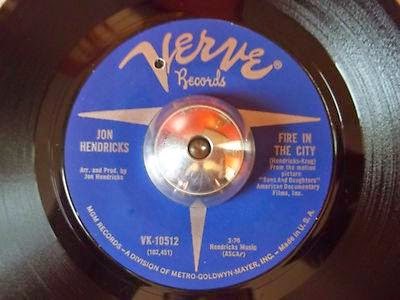
Jon Hendricks, backed by the Grateful Dead, recorded the songs "Sons And Daughters" and "Fire In The City" in October, 1966 for the soundtrack of the Sons And Daughters documentary. The tracks were released as a single by Verve Records in early 1967,
The Pacific Film Archive, at 2575 Bancroft Way in Berkeley, opened in 1966, and it was one of the things that set Berkeley apart from other places. In the shadowy old days, before Netflix, Cable TV or even VHS tape, movies that were not on TV were largely lost to history. Like many college towns, Berkeley had a great old Repertory movie house, the UC Theater, that played touring prints of "old" movies that rotated on a daily basis, thus allowing people to see Lawrence Of Arabia or Yojimbo every year. PFA was something else, however--they had their own library of movies, and there you could see amazing movies that were available nowhere else.

Today you can see anything with a few clicks, but back then, going into the comfortable, dark, and yet popcorn-less theater on Bowditch Street was an invitation to another world. For decades, until the video revolution, I could say I had seen Wages Of Fear, Les Liaisons Dangereuses (the one from 1959) and Shadows Of Our Forgotten Ancestors, and got a glimpse of the unknowable. Imagine if you could only hear a great 60s Dead tape once every few years at a single place in Berkeley--that's what going to PFA was like.

Although the landscape has changed with greater modern accessibility to video, ironically enough the history of film is more important than ever, and the PFA remains a thriving institution. In the Fall of 2014, the PFA will be showing rare films from the 1960s, and one of them will be a rarely seen documentary called Sons And Daughters, directed by Jerry Stoll and released in 1967. Although the film is largely forgotten, it has remained on the radar of Deadheads because the Grateful Dead participated in the soundtrack. The band recorded two songs backing jazz legend Jon Hendricks, the title track "Sons And Daughters," and the song "Fire In The City." Both tracks were released as a rare single on Verve Records under Hendricks' name. A recent email query caused an investigation into the recording session for the soundtrack, and that will be the primary subject of the post.

The Vietnam Day Committee and Sons And Daughters
It is very difficult to sum up the history of 60s Berkeley anti-Vietnam War protests in a few paragraphs, but I'll try. By 1965, Berkeley was already a vortex for protests against anti-communist witch hunts and in favor of Civil Rights, both of which were intimately connected at the time. The Free Speech Movement at Berkeley had garnered national attention. The United States had ramped up its war in Vietnam following the Gulf Of Tonkin Resolution in August 1964. By mid-1965, 500,000 US troops were in Vietnam, most of them draftees. In May 1965, a group of Berkeley students held "Vietnam Day," a 35-hour demonstration against the war. The students were using the tactics of the Civil Rights and Free Speech movements to protest an American war, a hitherto unthinkable development.

After the Berkeley Vietnam Day protests in May, a loose coalition of student groups and activists planned Nationwide protests at numerous sites for October 15 and 16, 1965. The coalition was called The Vietnam Day Committee, or VDC. Berkeley was Ground Zero for protests, but in the end there were demonstrations in over two dozen locations, including college campuses and cities all across the country. The Sons And Daughters movie, whatever its exact origins, was a documentary of what was expected to be--and in many ways was--a watershed moment in American political life.

I do not know the financial history of Sons And Daughters, but I assume that like most documentaries, it was financed on a wing and a prayer. Thus although it covered events in October of 1965, it was another 18 months before the movie was ready for its public debut. Apparently there was some awareness of the film, as Ralph Gleason reported on the movie in his Ad Libs section of the Chronicle, and his phrasing was such that the subject already seemed known. In his October 19, 1966 column, Gleason wrote "Virgil Gonsalves has done the score for the "Days of Protest" film now renamed "Sons and Daughters."

Virgil Gonsalves (1931-2008) was a baritone sax player from Monterey, and well known around the local jazz scene. He had put out a few obscure records in the late 50s (I have one--its pretty good for that sort of thing). Gonsalves was in the final version of Electric Flag (which morphed into the Buddy Miles Express) and he was also in the rock band Pacific Gas And Electric in the early 70s, so he was definitely down with the hippies.

However, the practice at the time for a movie appealing to young people was to have at least one rock song that might get played on the radio. This fit in with the idea of a soundtrack album--there were plenty of movies that had an accompanying soundtrack album that consisted of a title track hit single (like "What's New Pussycat") and some background music from the film. The filmmakers engaged legendary jazz vocalist Jon Hendricks, and somehow, by a sequence of events I have been unable to pin down, the Grateful Dead were recommended as his backing group.

Hendricks was deservedly legendary in jazz circles, and even if you don't like jazz vocals--I don't--Hendricks and his partners Dave Lambert and Annie Ross were something else entirely. Hendricks and Ross would create lyrics for jazz solos, and the trio would sing them. This would be followed by scat-vocal solos that have to be heard to be believed (check it out: Lambert, Hendricks and Ross from 1961). Modern acts like Manhattan Transfer and Van Morrison owe plenty to Jon Hendricks and LHR, and he remains a revered figure long after his career wound down (although, at age 92, he's still with us).

Dennis McNally describes some of the details (p.173-74)
Shortly after they signed their contract, the band had a side adventure in recording, spending a couple of days with the distinguished jazz vocalist Jon Hendricks, who'd been commissioned to produce the sound track of a radical film about the Vietnam Day Committee's antiwar demonstrations called Sons And Daughters. Hendricks had grown up in Ohio, five doors down from Art Tatum, then formed the jazz vocal group Lambert, Hendricks And Ross. He was a genuine hero, and the Dead leaped at the chance to work with him.

Ralph Gleason's Lively Arts column from the November 20, 1966 SF Chronicle
The Grateful Dead had agreed to their contract with Warner Brothers in October of 1966,  but did not actually sign it until around December 1. Hendricks and the Dead worked at Columbus Recorders at 906 Kearny Street for a few days (they would also mix Anthem Of The Sun there as well, in the Spring of '68). Thanks to the Yellow Shark, we can put a pretty good bracket around when the Dead recorded with Hendricks. Gleason wrote about the session in some detail in his Chronicle column of Sunday, November 20, 1966. Yellow Shark:
I will throw my hat in to the ring and say that the recording dates for the Hendicks’ cuts are October 1966 - as they were delivered by Hendricks himself to Columbia the first week of November 1966 (when he was playing Shelly's Manne Hole in Hollywood).
By November 20 when the Sunday afternoon at the Fillmore featured the Grateful Dead, Quicksilver Messenger Service, Stokely Carmichael and The Staff, James Cotton Chicago Blues Band, Johnny Talbot and Da Thangs with Jon Hendricks and John Hardy as MCs, Ralph J Gleason had already mentioned the recordings in his "Lively Arts" column for the Chronicle.
 Supposition: October provides three nice little gaps when the GD could have been in the studio with JH – commencing October 3, October 10, October 17 and October 27. I think I can comfortably ignore the 3rd after the events of that previous weekend. I rather like the last two dates – particularly the last where JH could have left with the tapes for LA right after they were completed.
Hendricks, for all his legendary status as a jazz icon, had no record contract in 1967. So he probably bought the tapes to Columbia's Los Angeles office in the hopes of getting a record deal. This may shed a little light on why the Dead put off signing with Warners on what they had apparently agreed to--they may have wanted to renegotiate if there was a chance to appear on a Columbia album with Hendricks, or something like that. Nonetheless, Columbia did not bite, and just a single ended up coming out on Verve Records, which was basically a jazz label.

The complete story of how Country Joe And The Fish came to be, and how Peter Krug's songs ended up on the b-side of their record, is too long to fit in a caption, so you'll need to see Country Joe's blog
"Sons And Daughters" and "Fire In The City"
Ultimately, two songs were recorded and released a single on Verve Records. I do not know if Verve thought the songs would be a hit--maybe they were thinking that if the single caught on, they could release a soundtrack album with the two Hendricks songs and Virgil Gonsalves' soundtrack score as well. McNally has some interesting descriptions of the sessions (p.174)
Weir was not familiar with Lambert, Hendricks and Ross, and Garcia and Lesh gave him an education. The session was hard for him [Weir], and he felt considerable pressure. Hendricks enjoyed himself: "Pigpen was the one I was told I was going to have so much trouble from. He was like a child, he was very sweet." Jon had heard of Jerry, and said much later that Garcia had the respect of some of the local jazz musicians. The band as a whole "seemed to feel like they were in training. And I didn't realize it myself until about the end of the first day. They didn't seem to want any latitude at all. Garcia said, 'look, anything you want us to do, just let us know. And we'll do it." And when it got to the singing, Pigpen was brilliant on the vocals.
To me, the fact that Hendricks was told that Pigpen was the one who would be "trouble" was a clear sign that whoever made the connection between the Dead and Hendricks did not actually know the Grateful Dead very well. Pigpen had a scary appearance, and he was the least interested in getting high, but by all accounts was actually far friendlier and easier to work with than the others. I think the connection to the Dead came from some people on the Berkeley political scene who had seen the Dead, and perhaps met them, but hadn't really had any musical association with them.

The movie's title track was written by Hendricks. The other song, which was the b-side of the single, "Fire In The City," was written by Berkeley songwriter named Peter Krug. The hyper-obscure Krug song, never really remarked upon to my knowledge, suggests an overt Berkeley connection. There had been one prior recording of the song, released on Joe McDonald and ED Denson's "talking magazine" Rag Baby. The A-side of the EP is Country Joe and The Fish, doing "Feel Like I'm Fixin' To Die Rag" and "Superbird", and the b-side is Peter Krug doing "Fire In The City" and another song ("Johnny's Gone To War").

The Rag Baby EP had a press run of about 100 copies, and any copies not bought personally from Joe McDonald were only available for sale in the basement of Moe's Books on Telegraph Avenue. Thus there is essentially zero chance that anyone outside of Berkeley knew about this song.  In 1966, at least, there were still plenty of connections between the Berkeley Anti-War hippies and the Haight Street crowd. The split between them didn't really set in until after the Human Be-In, in January of 1967. The organizers of the VDC would have had all the phone numbers of the Grateful Dead (and every other band) and seen them numerous times at Harmon or Pauley. They also would have thought that all the bands were sympathetic to The Cause, which turned out to be not nearly so simple.

The surprising thing, really, is that the filmmakers didn't hire Country Joe And The Fish. If they knew about Peter Krug, they surely knew about Country Joe And The Fish, and they were far more committed to activism than the Dead. Of course, the Dead were "bigger", as in more infamous, so they probably got the first call, which they accepted.

Sons And Daughters, American Documentary Films, Released April 1967
However, shortly before the release of Sons And Daughters, the Dead withdrew their names from the  project. McNally:
when the film was being prepared for showing, the Dead asked that their name be removed from the credits. To [Dead manager Danny] Rifkin, they were about music, not politics. Weir remembered 'We were getting a lot of heat then." The FBI had a tendency to stop by 710 looking for Bear or other well-known "underground" people and "they knew our names'"
Sons And Daughters  debuted on April 21, 1967, at a theater in San Francisco (possibly the Washington Square at 1741 Powell). Steve Seid, the video curator of the Pacific Film Archive, describes the film:
It clearly depicts the anti-war marches of October, 1965 from the point of view of the students and activists. An occasional, semi-poetic voice-over talks about the yearnings of youth for a just world. The first cut of Sons and Daughters begins with about three minutes of black with just the Sons and Daughters theme song playing. That was eventually cut out and Sons and Daughters only plays over the end-credits.The song announces the optimism of youth versus the indifference of parental authority and with that in mind you enter the film. The two marches shown left from Sproul Plaza and were both turned away at the Oakland border by hundreds of police.
About two thirds in, Sons and Daughters takes a bit of a diversion to racial unrest around Hunters Point in the city. There is a montage of African American guys scuffling with the police etc etc. This is when Fire in the City is played. This section is somewhat extraneous to the main thrust of the documentary.
It is hard to say without seeing the film, but to Berkeley students in the mid-60s, the Vietnam War and the struggle for Civil Rights were intimately connected, so whether or not the film effectively portrayed that, it did reflect a common viewpoint of the time. 

Like many documentaries, Sons And Daughters was probably poorly funded and had difficulty finding a distributor. Anti-war films were not likely to find an audience in 1967. Seid explains
American Documentary Films was a short-lived endeavor. Jerry Stoll, who died about 5 years ago, had teamed with Stephen Lighthill, then a very young cinematographer but now somewhat of an esteemed shooter. They had differing views about what Sons and Daughters should accomplish. Soon after the premiere in North Beach I think they parted ways. The film had very few actual screenings and then vanished into Stoll's basement. Lighthill rescued the film probably 10 years ago, gave PFA two prints, and the UCLA Film and Television Archive has additional prints and the original materials. 
The original press kit apparently lists the Grateful Dead's drummer as Bill Sommers. "Sommers" was the name on the fake draft card that Kreutzmann used to be allowed into bars (I do not know what Weir used).

An interesting comment online at the Archive
https://archive.org/post/227528/gd-incunabula-12-05-66

- you will find me in the credits of the movie in question as one of the sound editors: Don Cochrane.
- you found confusing data about the name of Jerry Stoll's fiim. it is not "Fire in the City"; it is "Sons and Daughters":
- dir.- Jerry Stoll, camera, Stephen Lighthill, Jerry's assistant was Sally Pugh. his son worked on sound as well.
- it was produced by American Documentary Films.
- title song ( which may have been "Your Sons and Daughters" ) was written and sung by Jon Hendricks, backed by the Grateful Dead.
- the sound quality of the song in the movie is good, but someone added an unrequested echo to the version used for the record and- in my view- ruined it.
- I made 20 minutes of the sound track- mostly creating audio for silent AP film footage of the Vietnam War. an example of the work i did was to "live up" AP footage of American troops, walking in shallow water. to create this effect, i waded through the reeds of a pond, carrying a Nagra tape recorder and then staggered and multiplied the recording, so that one person became several.
- as you say, it is hard to find "Sons and Daughters". i remember seeing it in old film catalogs. had little- but not no- luck, googling it.
- i do have a copy of the poster for the world premier at the old theatre in Washington Square in North Beach, San Francisco.
- it was the only American feature film made during the war that opposed the war.
- it won a European film festival- i think Leipzig. (my guess is, that prize was a political choice to tweak the nose of our government. Leipzig was part of the [Soviet Bloc] at the time.)

A poster for the SNCC Benefit at Fillmore Auditorium on November 20, 1966, with the Grateful Dead and others. Ralph Gleason announced that Jon Hendricks would be the MC at this event. Did they...?
November 20, 1966  Fillmore Auditorium, San Francisco, CA: The Grateful Dead/Quicksilver Messenger Service/James Cotton Blues Band/Johnny Talbot And De Thangs/MCs: Jon Hendricks and John Hardy Benefit for the Student Non-Violent Coordinating Committee

Gleason promoted the Fillmore benefit for the Student Nonviolent Coordinating Committee (SNCC) on Sunday night, November 20, 1966. The Dead and James Cotton were billed at the Fillmore over the weekend, but Quicksilver and Johnny Talbot were added. The event when from 3pm to midnight and included speakers as well as bands. Jon Hendricks, though not on the poster, was announced by Gleason in his column as MC for the evening (along with KDIA dj John Hardy). The MC gig, in fact, seems to have been a reason for Gleason to mention the Hendricks/Dead sessions, and thus the reason the Yellow Shark could make a good guess as to the date of the recording.

Hendricks had met the Dead, worked with them for a few days, and seemed to have liked them, enough that he remembered them many years later when Dennis McNally interviewed him. Is there any chance that Hendricks went through a nine hour show and never once came on stage? I don't think so. And maybe, just maybe, he stepped out on the Fillmore stage for some "Fire In The City" or  a little vocalese with Pigpen? Maybe not--but I prefer to think he did, until someone can prove otherwise to me.

An ad from the July 7, 1967 Reno Gazette-Journal, promoting a showing of Sons and Daughters, "with background music by the Grateful Dead"


[update] Fellow scholar Dave found a newspaper listing from the Reno Gazette-Journal for a showing of Sons And Daughters at the University of Nevada at Reno on July 7, 1967.The ad says "background music by the Grateful Dead."


Friday, April 11, 2014

March 17, 1980 Masonic Hall, Seattle, WA: Robert Hunter and The Ghosts (Lost And Found)

The Ghosts, featuring Keith and Donna Godchaux, recorded in 1979-80, released an album on Whirled Records in 1984
This blog does not typically assess live concert tapes, whether well known or not, since so many other blogs and sites do a better job of that. In general, the archaeology of Hooterollin Around is focused on different sorts of evidence. However, when a tape is the only evidence that we have of a lost concert, and in particular one that may be very telling about the state of the Grateful Dead at a point in time, the blog is not going to ignore that information.

I am one of the few people who has attempted to document Robert Hunter's live performing history, particularly in the 1970s, in general, Hunter spent the mid-70s mostly working in somewhat conventional rock band settings, before finally narrowing his sights in mid-1978 to a mostly solo approach. Thus it was quite surprising to find a tape on the internet of Robert Hunter performing with Keith and Donna Godchaux  and their band The Ghosts, apparently (per the tape), on March 17, 1980 at the Masonic Temple in Seattle, Washington. While I have no other evidence save this, nevertheless the date is pretty plausible. Since Keith Godchaux would die in an unfortunate auto accident a few months later, it is easy to confirm that the tape is what it says it is--Robert Hunter making a live appearance, backed by two former members of the Grateful Dead and some other musicians. I have no idea whether this was for a single show or a few--I expect they played more than one show--but I had never heard of this collaboration before, and it tells me a number of interesting things.

The Tape
Here is the information. I have listened to the tape, and the setlist accurately describes the music. I have no other knowledge of this event.

The back cover of Robert Hunter's Promontory Rider album on Relix Records, an anthology that included material from the 1978 Alligator Moon sessions.
Robert Hunter and The Ghosts
March 17, 1980, Masonic Hall, Seattle, WAaudience recording
unknown gen cassette>cdr,unknown gen cassette>cdr
trade cdr > eac > wav > flac

Additional Lineage: Received as four long tracks,
tracks rejoined and retracked with Audacity,
Checksums and flac level 8 with traderslittlehelper

-Early Show?-
01 //Last Flash Of Rock and Roll
02 Stop That Train
03 Strange Man
04 Promontory Rider
05 Franklin's // Tower
06 -applause-
-Encore-
07 Better Move On

-Late Show?-
08 unknown snippet
09 Heart Of Glass >
10 Cruel White Water
11 Mississippi Half-Step
12 Sunshine Daydream >
Scarlet Begonias >
13 //Stella Blue >
Sunshine Daydream >
Scarlet Begonias
14 Last Flash Of Rock And Roll
15 Tiger Rose
16 -tuning-
17 It Takes A Lot To Laugh,
It Takes A Train To Cry

I can only guess at the lineup, based on listening to the tape and fragmentary information from their only release.
update: Thanks to fellow scholar JGMF, we have a photo and lineup for The Ghosts, from the Santa Cruz Sentinel of May 9, 1980 (advertising a Catalyst gig on May 16)
-The Ghosts-
Donna Godchaux vocals
Bill Middlejohn-guitar
Billy Travis-guitar
Don Gaynor-guitar, vocals
Keith Godchaux piano, vocals
Larry Klein-bass
Grag Anton drums(I am not at all certain about this lineup, and anyone with additional information should put it in the Comments or email me. However, I will note that Steve Kimock's biography on his own site does not have him joining until later than March of 1980, when he joined The Heart Of Gold Band).

Since Hunter bids everyone goodnight after "Franklin's Tower," it appears the ensemble played two shows. The first part of the tape seems to be the end of the early show, and the later tracks seem to be the late show. Since they do not repeat songs, I assume that the venue had more of a nightclub setup, where fans could simply stay for the late show, rather than filing out and re-entering. The last two tracks (16.tuning and 17. It Takes A Lot To Laugh...) seem to be another edited-in bit, possibly from a different set or event.

[update]: thanks to a Correspondent, I have found out some information. There were at least three shows:
  • March 15, 1980: HUB Ballroom, U. of Washington, Seattle, WA
  • March 16, 1980: Fabulous Rainbow Tavern, Seattle, WA
  • March 17, 1980: Masonic Temple, Seattle, WA
The shows varied somewhat, but in general Robert Hunter performed solo and also sang a few numbers with The Ghosts. It appears there were multiple sets with different musicians coming and going, so it must have been more like a "Revue" than a simple Opener/Headliner setup. As a Commenter pointed out, it's worth considering that except for February and March 1980 (with the JGB and The Ghosts, respectively), Hunter never performed live with other members of the Grateful Dead. Given how many times Hunter has opened for numerous ensembles, that has to have been a conscious choice. Hunter's brief flirtation with Garcia and then in Seattle with The Ghosts seems to have been rejected as a route map.
After Midnight, recorded in February 1980, by the Jerry Garcia Band, featuring opening act Robert Hunter as a special guest

Robert Hunter Landscape, Spring 1980
Robert Hunter released two solo albums on Round in 1974 (Tales Of The Great Rum Runners) and 1975 (Tiger Rose). Although he had been quietly performing with a local group called Roadhog since 1974, he stepped forward under his own name in 1976. Robert Hunter and Roadhog peformed in the Summer of 1976, and in mid-1977, Hunter joined another existing group, Comfort. Robert Hunter and Comfort performed from mid-77 until mid-78. They recorded an unreleased album, Alligator Moon, made a couple of FM radio broadcasts and toured the East Coast. However, the band was apparently supported by Hunter, from his songwriting royalties, but in 1978 Hunter stopped performing with Comfort. For the next several months, he toured as a duo with former Comfort bassist Larry Klein. From 1979 onwards, Hunter was a solo performer.

When Hunter had been in Roadhog and Comfort, he had focused on performing his own songs. Hunter had made a point of not performing Grateful Dead songs with his own groups. I believe there was the occasional performance of a few chestnuts, like "Friend Of The Devil," but in general Hunter kept his own bands as distinct as he could from the Dead. Hunter's solo performances, while featuring a wide variety of new and old Hunter songs, also featured a lot of Grateful Dead songs. Most of those songs, however, were not being performed by the Grateful Dead in the late 70s, so it was fun for fans to hear live versions of songs like "China Cat Sunflower" or "Mr. Charlie," and there wasn't as much implicit reason to compare them with the contemporary Grateful Dead. In his own quiet way, Hunter celebrated his Grateful Dead connection while maintaining some artistic distance that allowed him to be evaluated as a performer in his own right.

Hunter's performance with The Ghosts, however, breaks all Hunter's conventions, more or less uniquely, as far as I can tell. Hunter sings "Franklin's Tower", "Mississippi Half-Step" and "Scarlet Begonias" in full out electric versions, and all three were staples of Grateful Dead live shows at the time. Hunter also does some songs from both his released and unreleased albums, and a solo version of a Blondie song (a standard thing for him at the time), but this recording is the only time I know of where Hunter puts himself, as a performer, into direct comparison with Garcia.

Fellow Scholar JGMF sent along this photo of The Ghosts from the Santa Cruz Sentinel of May 9, 1980
Keith And Donna Godchaux and The Ghosts
The performing history of The Ghosts is quite obscure. The band is only really known from a release on Whirled Records from 1984 (The Ghosts Playing In The Heart Of Gold Band), later re-released in various forms on Relix Records in 1986 and '88. Like all Relix releases, details are actually fairly sparse. I myself was not aware of any performances by The Ghosts in the Bay Area in 1979 or 1980, although there must have been a few. Keith and Donna Godchaux had left the Grateful Dead in March of 1979 (their last performance with the band was February 17, 1979), so I was alert to any new ventures by them. They very well may have played around a bit, but they seem to have kept a very low profile.

As rock fans, we always assumed that the members of our favorite bands were well-off, with an endless supply of "money for nothing," as Mark Knopfler put it. The reality was often quite different. Generally speaking, songwriters were the ones who made the most money in 1970s rock bands, and even the songwriters often had serious cash flow problems. Almost every 70s rock band, the Grateful Dead included, was effectively deficit financed, with loans from banks or the record company paying the day-to-day. Thus when revenue came in, it was often spoken for, so musicians could hardly count on a big payday, even if they sometimes got one. JGMF has documented how Jerry Garcia seems to have had serious tax issues in 1978. Even if Garcia was taking advice not to pay his tax bills (possibly as fallout from Round Records), it was a sign that Grateful Dead finances were hardly in good shape.

The Healy-Treece Band
When Keith and Donna Godchaux left the Grateful Dead, I don't think they really had any money. They probably got occasional royalty checks, but the amounts would have been unpredictable. They had to live on something, and as musicians, that meant playing music. I don't really have to guess at this--it's generally forgotten that Keith Godchaux toured with the Healy-Treece Band in 1979 and 1980, after they had left the Grateful Dead. It remains the most undocumented Grateful Dead spinoff band ever.

Healy-Treece Band (1980)
Dan Healy-vocals, guitar'
Richard Treece-lead guitar
Diane Mestrovich-vocals
Keith Godchaux-piano
Mike Larsheid-bass
Bill Kreutzmann-drums
The Healy-Treece Band had played a few dates in 1979, but they were only alluded to vaguely in Relix magazine. In 1980, however, the Healy-Treece Band booked the following shows


February 7, 1980 The Palms Club, Milwaukee, WI (tentative)
February 8, 1980 Stage West. Hartford, CT
February 9, 1980 Chateau De Ville, Warwick RI
February 10, 1980 Traces Club, Hillside, NJ
February 11, 1980 Toad's Club, New Haven, CT
February 12, 1980 Academy of Music Cabaret, Philadelphia, PA
February 13, 1980 Final Exam, Randolph, NJ
February 15, 1980 Speakers Club, New Paltz, NY
February 16, 1980 SUNY, Buffalo, NY
February 17, 1980 JB Scott's, Albany, NY
February 19, 1980 Paradise Club, Boston, MA
February 20, 1980 Fast Lane, Asbury Park, NJ
February 21, 1980 Stockton State College, Pomona, NJ
February 22, 1980 My Father's Place, Roslyn, NY
February 23, 1980 The Red Rail, Nancet, NY
February 24, 1980 The Lone Star, New York, NY
February 26-27, 1980 The Cellar Door, Washington, DC
February 28, 1980 Norris Theater, Norristown, PA Richie Havens/Healy-Treece Band
February 29-March 2, 1980 The Other End, New York, NY[as always, anyone with any information, corrections or memories--real or imagined-- about the 1979-80 Healy/Treece Band, please include them in the comments or email me]

The rhythm section (Keith, Larsheid, Billy K) was the same as the late 1975 Keith and Donna Band. Diane Mestrovich--possibly Diane Margolis-is unknown to me, and I find it surprising that Keith went on the road without Donna. However, I can only guess that they really needed the money. I have never heard a tape of the Healy-Treece Band from this era, so I don't know how they sounded, or what they played. Guitarist Richard Treece seems to have been a long-standing friend of Healy's. I have confirmed that Treece was not the same Richard Treece that played with the fine English bands Help Yourself and Green Ray. Other than that, very little is known, though some interesting photos of the group at Toad's Place (Feb 11 '80) in New Haven can be seen here.

The Healy-Treece Band toured the same circuit of clubs that Robert Hunter had been playing n the East Coast, where there was always a need for any Grateful Dead proxy. I think Healy-Treece had played the same circuit the previous Fall--a second-hand eyewitness told me that Keith had mostly played electric bass, strange as that sounds. There is a photo of Keith Godchaux on stage at the Pastime Pub, in Amityville, NY, on May 10, 1979 and he is playing guitar, so who knows. (There is also a backstage photo, and Keith is playing a guitar as well). There are the faintest stories of Keith and Donna playing Mendocino bars under the name Billy And The Beaters, so perhaps the Healy-Treece configuration went back further than anyone realized.

Nonetheless, no band plays 20 dates in 23 days unless they need the money, so Keith and Donna must have needed money. The putative date of the Hunter/Ghosts show fits nicely with the known Healy/Treece schedule, too. We also know where Hunter was in February of 1980: touring the East Coast with the Jerry Garcia Band. We know from Hunter's own liner notes for the fine After Midnight set that money was a squeeze, which was one reason that Hunter had gone solo. So if there was a good paying Hunter/Ghosts gig in Seattle in mid-March, both Hunter and the Godchaux could have used the money.

[Update]: 1981 Healy/Treece Band Shows
February 1, 1981 Selway's, San Ramon, CAFebruary 8, 1981 Knight's Inn, Walnut Creek, CAFebruary 15, 1981 Phyllis Place, Petaluma, CAMay 28, 1981 Old Waldorf, San Francisco, CAMay 29, 1981 Catalyst, Santa Cruz, CAMay 30, 1981 Alameda County Fairgrounds, Pleasanton, CAJune 7, 1981 Phyllis Place, Petaluma, CAJune 11, 1981 Keystone Berkeley, Berkeley, CA
Lineup (at least for May/June shows)
Dan Healy-guitar, vocals
Richard Treece-guitar
John Cippolina-guitar
Larry Klein-bass
Bill Kreutzmann-drums

update: reader John M saw the Healy/Treece Band, and recalled some of the setlist:
I attended the February 12, 1980, late show at the Academy Cabaret Theater, Philadelphia, PA; besides Healy and Treece, the band included Bill Kreutzman, Keith Godchaux (keys), and Kathi McDonald ( vocals); there was no stage and we sat on folding chairs...they were not memorable.

Here's my recollection of the set list:
Roll Over Beethoven
-unknown
Miss You (Rolling Stones)
-unknown
Knockin' On Heavens Door
Nobody Knows What's Goin' On
Stagger Lee
Never Gonna Let Her Go
Temptation
I Shall Be Released
~
Johnny B. Goode
[update2] Commenter and Scholar Ihor has tracked down every Healy-Treece Band tape ever in circulation. I have updated the known performance list above, and you can see complete setlists in the Comments below. Here's just one example:
db.etree.org/lookup_show.php?shows_key=641101

Healy Treece Band 02/08/80
Stage West, West Hartford, CT

Set 1 ( 58:58 )
1 //Willie & The Hand Jive 06:25
2 Just A Song 08:15
3 Bye Bye Love 05:26
4 Miss You 08:45
5 Unchain My Heart 07:47
6 Don't Knock It 06:34
7 You Better Move On 05:06
8 Slippin' Into Darkness 10:38

Set 2 (68:37)
9 tuning up 01:40
10 I've Been Working 16:51
11 Runaway 09:26
12 I Shall Be Released 07:30
13 Nadine 04:34
14 It Takes A Lot To Laugh, A Train To Cry 06:48
15 Bring It On Home 10:56
16 Stagger Lee & Billy 05:27
encore:
17 Johnny B. Goode 05:22

Dan Healy - guitar, vocals
Richard Treece - guitar, vocals
Diane Margolis - vocals, tambourine
Keith Godchaux - keyboards, vocals
Mike Larshied- bass
Bill Kruetzmann - drums


Keith Godchaux's final live performance on July 10, 1980 at The Back Door in San Francisco, with his new band The Heart Of Gold Band, was released on Relix Records in 1986.
Aftermath
In many ways, the 1980 Ghosts performance with Hunter was a road not taken. I'm always curious as to how many other shows by this ensemble there might have been, but I have to think there weren't many. Sadly, Keith Godchaux died in a car crash on July 23, 1980, so no matter what, this didn't last long. Many people grumble today, rightly or wrongly, that groups like Furthur, Phil and Friends or Ratdog are just sort of pedigreed Grateful Dead copy bands. Yet back in 1980, here was three members of the Dead, treading awfully close to that territory. To my knowledge, Hunter never played electric versions of significant Grateful Dead songs again on stage. Was that a good thing? We'll never know.

Everything about performances by The Ghosts, and particularly this performance with Robert Hunter, remain appropriately spectral. Anyone with an eyewitness account, archaeological evidence,second hand rumors or just some intriguing speculation is encouraged to put them in the Comments, in the hopes that we can bring some more about this performance into the light.